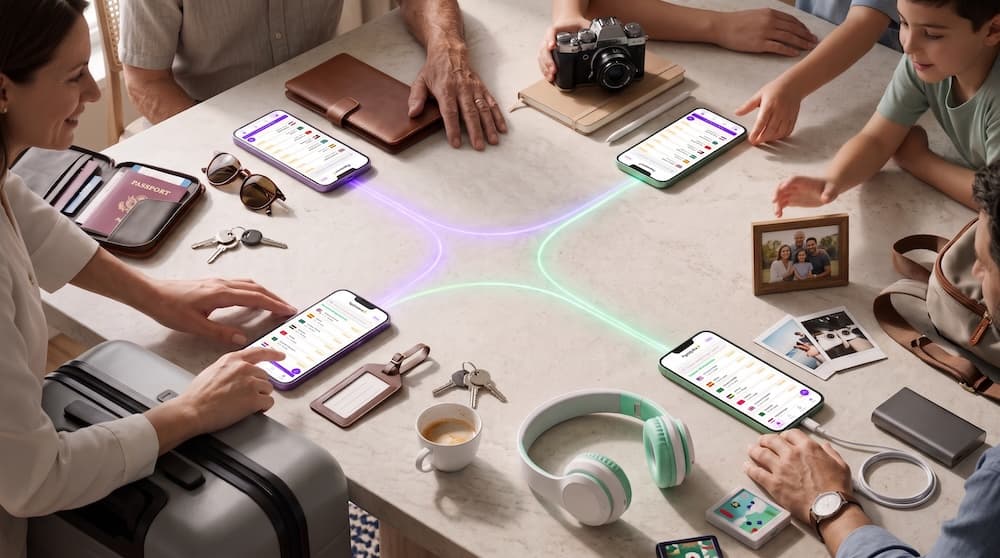
Traveling with family means managing more than flights, hotels, and luggage. There are also phones, maps, messages, tickets, ride-hailing apps, and children who expect to stay connected wherever they go.
The challenge gets bigger when several family members need mobile data at the same time.
Traditional roaming can become expensive across multiple lines, while buying physical SIM cards after arrival means managing different cards, plans, and phone numbers.
A travel eSIM gives families another option.
With Figabytes, you can prepare travel data before departure and organize connectivity for the family before everyone leaves home.
When traveling alone, losing internet access can be inconvenient.
When traveling with children, teenagers, parents, or a larger group, it can affect the entire trip.
Mobile data may be needed for:
It also becomes particularly useful when family members temporarily separate.
A teenager exploring a nearby area, a parent returning to the hotel, or family members arriving on different flights can all benefit from having their own connection.
Not necessarily.
The best setup depends on how your family travels.
One important point is that an eSIM profile is generally installed on one compatible device. You should not assume one travel eSIM can simply be installed across every family member's phone.
Plan the number of connections you need before purchasing.
Imagine a family of four traveling abroad.
The parents both have smartphones, while two teenagers also carry their own devices.
Instead of automatically buying four large plans, think about how each person will actually use data.
May need more data for:
May mainly use:
May need:
Each family member does not necessarily need the same amount of data.
Choosing plans based on actual usage can help avoid paying for data that nobody uses.
Start with your itinerary.
If the entire trip takes place in one country, a country plan may be enough.
If your family is visiting several countries, consider a regional plan that includes the destinations on your itinerary.
For example, a family traveling through several European countries may find a regional Europe eSIM more convenient than buying a different plan every time they cross a border.
Before purchasing, check:
Matching the plan to the itinerary is more important than simply choosing the largest data package.
There is no single answer because family data consumption can vary dramatically.
A child watching video for hours will consume far more data than a parent mainly using maps and WhatsApp.
Mostly:
A smaller plan may be sufficient.
Includes:
Consider a larger allowance.
Includes:
Heavy users may require significantly more data.
The important family travel trick is to avoid treating every device the same.
Choose according to the person using it.
Do not wait until everyone is standing in the arrivals hall with luggage and tired children.
Prepare the phones before traveling.
For every device that will use a Figabytes eSIM:
Clear labels become particularly useful when you are preparing several phones.
Instead of leaving generic names such as Secondary or Business, use something obvious such as:
If you are managing phones for children or relatives, prepare each device while you still have time and reliable internet access.
Installation and activation are not always the same thing.
The exact activation conditions depend on the eSIM plan.
Some plans begin their validity when they first connect to a supported destination network, while other products may have different activation rules.
Always check the plan details before enabling it.
Preparing the eSIM early is useful, but you should understand exactly when its validity starts.
Once you arrive, configure each device that will use Figabytes.
The general process is:
You should also review the home SIM settings.
If the home SIM remains active for calls or SMS, make sure it is not accidentally being used for mobile data abroad.
A useful Dual SIM setup is:
Use it for:
Use it for:
This can allow family members to keep their familiar numbers while using a separate travel data connection.
However, your home carrier's roaming charges can still apply to calls, SMS, or other services.
Check those charges before traveling.
This is one of the most important steps for avoiding unexpected charges.
If Figabytes is your travel data line:
Do this on every family phone you prepare.
One incorrectly configured device can undermine the savings you expected from switching the family to travel eSIMs.
Children can consume large amounts of mobile data without realizing it.
Streaming movies, episodes, music, and videos throughout a trip can quickly reduce your available data.
Before departure, download entertainment over Wi-Fi.
Consider downloading:
You can also download offline maps for your destination.
Save travel data for the things that actually need a live connection.
Independent connectivity becomes particularly valuable when traveling with older children or teenagers.
If they are allowed to explore a shopping area, museum, theme park, resort, or neighborhood separately, mobile data gives them access to:
Agree on meeting points and times as usual, but connectivity gives the family another way to stay in contact.
Many travel eSIM plans focus on mobile data rather than traditional voice calls and SMS.
That still gives families plenty of ways to communicate.
You can use:
Create a family travel group before departure.
Use it for:
If someone gets separated from the group, everyone knows where to communicate.
Mobile connectivity is useful, but your family should not depend on it for absolutely everything.
Before departure, save important information offline.
Keep copies of:
Connectivity should make your trip easier, not become a single point of failure.
A hotspot can be useful when several family members are together.
For example, one parent may use their Figabytes connection to temporarily connect a tablet or another family member's device.
This can reduce the number of plans needed in some situations.
However, hotspot sharing has limitations.
It can:
Check whether hotspot or tethering is supported by your selected plan.
For families that regularly split up during the day, individual connectivity may be more practical.
Connectivity is not very useful when the phone battery reaches zero.
Family travel often involves long days away from charging points, particularly during sightseeing or theme park visits.
Before leaving the hotel:
If one parent is responsible for navigation, tickets, transportation, and bookings, protecting that phone's battery should be a priority.
Before your trip, confirm:
A few minutes of preparation at home can prevent a lot of troubleshooting during the trip.
For many families, the biggest advantage is not simply saving money.
It is organization.
Instead of arriving and immediately searching for several physical SIM cards, you can prepare connectivity before departure.
Parents can stay connected to travel apps. Teenagers can remain reachable. Everyone can access maps and messages. Home numbers can remain available on compatible Dual SIM devices.
If your itinerary includes several countries, an appropriate regional plan can simplify connectivity even further.
Family travel already has enough moving parts.
Mobile connectivity should not be another one.
The best approach is to decide before departure who actually needs independent data, choose plans based on each person's usage, install everything over Wi-Fi, and configure the home and travel lines carefully.
With Figabytes, families can prepare their travel connectivity before the journey and spend less time thinking about SIM cards after they arrive.
Choose Figabytes plans for your destination and prepare everyone's travel data before the family trip begins.

