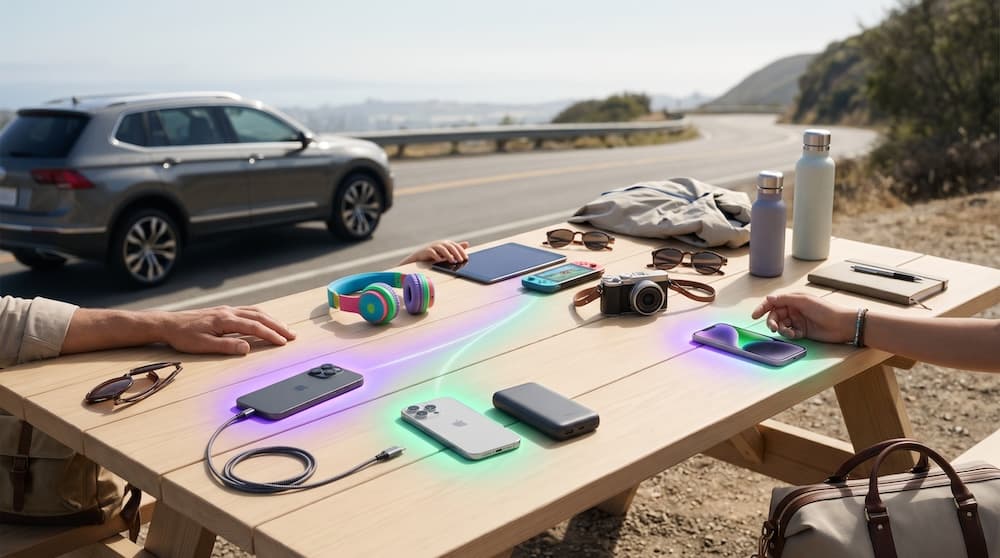
Planning mobile data for one traveler is easy.
Planning it for two parents, teenagers, younger children, tablets, laptops, and several destinations is a different story.
The good news is that you do not necessarily need to buy a travel eSIM for every device your family brings.
For some families, one or two Figabytes eSIMs combined with hotspot sharing may be enough. For others, giving each family member their own travel connection makes much more sense.
The right setup depends on your devices, how often your family separates, and how much data everyone actually uses.
A family of four might travel with:
That does not mean you need nine mobile plans.
Instead, ask one question:
Who actually needs internet when they are away from the rest of the family?
A tablet used by a child in the back seat may only need a parent's hotspot.
A teenager who explores independently may benefit from their own eSIM.
A parent responsible for maps, bookings, transportation, and tickets should probably have an independent connection.
Think about how the family travels before deciding how many eSIMs to buy.
The simplest setup is one Figabytes eSIM on a parent's phone.
That phone provides mobile data and shares it with other devices through Personal Hotspot.
This can work well for:
It can also reduce the number of eSIMs you need to install and manage.
But there is an important limitation.
Everyone depends on one phone.
If that phone leaves the group, loses battery, runs out of data, or has a connection issue, everyone loses their connection.
For many families, this is the most practical setup.
Each parent has a Figabytes eSIM and their own mobile data connection.
Children can connect to either parent's hotspot when needed.
This gives the family more flexibility.
If the group separates, both sides can still access:
It also avoids putting all of the family's connectivity and battery burden on one phone.
For families traveling with younger children, two independently connected parents can offer a good balance between convenience and cost.
Individual eSIMs make more sense when older children or teenagers need to use their phones independently.
Consider a separate Figabytes eSIM for each family member if:
This gives everyone more independence.
The trade-off is that you have more plans and devices to manage.
Many tablets are Wi-Fi-only.
Those devices cannot install an eSIM simply because another family member has one.
Instead, they can connect to a compatible phone's hotspot just like they would connect to a normal Wi-Fi network.
This can be ideal for:
However, video can consume travel data very quickly.
A better strategy is to download entertainment before leaving the hotel or home.
Hotspot sharing sounds perfect until one parent's phone becomes responsible for connecting half the family.
Running a hotspot can increase battery consumption, particularly when several devices are connected.
At the same time, that parent's phone may also be running:
That can turn the family's most important phone into the first one that needs charging.
If your family relies heavily on hotspot sharing:
For long sightseeing days, having two independently connected parent phones can be more practical.
This is where the difference between hotspot sharing and individual eSIMs becomes obvious.
Imagine one parent takes one child to a museum while the other parent takes another child shopping.
If everyone relies on one hotspot, one group may suddenly have no mobile data.
With at least one connected phone in each group, both sides can continue using maps and messaging.
Before choosing your setup, think about your itinerary.
If the family will regularly split into smaller groups, independent connections become more useful.
Family data usage can vary dramatically.
The biggest factor is usually video.
Maps, messaging, email, and basic browsing generally use much less data than streaming and social video.
Mostly:
You may be able to use relatively small plans.
Includes:
Plan for more data, particularly if several people have independent connections.
Includes:
This is where data can disappear surprisingly quickly.
Children streaming video through a parent's hotspot can consume far more data than navigation and messaging combined.
A simple family rule can make your travel data last much longer:
If you are at the hotel, use Wi-Fi. If you are outside, use Figabytes.
Use hotel or accommodation Wi-Fi for:
Save your Figabytes data for when your family actually needs connectivity on the move.
Before leaving home or the hotel, prepare entertainment over Wi-Fi.
Download:
This is especially useful for:
It also means children do not need continuous hotspot access just to stay entertained.
This depends more on independence than age.
If your teenager is always with you, hotspot access may be enough.
If they are allowed to explore separately, having their own mobile data becomes much more useful.
An independent connection gives them access to:
It also means they are not dependent on being physically close enough to a parent's hotspot.
Do not assume every smartphone supports eSIM.
Children often use older or more affordable phones, where eSIM support may be less common.
Before purchasing a plan, check:
If the phone does not support eSIM, it can still connect to another phone's hotspot over Wi-Fi.
That can be a perfectly practical solution for a family trip.
Families traveling through several countries have another decision to make.
Buying separate plans every time you cross a border can create unnecessary work.
If your Figabytes regional plan covers your entire itinerary, you can keep the same travel setup while moving between included destinations.
This can be especially useful for:
Before purchasing, check that every country on your route is included.
On compatible Dual SIM phones, you may be able to keep your normal SIM active while using Figabytes for mobile data.
A practical setup is:
Use for:
Use for:
Remember that your home carrier may still charge for roaming calls, SMS, or other services.
Turn off Data Roaming on the home line if Figabytes is handling your travel data.
Family travel day is not the best time to troubleshoot four different smartphones.
Prepare everything while you still have reliable Wi-Fi.
For each Figabytes device:
Do not delete an installed eSIM if something appears wrong.
Troubleshoot first or contact support.
Here is an easy way to decide.
| Family situation | Practical setup |
|---|---|
| Couple traveling together | One or two eSIMs |
| Parents with young children | Two parent eSIMs + hotspot |
| Kids using Wi-Fi tablets | Parent eSIM + hotspot |
| Family with independent teenagers | Individual eSIMs may be better |
| Family that frequently splits up | At least one eSIM per group |
| Heavy streaming family | Larger data plans + hotel Wi-Fi |
| Multi-country family trip | Regional eSIM where available |
| Child's phone has no eSIM | Connect through hotspot |
There is no universal family setup.
The best configuration is the one that gives everyone who genuinely needs independent connectivity their own connection without paying for unnecessary plans.
Parents can prevent most data problems with a few simple rules.
Consider agreeing that:
These small habits can make a significant difference during a longer trip.
For a family of four, you might choose:
Two Figabytes eSIMs for the parents, with children using hotspot or Wi-Fi.
Two parent eSIMs plus individual plans for teenagers who need independent connectivity.
One larger plan with hotspot may be sufficient if the selected plan supports tethering and the family is comfortable relying on one phone.
Individual plans provide the greatest flexibility.
The goal is not to put an eSIM on every device.
The goal is to make sure everyone who needs independent connectivity has it.
Family travel connectivity does not need to mean buying a mobile plan for every phone, tablet, and laptop in your luggage.
Start by deciding who actually needs independent internet access.
Young children may be perfectly fine using downloaded entertainment and a parent's hotspot. Parents may benefit from separate connections. Teenagers who explore independently may be better with their own travel eSIM.
Then think about battery life, hotspot use, data consumption, and whether your family will stay together or split into groups.
With the right setup, Figabytes can help your family stay connected without turning mobile data into another complicated part of the holiday.
Choose Figabytes eSIM plans based on your destination, devices, and the way your family actually travels.

