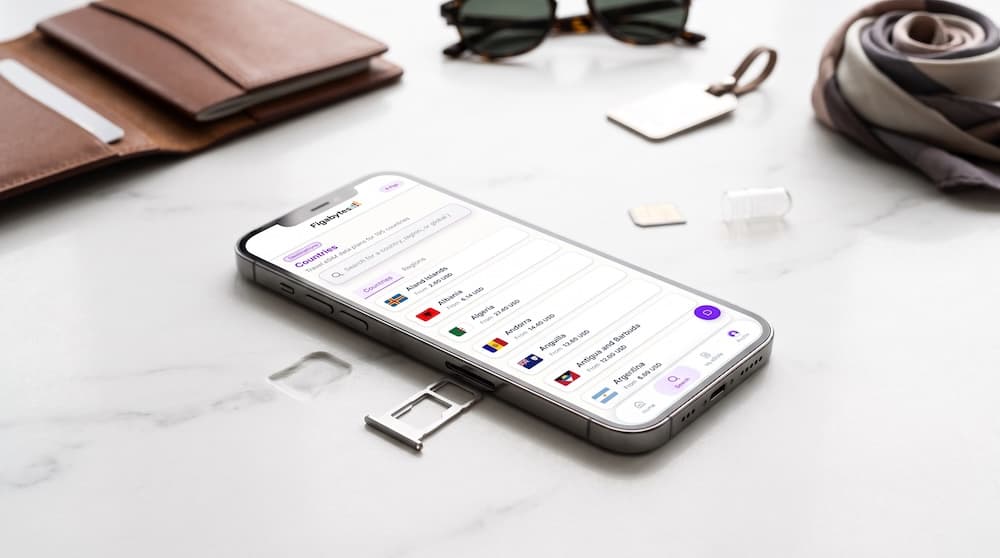
For years, changing mobile networks meant finding a SIM tool, opening a tiny tray, removing one card, and carefully storing another.
Travel made the process even more complicated.
You might land in another country, search for a local SIM shop, compare unfamiliar plans, remove your home SIM, and hope you did not lose it before returning home.
eSIM changes that experience.
Instead of physically replacing a SIM card, an eSIM lets compatible phones download a mobile plan digitally.
For travelers, that difference can be significant.
The basic purpose of both technologies is similar.
They allow your device to connect to a mobile network.
The major difference is how the mobile plan gets onto your phone.
A physical SIM requires a removable card that sits inside your phone.
Changing SIMs may involve:
An eSIM is built into a compatible device.
Instead of inserting another card, you install a digital mobile profile.
For travel, this means you can potentially prepare your mobile data before leaving home.
This is one of the biggest advantages for travelers.
With a compatible Dual SIM phone, you can potentially keep your primary line active while using a travel eSIM for mobile data.
Your setup could look like this:
Home SIM:
Figabytes eSIM:
You do not have to keep swapping physical cards every time you travel.
Traditional travel SIM shopping often begins after arrival.
With eSIM, preparation can start before departure.
You can choose your Figabytes plan online and install the eSIM on a compatible device while you still have reliable Wi-Fi.
This can make your arrival much easier.
Instead of looking for connectivity, you can focus on:
Your travel connectivity is already prepared.
Physical SIM cards are small.
Very small.
That becomes inconvenient when you remove your primary SIM while traveling.
You need somewhere safe to store it for the entire trip.
Lose it and you may need to contact your carrier for a replacement.
With eSIM, the mobile profile is stored digitally on the device.
There is no loose plastic card sitting inside your wallet, passport holder, or luggage.
Frequent travelers may need different mobile plans for different trips.
Instead of collecting physical SIM cards from different destinations, compatible smartphones can store multiple eSIM profiles.
For example, your phone might contain:
The exact number of stored and simultaneously active eSIMs depends on the device.
But the overall experience is much more digital than physically changing SIM cards.
Physical SIMs can become particularly inconvenient when your itinerary includes several countries.
Imagine traveling through multiple destinations during one trip.
Buying a different physical SIM in every country could mean:
A compatible regional travel eSIM can simplify this.
Instead of changing SIM cards at every border, you may be able to use one plan across multiple supported destinations.
Figabytes offers country and regional options depending on where you are traveling.
One of the biggest changes introduced by eSIM is that mobile connectivity can be purchased digitally.
You do not necessarily need to find a mobile store after landing.
With Figabytes, you can choose a destination and purchase a travel eSIM online.
That can be particularly useful when:
Travel itself has become increasingly digital.
Boarding passes are on phones.
Hotel bookings are on phones.
Maps are on phones.
Ride-hailing is on phones.
Translation apps are on phones.
Banking is on phones.
Travel connectivity moving onto the same device is a natural extension of that shift.
Instead of treating mobile service as something you physically purchase after arrival, eSIM makes it something you can prepare alongside the rest of your trip.
Not necessarily.
Physical SIM cards still have advantages.
The biggest is portability.
If your phone breaks, you can often remove a physical SIM and place it into another compatible unlocked phone within seconds.
eSIM transfers can be different.
Depending on the provider, device, and type of eSIM, moving a profile to another phone may require additional activation steps.
Travel eSIMs may also have restrictions on transfer or reinstallation.
That is why you should never delete a travel eSIM simply because you are experiencing a connection problem.
Check the instructions or contact support first.
This is an important difference between physical SIM and eSIM.
With a physical SIM, changing phones can sometimes be as simple as moving the card.
With eSIM, transfer rules depend on the provider and device.
Some carrier eSIMs support digital transfer between compatible phones.
Travel eSIMs can operate differently and may be tied to the device where they were originally installed.
If you are using Figabytes and plan to change devices, check your eSIM information before deleting or transferring anything.
eSIM itself does not automatically make mobile data cheaper.
The savings depend on the plan you choose.
What eSIM does provide is another way to shop for travel connectivity.
Instead of automatically accepting your home carrier's international roaming rate, you can compare travel data plans before departure.
Compare:
Then decide which option makes the most sense for your trip.
eSIM removes several physical risks.
There is no removable travel SIM to:
It also means you do not have to repeatedly open your phone's SIM tray while traveling.
However, your smartphone itself still needs proper security.
Use:
eSIM should be considered one part of your overall mobile security.
Before buying any eSIM, confirm three things.
Support varies by model and sometimes by the region where the phone was purchased.
An eSIM-compatible phone can still be locked to a mobile carrier.
A carrier-locked device may prevent you from using another provider.
Check that the plan supports the country or countries you will visit.
Do this before purchasing.
| Physical SIM | eSIM |
|---|---|
| Physical card required | Digital profile |
| SIM tray required | No card swapping |
| Often purchased after arrival | Can be purchased online |
| Easy to physically move between compatible phones | Transfer depends on provider |
| Main SIM may need to be removed | Can coexist with another line on supported phones |
| Card can be lost | No loose card |
| May require visiting a shop | Can often be prepared remotely |
Neither technology is perfect for every situation.
But for international travel, the digital flexibility of eSIM can remove several common inconveniences.
The biggest benefit is not one individual feature.
It is everything you no longer have to do.
No searching for a SIM ejector tool.
No storing your home SIM inside your wallet.
No collecting plastic SIM cards from every country.
No spending your first hour after landing searching for mobile data.
Instead, your connectivity can become part of your pre-trip checklist.
Passport.
Tickets.
Hotel.
Travel eSIM.
Done.
Getting started is straightforward.
Always review the activation conditions for your specific plan before traveling.
Physical SIM cards still work, and for some situations they remain useful.
But travel highlights many of their inconveniences.
eSIM removes the physical part of changing mobile connectivity and turns it into a digital process that can often be prepared before you leave home.
For travelers, that means fewer cards to manage, easier access to international data, and less time spent thinking about connectivity after landing.
Once you experience a trip without swapping SIM cards, going back to the old routine can feel surprisingly outdated.
Choose your destination and prepare your Figabytes travel data before you leave.

