If you have recently bought a new smartphone or started researching mobile data for an international trip, you have probably seen the term eSIM.
But what is an eSIM, what is it used for, and how does it actually work?
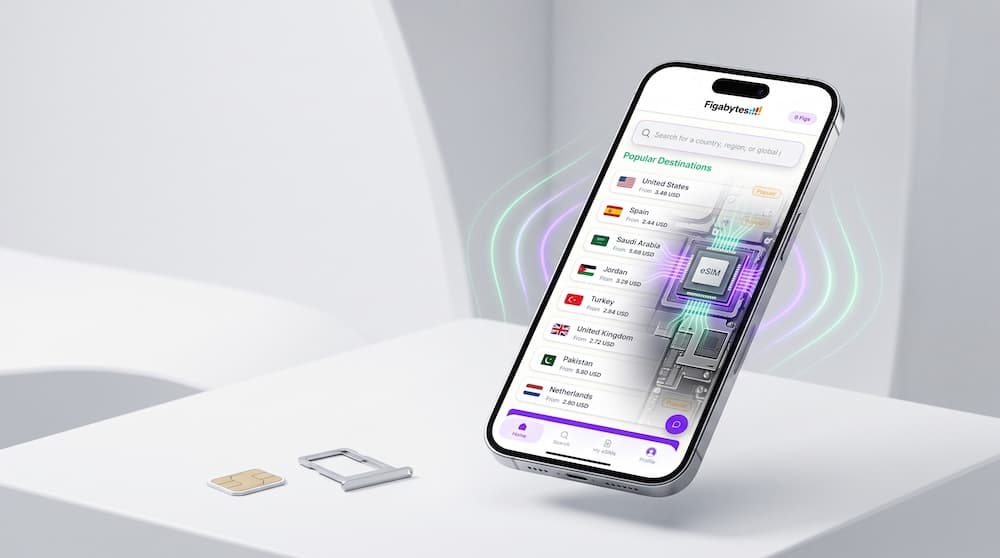
An eSIM is a digital version of the traditional SIM card. Instead of inserting a small plastic card into your phone, you can install a mobile plan digitally on a compatible device.
For travelers, this means you can buy a Figabytes travel eSIM online, install it before your trip, and connect to mobile data when you reach your destination without searching for a physical SIM card.
eSIM stands for embedded SIM.
It performs the same basic function as a traditional SIM card by allowing your device to connect to a mobile network.
The main difference is that an eSIM is built into your device.
Instead of physically replacing a SIM card when you want another mobile plan, you install a digital eSIM profile.
This can usually be done using:
Once installed, the eSIM appears alongside your other mobile lines in your phone settings.
People often search for "eSIM card," but technically there is no separate card to insert.
The SIM technology is already embedded inside the device.
When you purchase an eSIM plan, you receive the information required to install a mobile profile onto that embedded SIM.
Think of it this way:
A traditional SIM requires new physical hardware when changing SIMs.
An eSIM allows compatible mobile profiles to be downloaded digitally.
An eSIM can be used for many of the same purposes as a traditional SIM.
Depending on the plan and provider, this can include:
Travel is one of the most practical uses of eSIM technology.
Instead of paying international roaming rates or buying a physical SIM after arriving, travelers can purchase a travel eSIM before departure.
An eSIM works by downloading a mobile network profile to the embedded SIM hardware inside your device.
The process is usually straightforward.
Once connected, your phone uses the eSIM to access the mobile network according to your plan.
There is no physical card to insert or replace.
Figabytes provides travel eSIM plans that can be purchased online before your trip.
The basic process is:
Depending on your selected plan and device, additional settings such as Data Roaming or APN configuration may be required.
Always follow the installation and activation instructions provided with your Figabytes plan.
No.
An eSIM does not require a separate physical SIM card to work.
However, many compatible smartphones allow you to use an eSIM alongside your existing SIM.
This is commonly called Dual SIM.
For travelers, this can be particularly useful.
You can potentially keep:
This allows you to stay reachable on your usual number while using a separate data plan abroad.
Your home carrier may still charge for roaming calls, SMS, or other services, so check its roaming conditions before traveling.
Yes, if you keep your existing home SIM or eSIM active.
Using a Figabytes travel eSIM for mobile data does not necessarily mean replacing your normal phone number.
On a compatible Dual SIM device, you can keep your primary line active while selecting Figabytes for mobile data.
This can be useful for receiving:
Be aware of possible roaming charges from your home carrier.
There are several reasons eSIM adoption is growing.
You do not have to insert, remove, or store a tiny plastic card.
A compatible eSIM can be installed digitally without visiting a mobile store.
You can arrange mobile data before leaving home instead of searching for a local SIM after arrival.
Compatible devices can store multiple eSIM profiles, although the number that can remain active simultaneously depends on the device.
Dual SIM functionality can allow you to keep your normal line while using another eSIM for data.
Changing between installed mobile profiles can be managed through your phone settings rather than physically swapping cards.
Digital eSIM distribution reduces the need for plastic SIM cards and their associated packaging.
eSIM also has some limitations.
Older devices and some regional smartphone variants may not support the technology.
A carrier-locked phone may prevent you from using an eSIM from another provider.
A physical SIM can simply be removed and inserted into another compatible device.
An eSIM may require a transfer process, new activation, or provider assistance depending on the type of plan.
First-time users need to follow the correct installation steps.
Once you understand the process, however, it is generally straightforward.
An eSIM uses mobile networks in much the same way as a traditional SIM.
The fact that the SIM is digital does not inherently determine your signal quality.
Your actual experience depends on factors such as:
This is why checking the coverage and plan information for your destination is important before purchasing.
eSIM technology can offer some practical security advantages.
Because the SIM is embedded in the device, there is no physical SIM card for someone to simply remove.
However, you should still protect your smartphone with normal security measures such as:
An eSIM does not replace normal smartphone security practices.
An eSIM itself is simply the technology that allows a mobile profile to be installed digitally.
Whether it includes mobile data depends on the plan you purchase.
Travel eSIMs are commonly designed around mobile data because travelers often need connectivity for:
Check exactly what your selected plan includes before purchasing.
You will generally need an internet connection during the initial eSIM installation process.
For travelers, the easiest approach is to install the eSIM over reliable Wi-Fi before departure.
Whether your plan begins immediately after installation depends on its activation policy.
Installation and plan activation are not always the same thing.
Always check the activation conditions for your specific plan.
Yes, provided you have an appropriate eSIM plan for the destination and your device is compatible.
This is one of the reasons eSIM has become particularly useful for international travel.
With a travel eSIM, you can prepare your connectivity before your journey and connect to supported networks at your destination.
Depending on your itinerary, you may choose:
Choose according to where you are actually traveling.
Many modern smartphones support Dual SIM functionality.
This can allow a physical SIM and eSIM, or in some devices multiple eSIM configurations, to coexist.
A common travel setup is:
Your normal mobile number for calls and SMS.
Your Figabytes eSIM for mobile data abroad.
The exact Dual SIM capabilities depend on your smartphone model.
eSIM support is available across many modern smartphones.
Compatible devices can include selected models from manufacturers such as:
However, compatibility can vary by model and country of purchase.
Do not assume that every version of a particular phone supports eSIM.
Check the exact model before purchasing a travel plan.
One easy method is to check your mobile settings.
On iPhone, look for an option such as:
Settings → Cellular / Mobile Data → Add eSIM
On Android, the wording differs by manufacturer.
You may see options such as:
Settings → Connections → SIM Manager → Add eSIM
or:
Settings → Network & Internet → SIMs → Add eSIM
You should also confirm that your device is carrier-unlocked.
Neither technology is automatically better for every situation.
Physical SIM cards remain useful and widely supported.
eSIM, however, offers several advantages for people who value digital setup, multiple mobile profiles, and easier travel connectivity.
For international travelers in particular, being able to purchase and prepare mobile data before departure can remove one of the traditional hassles of arriving in another country.
The appeal is simple.
Instead of:
Arrive → find SIM shop → compare plans → buy SIM → remove home SIM → install new SIM
Travelers can potentially:
Buy → install → travel → connect
That difference can make the first few minutes after landing much easier.
You can focus on finding transportation, opening your hotel booking, checking maps, or messaging family rather than looking for a mobile store.
Figabytes is a travel connectivity service that provides eSIM plans for compatible devices.
Travelers can search for their destination, choose an appropriate plan, purchase it online, and follow the provided instructions to install it on their device.
This gives travelers another way to access mobile data abroad without relying entirely on their home carrier's roaming service or purchasing a physical SIM after arrival.
A travel eSIM can be useful for:
The most important step is checking that your device is compatible and unlocked before purchasing.
An eSIM is simply a digital evolution of the traditional SIM card.
Instead of inserting a physical card, you install a mobile profile directly onto a compatible device.
For everyday users, that means easier mobile line management.
For travelers, it can mean something even more useful: arranging mobile data before the trip and avoiding the need to search for a physical SIM card after landing.
Figabytes makes that process straightforward by allowing travelers to choose an eSIM for their destination, install it digitally, and prepare their phone before the journey begins.
Choose your destination, find the right travel data plan, and prepare your eSIM before departure.

