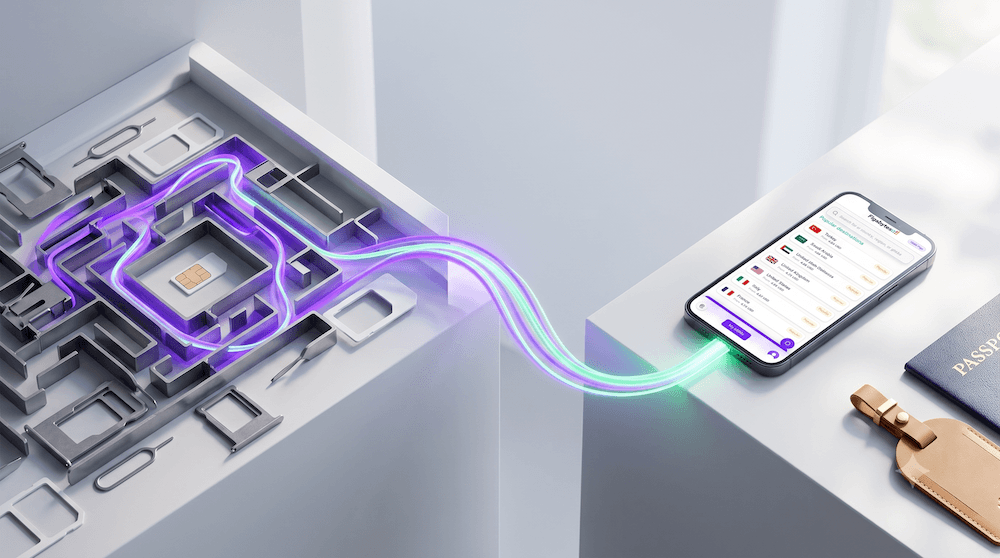
eSIM technology promised a simpler way to connect.
No tiny plastic cards. No SIM ejector tools. No waiting for a physical SIM to arrive. In theory, changing mobile plans should be as simple as downloading a digital profile.
But the reality can sometimes feel more complicated.
The technology itself is designed for flexibility, but activation rules, carrier restrictions, device transfers, and provider processes can still create friction.
So is eSIM actually easier?
For travelers, the answer depends largely on how you use it and which type of eSIM service you choose.
A physical SIM ties your mobile service to a small removable card.
Changing connectivity traditionally meant:
eSIM was designed to digitize much of this process.
Instead of physically replacing a SIM, compatible devices can download mobile profiles digitally.
For travelers, that creates a completely different way to prepare for international connectivity.
The technology may be digital, but the rules surrounding it vary.
Depending on the carrier or provider, users may encounter:
This is an important distinction.
eSIM technology and the experience offered by an eSIM provider are not the same thing.
A digital SIM can be convenient, but the journey around buying, installing, activating, managing, and getting support matters just as much.
One source of confusion is that not every eSIM serves the same purpose.
Your regular mobile operator may provide an eSIM that replaces your physical SIM.
It can be linked to:
Moving this eSIM between devices may depend on your carrier's policies and supported transfer methods.
A travel eSIM is typically designed to give you mobile data while traveling.
With Figabytes, you can purchase a plan for your destination before departure and install it on a compatible device.
You can then use:
This allows both lines to serve different purposes on supported dual-SIM devices.
Despite some limitations, travel is one area where eSIM solves several real problems.
You do not need to wait until you arrive to start looking for connectivity.
You can choose a Figabytes plan before departure and prepare your phone while you still have reliable Wi-Fi.
Your home SIM can stay exactly where it is.
There is no need to remove it, store it in your wallet, or worry about losing it during the trip.
On supported devices, your home line can remain available for calls, SMS, or verification messages while Figabytes handles mobile data.
Remember that your home carrier may still charge roaming fees for certain calls, messages, or services, so check its roaming policy before traveling.
Instead of searching for a mobile store or airport kiosk, your travel eSIM can already be installed.
Once you arrive, you can configure the correct data line, enable the required settings, and connect to a supported network.
eSIM is convenient, but it is important to understand its limitations.
Not every phone supports eSIM.
Even phones with the same model name may have different capabilities depending on where they were purchased.
Always check compatibility before buying.
An eSIM-compatible phone can still be restricted by a carrier lock.
If your device is locked to your home operator, another eSIM may not work until the restriction is removed.
With a physical SIM, you can remove the card and insert it again later.
Digital profiles can work differently.
Some travel eSIM profiles are designed for installation on a specific device and may not be reusable after deletion.
Do not delete your Figabytes eSIM unless you are finished with it or have been instructed to do so.
A carrier eSIM may support built-in phone-to-phone transfer depending on the operator and device.
Travel eSIMs may follow different rules.
If you change or lose your phone while your Figabytes plan is active, contact support to check the available options for your specific plan.
Most eSIM problems can be avoided with a little preparation.
Before traveling:
When you arrive, follow the instructions provided with your plan to select Figabytes for mobile data and enable Data Roaming if required.
A connection problem does not necessarily mean the eSIM itself is faulty.
Start with a few basic checks.
Make sure Figabytes is selected for mobile data.
Travel eSIMs commonly connect through partner networks, so Data Roaming may need to be enabled on the Figabytes line.
Turning Airplane Mode on briefly and then off can force the phone to reconnect to available networks.
Automatic network selection is usually recommended unless your plan instructions specify a particular network.
Some plans may require an APN configuration.
Follow the details included with your Figabytes order if manual settings are necessary.
| Feature | Physical SIM | Travel eSIM |
|---|---|---|
| Physical card required | Yes | No |
| Can be purchased before travel | Sometimes | Yes |
| SIM tray needed | Yes | No |
| Keep home SIM installed | Difficult on single-slot phones | Yes, on supported dual-SIM devices |
| Digital delivery | No | Yes |
| Risk of losing a tiny SIM card | Yes | No physical card |
| Device compatibility required | Yes | Yes |
| Installation rules | Physical insertion | Digital profile setup |
| Easy to physically move between phones | Often | Depends on provider and plan |
Neither technology is perfect for every situation.
The advantage of eSIM is that it removes much of the physical friction and allows connectivity to be prepared digitally.
As eSIM becomes more common, travelers should look beyond whether a provider simply "offers eSIM."
The better questions are:
The technology is only one part of the experience.
A good eSIM journey should make connectivity feel simpler, not replace physical friction with digital confusion.
Figabytes is built around making travel connectivity easier to prepare and manage.
Travelers can choose destination and regional eSIM plans online, install digitally on compatible devices, and prepare their connectivity before departure.
The goal is not simply to replace a piece of plastic.
It is to make getting connected abroad more convenient from the moment you start planning your trip.
eSIM was designed to make mobile connectivity more flexible, but going digital does not automatically eliminate every inconvenience.
Carrier policies, device restrictions, transfer rules, and unclear activation processes can still create friction.
For travelers, however, eSIM offers a major practical advantage: the ability to arrange mobile data before leaving home without replacing your primary physical SIM.
Understanding how your eSIM works before you travel is the key.
Choose your destination, prepare your travel eSIM before departure, and arrive ready to connect with Figabytes.

