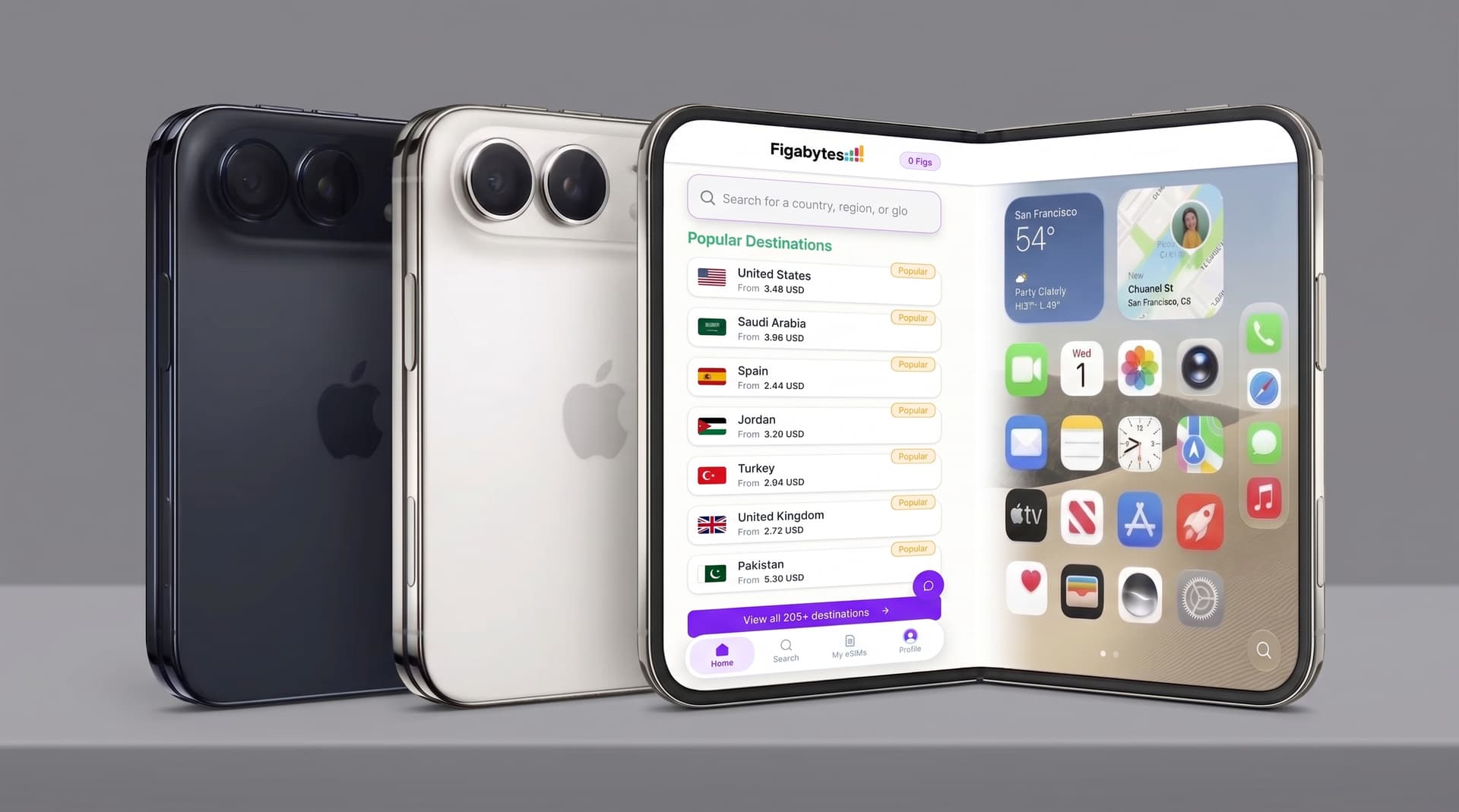
Apple's newest iPhone generation is here, and one of the biggest changes for travelers isn't only the camera, processor or foldable display.
It's the SIM.
Apple announced the iPhone 18 Pro, iPhone 18 Pro Max and the first foldable iPhone, iPhone Duo, on September 9, 2026.
The iPhone Duo is eSIM-only worldwide. Apple is also expanding eSIM-only versions of the iPhone 18 Pro and iPhone 18 Pro Max across markets including the UAE, Saudi Arabia, Japan, Canada, Mexico and the United States.
That makes understanding eSIM increasingly important for anyone buying a new iPhone or traveling internationally.
Whether you're considering the iPhone 18 Pro, iPhone 18 Pro Max, iPhone Duo or keeping an iPhone 17, iPhone 16, iPhone 15 or older model, here's what you need to know about Apple's newest devices and staying connected abroad.
Apple announced the iPhone 18 Pro, iPhone 18 Pro Max and iPhone Duo on September 9, 2026.
The iPhone Duo is Apple's first foldable iPhone and is eSIM-only worldwide. Apple is also selling eSIM-only iPhone 18 Pro and iPhone 18 Pro Max models in a growing number of markets, including the UAE, Saudi Arabia, Japan, Canada, Mexico and the United States.
For international travelers, an unlocked and compatible iPhone can use a travel eSIM instead of swapping physical SIM cards.
Figabytes offers travel eSIM plans across more than 200 destinations, giving compatible iPhone users another way to arrange mobile data before traveling.
Explore Figabytes destinations
Apple's September 2026 event introduced a major new generation of iPhone hardware.
The headline iPhone announcements were:
The biggest newcomer is iPhone Duo, Apple's first foldable iPhone.
Apple also introduced major changes to the Pro lineup, including the A20 Pro chip, new camera technology, improved battery life and iOS 27.
For travelers, however, Apple's continued transition toward eSIM-only hardware deserves just as much attention.
Apple describes the iPhone 18 Pro and iPhone 18 Pro Max as major upgrades in camera performance, battery life and sustained performance.
Both devices use the A20 Pro chip and Apple's next-generation vapor chamber.
The camera system introduces a 48MP Fusion Main camera with variable aperture, giving users greater control over depth of field and lighting.
Other major updates include:
For travelers who depend heavily on their phones for maps, translation, reservations, photography, messaging and mobile data, battery life and cellular connectivity can be just as important as camera improvements.
iPhone Duo is Apple's first foldable iPhone.
When opened, it has a 7.6-inch inner display.
When closed, it has a 5.4-inch outer display.
Apple says the outer display provides 90 percent of the screen area of the iPhone 18 Pro while keeping the phone compact when folded.
Both displays use the same aspect ratio so content can transition between the outer and inner displays.
The device is powered by the A20 Pro chip and uses an advanced thermal management system with a custom vapor chamber.
But for travelers, there is another particularly important specification:
iPhone Duo has no physical SIM card slot.
Yes, if you've been searching for Apple's rumored foldable iPhone.
Before the official announcement, searches such as:
were commonly used to describe Apple's expected foldable device.
Apple's official product name is:
iPhone Duo.
So the device previously discussed online as the "iPhone Fold" is now officially Apple's iPhone Duo.
Yes.
iPhone Duo is eSIM-only worldwide.
There is no physical SIM version of iPhone Duo.
Apple says the device supports Dual eSIM, meaning two eSIMs can be active simultaneously, and it can store eight or more eSIM profiles.
That can be particularly useful for frequent travelers.
For example, a traveler could potentially keep a home carrier eSIM and a travel eSIM stored on the same iPhone.
Before traveling, you can then choose which line handles cellular data.
Removing the physical SIM tray creates additional internal space.
On a foldable device where internal space is particularly valuable, that can help Apple allocate more room to other components.
Apple says iPhone Duo uses an eSIM-only design to maximize physical space for battery capacity.
The device uses a dual-battery architecture with one high-energy battery on each side.
So eSIM is no longer simply a different way to activate cellular service.
It is increasingly affecting how Apple designs the physical hardware itself.
It depends on where you buy it.
Apple is expanding eSIM-only versions of the iPhone 18 Pro and iPhone 18 Pro Max into more countries and regions.
Apple says eSIM-only iPhone 18 Pro and iPhone 18 Pro Max models are available in:
| Country or region | eSIM-only iPhone 18 Pro models |
|---|---|
| Bahrain | Yes |
| Canada | Yes |
| Guam | Yes |
| Japan | Yes |
| Kuwait | Yes |
| Mexico | Yes |
| Oman | Yes |
| Qatar | Yes |
| Saudi Arabia | Yes |
| UAE | Yes |
| United States | Yes |
| U.S. Virgin Islands | Yes |
In these markets, the iPhone 18 Pro and iPhone 18 Pro Max are not compatible with physical SIM cards.
Other regional models can have different SIM configurations.
Always check the specifications for the exact country where you're purchasing your iPhone.
Yes.
Apple's UAE specifications list the iPhone 18 Pro and iPhone 18 Pro Max as eSIM-only devices.
They support:
They are not compatible with physical SIM cards.
This is particularly relevant for UAE residents who travel frequently.
Instead of purchasing a physical SIM at your destination, an unlocked compatible iPhone can use a travel eSIM.
Explore Figabytes travel destinations
Apple also includes Saudi Arabia among the markets receiving eSIM-only versions of the iPhone 18 Pro and iPhone 18 Pro Max.
That means travelers buying the device in Saudi Arabia should become familiar with adding and switching between eSIM profiles.
For international trips, you can check whether your destination is available through Figabytes before departure.
Japan is also included among Apple's eSIM-only iPhone 18 Pro markets.
This matters both for Japanese customers traveling internationally and travelers considering buying an iPhone while visiting Japan.
Always check the exact regional model before purchasing an iPhone abroad.
An eSIM-only iPhone cannot accept a traditional physical SIM card.
Instead, cellular plans are installed digitally.
For travelers, this changes the traditional arrival routine.
Instead of:
Land → find SIM shop → buy physical SIM → remove home SIM → insert local SIM
you can potentially use:
Choose destination → buy travel eSIM → install digitally → arrive → connect
For example, a compatible unlocked iPhone user can browse Figabytes plans before traveling and choose a plan for the destination.
Figabytes offers travel eSIM connectivity across more than 200 destinations.
Popular destinations include:
Plan availability, networks, prices, data allowances and validity vary by destination.
That makes checking your specific destination more important than simply asking whether an iPhone supports eSIM.
View all Figabytes destinations
Apple's newest iPhones are launching across many of the world's largest travel markets.
That includes destinations such as:
Many of these destinations are also available through Figabytes.
For travelers, this creates two different questions:
Where can I buy the new iPhone?
And:
Where can I use a travel eSIM with it?
Those answers aren't always identical, so check your destination and device separately.
Apple announced the iPhone 18 Pro and iPhone 18 Pro Max on September 9, 2026.
Pre-orders begin:
September 12, 2026.
Availability begins:
September 18, 2026.
Additional market availability can vary by country.
So if you're searching:
Apple has now officially announced the Pro generation.
Apple's September 9 announcement introduced the iPhone 18 Pro and iPhone 18 Pro Max alongside iPhone Duo.
Do not assume that every rumored device carrying the "iPhone 18" name was announced at the same event.
When searching for iPhone 18 information, distinguish between Apple's officially announced products and pre-announcement rumors or predictions.
iPhone Duo has its own release schedule.
Apple says pre-orders begin:
October 16, 2026.
Availability begins:
October 23, 2026.
Availability varies by market.
iPhone Duo pricing varies by market and storage capacity.
Apple offers four storage configurations:
If you're considering buying iPhone Duo while traveling, compare more than the local price.
You should also check:
A cheaper iPhone abroad is not necessarily the better purchase if its regional configuration doesn't match your needs.
No.
Whether you buy a 256GB, 512GB, 1TB or another available storage configuration does not determine whether your phone supports eSIM.
SIM configuration is determined by the iPhone model and regional version.
So if you're searching for an "iPhone 18 Pro Max 512GB," check the country-specific specifications separately from the storage capacity.
Apple says the iPhone 18 Pro and iPhone 18 Pro Max can store eight or more eSIM profiles.
They also support two active eSIMs.
That creates useful possibilities for travelers.
For example:
| eSIM | Possible use |
|---|---|
| Home eSIM | Your normal phone line |
| Figabytes eSIM | Mobile data at your destination |
| Previous travel eSIM | Stored for another trip |
| Work eSIM | Business line |
The exact services available on each line depend on the carrier and plan.
Apple lists iPhone Duo as supporting:
Because iPhone Duo has no physical SIM slot anywhere in the world, managing multiple digital profiles becomes a core part of using the device.
Yes, provided the exact device is:
The iPhone 18 Pro's eSIM support makes it suitable for installing travel eSIM profiles.
Check the destination before purchasing your plan.
Find a Figabytes eSIM destination
Yes, subject to the same requirements.
Your iPhone 18 Pro Max should be unlocked and compatible with eSIM, and your destination must be supported by the selected Figabytes plan.
The eSIM-only versions make digital cellular setup particularly important because you cannot fall back to inserting a physical travel SIM.
iPhone Duo is eSIM-only worldwide.
That makes digital cellular plans the standard method of adding mobile service to the device.
If the phone is unlocked and your destination and plan are compatible, you can install a compatible Figabytes travel eSIM for your trip.
Figabytes does not require you to download a Figabytes app.
Your eSIM is managed through your Figabytes account.
Before installation:
Figabytes supports installation methods including QR and manual installation, depending on the device and circumstances.
You can generally install your travel eSIM before departure and leave it unused until you need it, subject to the activation rules of your specific plan.
Learn how to install a Figabytes eSIM
Not necessarily.
Installation and activation are not always the same thing.
For most Figabytes plans, validity begins when the eSIM first connects to a supported local network, while some plans may use a different activation method.
This means you can often install the eSIM before traveling without immediately starting the plan.
Always check the activation details for your specific eSIM.
When using a Figabytes travel eSIM at your destination, Data Roaming should generally be enabled for the Figabytes line.
Your typical configuration would be:
| Setting | Figabytes | Home SIM |
|---|---|---|
| Line active | Yes | Optional |
| Cellular Data | Yes | No |
| Data Roaming | ON | Usually OFF |
| Home number | No | Yes |
Keeping Data Roaming off on your home SIM can help prevent that line from using your home carrier's international mobile data service.
Always check your home carrier's roaming terms.
On a compatible Dual SIM iPhone, you can potentially keep your home line active while using Figabytes for cellular data.
This can be useful if you want to retain access to your usual number while traveling.
Your home carrier's roaming policies still apply to calls, messages and other services on that line.
Using Figabytes for data does not automatically make activity on your home SIM free.
Potentially, yes.
If your home SIM remains active and your carrier supports receiving SMS while roaming, you may still receive verification messages while using another eSIM for mobile data.
The ability to receive an SMS and whether your carrier charges for roaming activity are controlled by your home carrier.
Yes.
WhatsApp uses an internet connection.
Changing the SIM used for cellular data does not automatically change your existing WhatsApp account or phone number.
You can therefore use the internet connection from a travel eSIM while continuing to use your existing WhatsApp account.
The iPhone 18 Pro generation and iPhone Duo use iOS 27.
Apple says iOS 27 includes improvements to responsiveness, reliability, personalization and Apple Intelligence.
It also introduces iPhone Handoff for supported carriers.
For travelers, the broader direction is important because managing digital cellular connections is becoming increasingly integrated into the iPhone experience.
iOS 27 introduces iPhone Handoff.
With supported carriers, Apple says the feature allows users to switch back and forth between two iPhone models using the same phone number.
This is different from using a travel eSIM.
However, it demonstrates how the relationship between your phone number, SIM profile and physical phone is becoming increasingly digital.
iPhone Air is another important part of Apple's move toward eSIM.
Apple designed iPhone Air around an eSIM-only architecture.
For travelers comparing iPhone Air, iPhone 17, iPhone 18 Pro and iPhone Duo, SIM configuration is now another specification worth checking alongside:
There isn't one answer for every traveler.
If connectivity is your priority, check:
Both device generation and country of purchase can affect the cellular configuration.
Yes.
You do not need to replace a working iPhone 17 simply because the iPhone 18 generation exists.
For travel connectivity, an unlocked and compatible iPhone 17 can still use eSIM.
If your device:
it can remain perfectly practical for international travel.
That depends on the market and exact model.
Apple has sold different SIM configurations in different countries.
Some models rely entirely on eSIM, while other regional configurations can differ.
Always check the technical specifications for your exact iPhone rather than assuming every iPhone 17 has the same SIM setup.
Compatible iPhone 16 models support eSIM.
Regional differences still matter, particularly regarding whether a physical SIM slot is also available.
You do not need the newest iPhone to use a Figabytes travel eSIM.
Yes.
Compatible iPhone 15 models support eSIM.
Depending on the market where the device was sold, the phone may use eSIM only or support another SIM configuration.
Yes.
The iPhone 14 generation supports eSIM.
Apple's move toward eSIM-only iPhones became especially visible with U.S. iPhone 14 models, which removed the physical SIM tray.
Other markets had different configurations.
Many iPhone 13 models support both nano-SIM and eSIM, depending on the market.
The iPhone 13 generation can therefore still be useful for international travelers who want the flexibility of eSIM while retaining a physical SIM option.
Selected iPhone SE generations support eSIM.
The iPhone SE (2nd generation) and later compatible models brought eSIM functionality to Apple's more affordable iPhone range.
Always check your exact model and region before purchasing a travel eSIM.
Apple introduced eSIM support to the iPhone lineup with:
Many later iPhones also support eSIM.
However, regional and carrier restrictions can apply.
This means travelers do not necessarily need an iPhone 18, iPhone Duo or even an iPhone 17 to benefit from a travel eSIM.
Buying an iPhone while traveling can sometimes save money or give you earlier access to a device, but regional differences matter.
Before purchasing, check:
This is becoming more important as Apple's SIM configurations vary between markets.
China mainland has specific eSIM rules.
Apple says China Mobile, China Telecom and China Unicom support eSIM on eligible devices.
For carrier eSIM activation in China mainland, users need a compatible China mainland iPhone and must visit a carrier store for activation and identity verification.
Apple lists iPhone Duo and iPhone Air as eSIM-only in China mainland.
Apple says iPhone 18 Pro and iPhone 18 Pro Max models for China mainland can activate using either eSIM or a physical nano-SIM.
There is also an important rule for international travelers:
eSIMs from non-China mainland carriers cannot be installed while located in China mainland.
If you have a compatible China mainland iPhone and are traveling outside China mainland, Apple says you can activate an eSIM from a local carrier while abroad, subject to its requirements.
Travelers should therefore plan their connectivity before entering China rather than assuming the same installation rules apply everywhere.
It can be.
An eSIM-only iPhone removes the need to physically swap SIM cards.
Before traveling, you can potentially:
The trade-off is that an eSIM-only iPhone cannot use a physical local SIM if digital options are unavailable.
Checking connectivity before departure therefore becomes more important.
Your iPhone model does not determine the best data allowance.
Your trip does.
| Type of trip | Figabytes option to consider |
|---|---|
| Short city break | Smaller fixed-data plan |
| One-country holiday | Destination-specific plan |
| European multi-country trip | Regional Europe plan |
| Heavy mobile data usage | Larger or eligible unlimited plan |
| Longer stay | Larger data allowance |
| Multi-country itinerary | Regional or Global plan where destinations are included |
Always check the countries included in a regional or Global plan rather than assuming every destination is covered.
Compare Figabytes destinations and plans
Your iPhone model does not determine how much mobile data you need.
Your behavior does.
Light usage may include:
Higher usage can include:
A traveler using an iPhone 18 Pro Max primarily for photography and maps may consume less mobile data than someone streaming video constantly on an older iPhone.
Choose your plan around your actual usage.
Probably not.
If your current iPhone supports eSIM, is unlocked and still works well, you can already use a travel eSIM.
The iPhone 18 generation makes eSIM more central to Apple's hardware strategy, but eSIM itself has been supported on iPhones for years.
Upgrade because the complete device makes sense for you, not simply because you want travel eSIM support.
Apple announced the iPhone 18 Pro and iPhone 18 Pro Max on September 9, 2026.
Apple says iPhone 18 Pro pre-orders begin September 12, 2026, with availability beginning September 18.
The iPhone 18 Pro Max follows the same initial schedule, with pre-orders beginning September 12 and availability beginning September 18, 2026.
Apple has officially announced the iPhone 18 Pro and iPhone 18 Pro Max. The first availability begins September 18, 2026.
Apple's first foldable iPhone is officially called iPhone Duo.
iPhone Duo is the official name of Apple's first foldable iPhone. "iPhone Fold" and "foldable iPhone" were common search terms before the official name was announced.
Yes. iPhone Duo is eSIM-only worldwide and does not support physical SIM cards.
Apple says iPhone Duo can store eight or more eSIMs and supports two active eSIMs.
Apple says iPhone Duo pre-orders begin October 16, 2026, with availability beginning October 23 in the first markets.
It depends on the market. Apple sells eSIM-only versions in Bahrain, Canada, Guam, Japan, Kuwait, Mexico, Oman, Qatar, Saudi Arabia, UAE, United States and U.S. Virgin Islands.
Yes. Apple's UAE specifications show iPhone 18 Pro and iPhone 18 Pro Max as eSIM-only devices.
Apple lists Saudi Arabia among the markets receiving eSIM-only iPhone 18 Pro and iPhone 18 Pro Max models.
Yes. Japan is included in Apple's list of eSIM-only iPhone 18 Pro markets.
It depends on the regional model. SIM configuration varies depending on where the iPhone was sold.
An unlocked, eSIM-compatible iPhone 17 can still be suitable for international travel. You do not need an iPhone 18 solely to use a travel eSIM.
Yes. Compatible iPhone 15 models support eSIM, although SIM configurations vary by region.
Yes. Compatible iPhone 14 models support eSIM.
Many iPhone 13 models support both nano-SIM and eSIM, depending on the market.
Selected iPhone SE generations support eSIM. Check the exact model before purchasing a plan.
Yes, if the exact iPhone is unlocked, eSIM-compatible and compatible with your selected Figabytes plan and destination.
iPhone Duo is eSIM-only. An unlocked device can use a compatible travel eSIM when the selected provider and destination are supported.
No. Figabytes does not require a dedicated app. Your purchased eSIM and installation information are managed through your Figabytes account.
On compatible Dual SIM iPhones, you can keep your primary line available while selecting a travel eSIM for mobile data. Your home carrier's international roaming charges can still apply to activity on your primary line.
When using a Figabytes travel eSIM at your destination, Data Roaming should generally be enabled for the Figabytes line so it can connect to supported partner networks.
Yes. Current compatible iPhones can store multiple eSIM profiles. Apple says iPhone 18 Pro, iPhone 18 Pro Max and iPhone Duo can store eight or more eSIMs.
Apple's 2026 iPhone generation marks another major step toward an eSIM-first future.
The iPhone Duo is eSIM-only worldwide.
The iPhone 18 Pro and iPhone 18 Pro Max are eSIM-only in an expanding group of markets including the UAE, Saudi Arabia, Japan, Canada, Mexico and the United States.
And Apple's newest devices can store multiple eSIM profiles, giving international travelers more flexibility to keep different cellular plans on one phone.
But you don't need the newest iPhone to use a travel eSIM.
Many previous iPhones already support the technology.
If you're traveling with a compatible unlocked iPhone, the important questions are whether your destination is supported, how much data you need, when your plan activates and how your cellular settings should be configured.
For travelers using an eSIM-only iPhone 18 Pro, iPhone 18 Pro Max or iPhone Duo, planning that connectivity before departure is becoming more important than ever.
Last checked: September 10, 2026

