Traveling internationally often means finding a reliable way to access the internet without depending on your regular mobile carrier's international roaming service.
Whether you're navigating a new city, booking transportation, checking hotel reservations, or staying in touch with family, mobile connectivity can make your journey easier.
But international roaming isn't your only option.
Travel eSIMs, local SIM cards, and Wi-Fi all offer different ways to get online while traveling.
Each option has advantages, limitations, and situations where it makes the most sense.
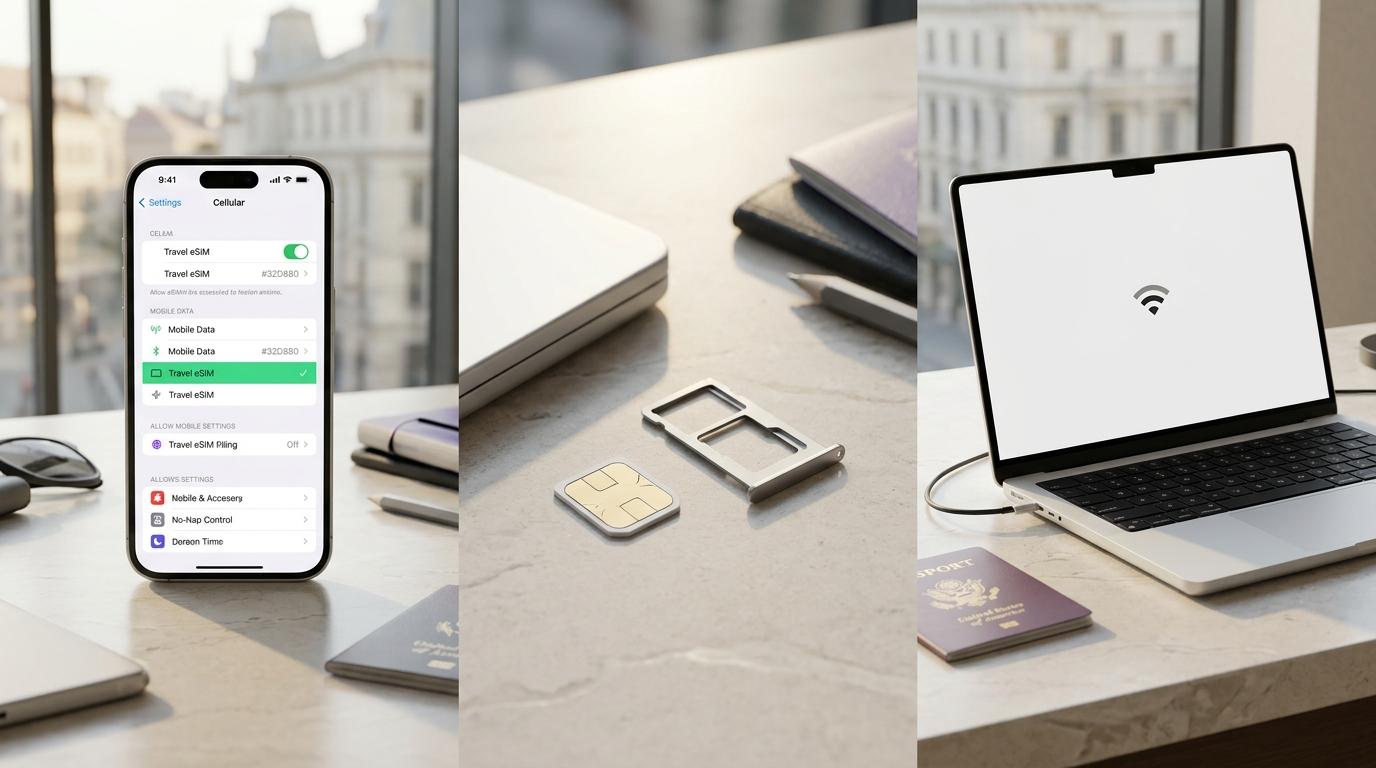
A travel eSIM allows you to prepare a digital mobile data subscription before departure. A local SIM provides connectivity through a mobile operator at your destination. Wi-Fi allows you to connect without using cellular data, although availability depends on nearby networks.
In this guide, we'll compare these three international roaming alternatives and explain how to choose the right connection for your next trip.
For many travelers with compatible smartphones, a travel eSIM is one of the most convenient alternatives to using a home carrier's international data roaming service.
It allows you to prepare mobile connectivity before departure, install a digital SIM, and connect to supported networks at your destination.
However, the best option depends on your needs:
You can also combine these options.
For example, you might use a Figabytes travel eSIM while exploring a destination and connect to trusted Wi-Fi for larger downloads.
International roaming occurs when your regular mobile subscription connects to a foreign mobile network outside your home carrier's standard coverage area.
For example, a traveler with a UAE mobile subscription visiting Japan may connect to a Japanese mobile network through their home carrier's roaming agreements.
Depending on the subscription, international roaming may support:
Some home mobile plans include international roaming allowances.
Others apply separate charges for data, calls, or messages.
Roaming costs and conditions depend on your carrier, destination, and subscription.
If you don't want to rely on your home carrier's international roaming data service, there are several alternatives.
The three most common alternatives are:
Each provides internet access differently.
A travel eSIM and local SIM use cellular networks.
Wi-Fi connects your device to a nearby wireless network that provides internet access.
Understanding these differences can help you prepare before traveling.
A travel eSIM is a digital mobile subscription that can be installed on a compatible smartphone without inserting a physical SIM card.
Instead of replacing your regular SIM, you download an eSIM profile onto your device.
The eSIM can then provide mobile data through supported networks at your destination.
A travel eSIM generally follows a simple process:
Some plans require Data Roaming to be enabled on the travel eSIM because they connect through local partner networks.
Installation and activation are not always the same event. Check the plan's validity and activation conditions before departure.
You can often purchase and install a travel eSIM before leaving home.
This can reduce the need to arrange mobile connectivity after arrival.
Compatible Dual SIM smartphones can allow your home SIM and travel eSIM to coexist.
This may let you keep your regular number available while using a separate mobile data connection.
An eSIM is installed digitally, so you don't need to remove your existing SIM card.
Travel eSIMs can cover individual destinations or multiple countries, depending on the plan.
A travel eSIM can be useful when you want mobile data immediately after arriving at a supported destination.
Travel eSIMs are not suitable for every situation.
Potential limitations include:
A travel eSIM does not automatically prevent your home SIM from generating roaming charges for calls or SMS.
A travel eSIM is particularly useful when:
Figabytes offers country, regional, and global travel eSIM plans for supported destinations.
Explore Figabytes travel eSIM plans
A local SIM card is a mobile subscription purchased from an operator or retailer at your destination.
Instead of using your home carrier's roaming data service, you use a local mobile subscription.
Depending on the plan, a local SIM may provide:
A typical local SIM setup involves:
The process varies by country and operator.
Some local subscriptions include a local phone number, domestic calling, and SMS.
This can be useful for travelers who need traditional local cellular services.
A local subscription may be practical when spending an extended period in one country.
You can connect through the operator's supported domestic mobile network.
Depending on the destination, purchasing a local SIM may require visiting a retailer or completing an in-person verification process.
If your phone has only one physical SIM slot, you may need to remove your existing SIM.
Some destinations require passport or identity documentation when registering a local mobile subscription.
Your phone must support the relevant physical SIM format, network technology, and frequencies.
It also generally needs to be carrier-unlocked.
A local SIM purchased in one destination may not provide suitable coverage in another country.
A local SIM may be suitable when:
Wi-Fi allows your smartphone, tablet, or laptop to access the internet through a nearby wireless network.
Unlike a travel eSIM or local SIM, Wi-Fi doesn't require your device to use a cellular data subscription.
You may find Wi-Fi at:
Your device connects to an available wireless network.
That network provides internet access through its underlying connection.
Once connected, you can use supported internet-based services such as:
The quality of your connection depends on the network.
You can access the internet without purchasing a separate mobile data plan, provided a suitable Wi-Fi connection is available.
A reliable Wi-Fi connection can be convenient for software updates, cloud backups, and downloading media.
Many Wi-Fi networks allow several devices to connect.
Wi-Fi can work well when you're spending time at a hotel, office, or accommodation property.
Wi-Fi is only available within the coverage area of an accessible network.
You may lose connectivity while traveling between locations.
Network speed and reliability depend on the provider, equipment, congestion, and internet connection.
Public Wi-Fi networks may expose users to security risks, especially when networks are untrusted or improperly configured.
Use encrypted websites, keep your device updated, and avoid joining suspicious networks.
Some public networks require registration, passwords, or acceptance of terms before allowing internet access.
Wi-Fi may be suitable when:
| Feature | Travel eSIM | Local SIM | Wi-Fi |
|---|---|---|---|
| Internet access | Cellular mobile data | Cellular mobile data | Nearby wireless network |
| Physical SIM required | No | Yes | No |
| Can prepare before departure | Often | Sometimes | Depends on network access |
| Works while moving | Within cellular coverage | Within cellular coverage | Only within connected Wi-Fi coverage |
| Local phone number | Usually not included | Often available | Not provided |
| Traditional cellular calls | Usually not included | Plan-dependent | Not directly provided |
| Device requirements | eSIM-compatible, unlocked | Compatible SIM slot, unlocked | Wi-Fi-capable device |
| Multi-country options | Available on selected plans | Plan-dependent | Depends on accessible networks |
| Internet-based messaging | Yes | Yes | Yes |
| Hotspot sharing | Plan-dependent | Plan-dependent | Device/network-dependent |
| Availability after landing | If configured and covered | After obtaining and activating SIM | When Wi-Fi is available |
The best choice depends on your device, destination, travel duration, and connectivity needs.
For short international trips, convenience is often a priority.
A travel eSIM can be useful because you can prepare your mobile data connection before departure.
You can then connect after arrival without searching for a physical SIM retailer.
Business travelers may need internet access for email, messaging, navigation, and online meetings.
A travel eSIM can provide mobile data while moving between locations.
Trusted Wi-Fi can complement that connection for larger downloads or longer video meetings.
Families may have several smartphones or tablets requiring internet access.
Each compatible smartphone can use its own travel eSIM.
Alternatively, a device with a supported hotspot plan may share its mobile data connection with other devices.
Check hotspot support and data allowances before relying on sharing.
For extended stays in one country, a local SIM may be useful, particularly when a local phone number or domestic cellular services are required.
A travel eSIM can still be convenient for the initial arrival period or for travelers who prefer digital installation.
Travelers visiting several countries may benefit from a regional or global travel eSIM.
Instead of arranging a new local SIM at every destination, one eligible plan may cover multiple countries.
Always verify the exact list of supported destinations.
If you mainly need internet at your accommodation or workplace, Wi-Fi may be sufficient.
However, consider whether you need connectivity while navigating, booking transportation, or moving between locations.
Yes.
A travel eSIM and Wi-Fi can complement each other.
For example:
Your smartphone can generally switch between Wi-Fi and cellular data according to its settings and connection availability.
This approach can help you manage your mobile data allowance.
Yes, on compatible Dual SIM smartphones.
You may be able to keep your home SIM enabled while using a travel eSIM for mobile data.
For example:
| Function | Home SIM | Travel eSIM |
|---|---|---|
| Regular phone number | Available | Usually data-only |
| Mobile data | Not selected | Selected |
| Cellular calls | Carrier-dependent | Usually not included |
| SMS verification | Carrier-dependent | Usually not included |
| Internet-based messaging | Uses active internet | Provides data connection |
However, keeping your home SIM enabled may still allow chargeable international roaming activity.
Regular calls, SMS, and other services are subject to your home carrier's policies.
If you want to avoid unwanted home-carrier data roaming, disable Data Roaming on your home line where supported and select your travel eSIM for mobile data.
For stronger protection against all chargeable roaming activity, consider disabling the home SIM or requesting a roaming block.
Before deciding, ask yourself a few questions.
If your smartphone supports eSIM and is carrier-unlocked, a travel eSIM may be an option.
If it doesn't support eSIM, a local physical SIM or Wi-Fi may be more suitable.
For one destination, a country-specific travel eSIM or local SIM may work.
For multiple destinations, review regional or global travel eSIM coverage.
If you need traditional domestic calls or SMS through a local number, a local SIM may be appropriate.
Many travel eSIM plans focus on mobile data.
If you need navigation, transportation applications, and messaging throughout the day, cellular connectivity may be more practical than relying only on Wi-Fi.
Consider your expected activities:
Choose a suitable data allowance based on your travel habits.
If you prefer arranging connectivity before traveling, a travel eSIM may offer a convenient setup process.
Check installation and activation conditions before departure.
Using an alternative connection does not automatically disable your home carrier's roaming services.
To reduce the risk of unwanted charges:
Remember that some travel eSIMs require Data Roaming to be enabled on the travel subscription.
The goal is to control which mobile subscription uses data, not necessarily to disable roaming on every SIM.
If you choose a travel eSIM, preparing ahead can make arrival easier.
Confirm that your smartphone supports eSIM and is unlocked.
Visit Figabytes and explore available plans for your destination.
Check:
Follow the installation instructions provided with your plan.
Use a reliable internet connection during installation.
Select the travel eSIM as your preferred mobile data subscription.
Enable Data Roaming for the travel eSIM if required by the plan.
Once you arrive, enable the travel eSIM and allow your phone to register on a supported network.
Test the connection before relying on it for essential travel activities.
Public Wi-Fi may not be available when you need navigation or transportation services.
Many travel eSIMs are data-only.
Check plan features before purchasing.
A regional plan may not include every country in the region.
An eSIM cannot be installed on a device that lacks the required functionality.
Your home SIM may still incur charges even when another connection provides mobile data.
Some eSIM profiles have restrictions on reinstallation or transfer.
Verify network legitimacy and use secure connections when accessing sensitive information.
A travel eSIM is a convenient option for many travelers with compatible smartphones. A local SIM may be preferable when a local number is needed, while Wi-Fi works well at locations with reliable internet access.
Neither is universally better. A travel eSIM offers digital installation and convenience, while a local SIM may provide a local number and additional domestic mobile services.
Yes, if you can access suitable Wi-Fi networks. However, you may not have internet access while moving between locations.
Not necessarily. Compatible Dual SIM smartphones can allow both subscriptions to remain installed.
Yes. On compatible devices, your regular SIM may remain active while the travel eSIM provides mobile data.
Some regional and global plans cover multiple destinations. Check the specific plan's country list.
Many travel eSIMs are data-only. Traditional cellular calling depends on the features included in the selected plan.
Yes. Internet-based messaging applications can generally use the travel eSIM's data connection.
Using Wi-Fi for internet access avoids ordinary cellular data usage while connected, but your home SIM may still incur charges for cellular calls, SMS, or other services.
Both connections can be available on your device. Your phone generally chooses the connection used for internet traffic according to its settings.
Some travel eSIMs require Data Roaming to be enabled to connect through supported partner networks.
Yes. A travel eSIM can provide mobile internet access for email, messaging, navigation, and other work-related activities within supported coverage areas.
International roaming isn't the only way to stay connected abroad.
Travel eSIMs, local SIM cards, and Wi-Fi each offer different advantages.
A local SIM may be useful when you need a local phone number or plan to stay in one country for an extended period.
Wi-Fi can work well for travelers who spend most of their time in locations with reliable internet access.
For travelers who want to prepare mobile connectivity before departure and avoid replacing their regular SIM, a travel eSIM can be a convenient option.
Figabytes offers country, regional, and global travel eSIM plans for supported destinations, helping you stay connected throughout your journey.
Explore Figabytes travel eSIM plans
Device compatibility, network coverage, plan conditions, and mobile services vary by destination and provider.

