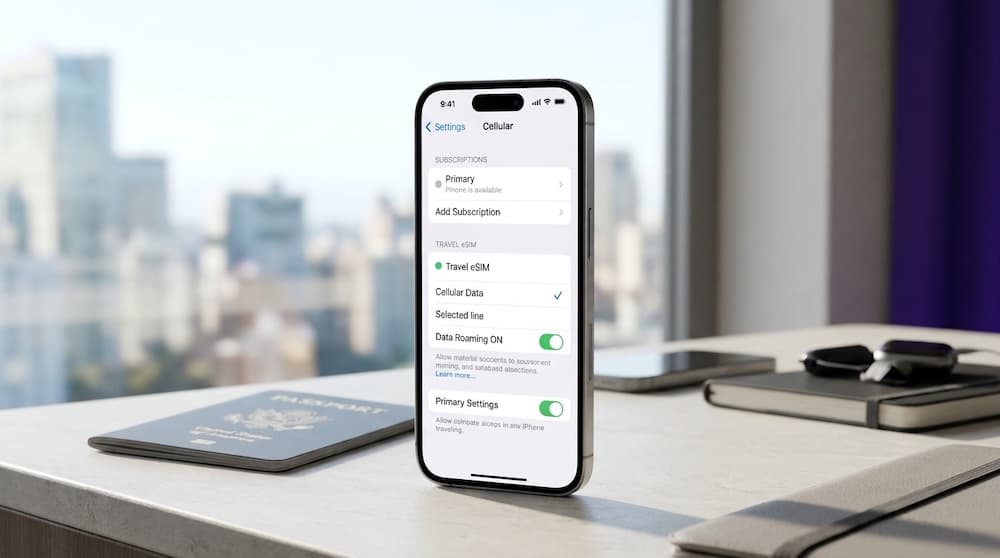
Your iPhone can make staying connected abroad easier than ever. Instead of searching for a physical SIM card when you land, you can prepare a travel eSIM before departure and connect to supported mobile networks at your destination.
But buying an eSIM is only part of the process.
To get connected successfully, you need to understand how to install your eSIM, select the correct mobile data line, configure Data Roaming, and manage your regular phone number while traveling.
This guide explains how to use an eSIM on iPhone when traveling internationally, including the settings to check before departure, what to do after arrival, and how to troubleshoot common connection problems.
To use a travel eSIM on your iPhone:
The exact steps depend on your iPhone model, iOS version, and travel eSIM plan.
An eSIM is a digital SIM that allows you to activate a mobile subscription without inserting a physical SIM card.
Instead of replacing your existing SIM, you can download an eSIM profile onto a compatible iPhone.
This is particularly useful for international travel because you can prepare a separate mobile data subscription for your destination.
For example, you could keep your regular mobile number available while using a Figabytes travel eSIM for internet access abroad.
Your iPhone can store multiple eSIM profiles, although the number of simultaneously active subscriptions depends on the model.
An eSIM does not automatically provide free international roaming. It is a separate subscription with its own coverage, validity, and usage conditions.
Most iPhone models released since the iPhone XS, iPhone XS Max, and iPhone XR support eSIM, although availability varies by country and model.
Examples of compatible iPhone families include:
Some regional iPhone models have different SIM capabilities, so model names alone are not enough to confirm compatibility.
Open:
Settings > Cellular
Look for an option such as Add eSIM.
You can also check:
Settings > General > About
Look for an EID, which is an identifier associated with eSIM functionality.
The presence of an EID is a useful compatibility indicator, but you should also confirm that your specific device supports the travel eSIM you intend to use.
Open:
Settings > General > About
Find Carrier Lock.
If the status says "No SIM restrictions," your iPhone is generally unlocked.
If your device is locked to a carrier, you may need to contact that carrier before installing a travel eSIM from another provider.
A travel eSIM can simplify international connectivity in several ways.
You can purchase and, where permitted by the plan's activation rules, install your eSIM before traveling.
This gives you time to review your settings and troubleshoot while you still have reliable internet access.
Compatible iPhones can support a regular SIM and travel eSIM together.
This allows you to use a separate mobile data subscription without necessarily removing your existing SIM.
An eSIM is installed digitally, so you do not need to open the SIM tray or carry a replacement SIM card.
Travel eSIM plans can cover individual countries, regions, or multiple destinations.
This can be useful for both short trips and longer international itineraries.
Your iPhone lets you choose which subscription provides cellular data.
That makes it easier to separate your home mobile service from your travel data connection.
Before starting, connect your iPhone to a reliable Wi-Fi network and make sure you have access to your eSIM installation instructions.
Figabytes provides installation details for supported plans.
The available installation method depends on the plan and device.
If the QR code is displayed on the same iPhone, you may need another screen or a supported method for adding the eSIM from an image.
Do not assume every QR code can be reused after installation.
Some eSIM plans provide manual activation information.
If manual installation is supported:
Use the exact information provided for your plan.
Some eSIM services support installation through an application, activation link, or another supported digital process.
Follow the instructions supplied with your plan.
Regardless of the installation method, confirm that the new eSIM appears in your iPhone's cellular settings.
After installation, your iPhone may ask you to name the new subscription.
A clear label helps prevent confusion between your regular mobile line and your travel data line.
For example:
To change a label later:
Menu labels may vary by iOS version.
Installing an eSIM does not always make it your active mobile data subscription.
You need to select the correct line.
Go to:
Settings > Cellular
Tap Cellular Data or Mobile Data.
Select the travel eSIM as your preferred mobile data subscription.
Your iPhone should now use that line for cellular internet access when it is enabled and connected.
If Allow Cellular Data Switching appears, turn it off when you want to prevent automatic switching to your home line.
This helps you maintain control over which subscription provides mobile data abroad.
This is one of the most important settings when using an eSIM internationally.
Many travel eSIMs connect through local partner networks and require Data Roaming to be enabled on the travel subscription.
For your Figabytes travel eSIM:
For your home SIM, you can generally leave Data Roaming off when you do not intend to use your home carrier's roaming data.
| Setting | Home SIM | Figabytes Travel eSIM |
|---|---|---|
| Line enabled | Optional | Yes |
| Cellular data | Not selected | Selected |
| Data Roaming | Off | On if required |
| Cellular calls | Subject to home carrier terms | Usually not included |
| SMS | Subject to home carrier terms | Usually not included |
| Internet-based messaging | Uses active internet connection | Provides mobile data |
Turning off Data Roaming on your home SIM does not necessarily prevent charges for regular cellular calls or SMS.
If you want to prevent all chargeable home-carrier roaming activity, consider disabling the home SIM or requesting a roaming block from your carrier.
Yes, on compatible iPhones.
You can often keep your home SIM active while using a travel eSIM for mobile data.
This may allow you to:
However, keeping your home SIM enabled can still result in roaming charges for certain services.
Your home carrier determines the applicable charges.
Your iPhone lets you choose a default line for regular cellular calls.
If you keep your home SIM selected for voice calls, those calls may be billed according to your carrier's international roaming policy.
A data-only travel eSIM generally does not provide traditional cellular calling or SMS.
Once you arrive at your destination, your iPhone needs to connect to a supported mobile network.
Follow these steps:
Some eSIM plans begin their validity period when they first connect to a supported network.
Others have different activation conditions.
Always check your specific plan's rules before installation or activation.
If your itinerary includes more than one country, you may prefer a regional or global travel eSIM.
Figabytes offers country, regional, and global options for supported destinations.
Before purchasing, check:
Do not assume that every regional plan covers every country within a geographic region.
For example, a plan described as covering Europe may not include every European destination.
Review the specific plan's country list.
Monitoring your data consumption can help you manage your travel plan.
To review cellular data usage:
Your iPhone may display usage over a longer period rather than automatically matching your travel eSIM's validity dates.
You can reset the relevant statistics before your trip if you want to track usage from a particular starting point.
For the most accurate plan balance, refer to the usage information available through your eSIM provider.
A few adjustments can help your data allowance last longer.
Offline maps can reduce the amount of mobile data needed for navigation.
Download applications, software updates, and large files over trusted Wi-Fi networks when practical.
Review background data usage for applications that do not need constant connectivity.
High-resolution video can consume significant amounts of data.
Lower streaming quality when you want to conserve your allowance.
Automatic photo and video uploads can use substantial mobile data.
Consider restricting large backups to Wi-Fi.
If your travel eSIM is installed but you cannot connect, several settings may be responsible.
Open Settings > Cellular and confirm that the travel subscription is turned on.
Check Cellular Data and make sure your travel eSIM is selected.
Some travel eSIMs require Data Roaming to be enabled.
Check your plan instructions.
A country-specific eSIM may not work outside its supported destination.
Verify that your current location is included.
After arrival, your iPhone may need time to register on a supported network.
You can try toggling Airplane Mode and waiting for the connection to establish.
Automatic network selection usually works best.
If your plan provides specific network instructions, follow them.
Some eSIM plans require a specific Access Point Name.
Only enter or change APN settings when your provider instructs you to do so.
Check the activation conditions, validity period, and remaining data allowance.
A locked iPhone may reject a travel eSIM from another provider.
Check Carrier Lock under Settings > General > About.
If the issue continues, contact official support before deleting the eSIM.
Deleting an eSIM does not guarantee that it can be reinstalled using the same activation details.
Some Figabytes plans support reusable eSIM installation.
With eligible reusable eSIMs, you may be able to keep the installed profile and use it with supported future plans.
However, reusability depends on the specific eSIM and plan.
It does not mean:
Review the relevant Figabytes plan conditions before relying on reusable installation.
Not necessarily.
If your eSIM is reusable, keeping the profile installed may be useful for future eligible purchases.
If it is not reusable, you may choose to remove it after confirming that you no longer need it.
Before deleting any eSIM:
Do not delete an eSIM as a first troubleshooting step unless official support instructs you to do so.
Confirm eSIM support and carrier-unlocked status before purchasing.
Installation and plan activation can be separate events.
Always verify your Cellular Data selection after installing a travel eSIM.
Your travel eSIM may require Data Roaming to connect.
Automatic switching may allow your phone to use another data subscription.
Some activation profiles cannot be reused after deletion.
A travel eSIM only works where its supported networks provide service.
Yes. Compatible, carrier-unlocked iPhones can use travel eSIM plans for supported international destinations.
No. Compatible iPhones can use a physical SIM and eSIM together, subject to model capabilities.
Often, yes. However, check your plan's activation and validity conditions before installation.
Some travel eSIMs require Data Roaming to be enabled. Follow your plan instructions and keep home-SIM Data Roaming disabled if you do not intend to use home-carrier roaming data.
Yes, if your iPhone supports the required dual-SIM configuration and your home carrier provides roaming service. Regular calls may incur roaming charges.
Yes. Most internet-based messaging apps can continue using their existing registered accounts through the travel eSIM's data connection.
It may connect automatically when enabled and correctly configured within its supported coverage area. Network registration and activation conditions vary.
Yes, if the selected regional or global plan includes those destinations.
Your mobile data connection may stop or become restricted according to the plan conditions. Supported plans may offer top-up options.
Transfer support depends on the eSIM provider, plan, and device. Do not assume a travel eSIM can be transferred or reinstalled on another phone.
Using a travel eSIM on iPhone is straightforward once you understand the essential settings.
Before departure, confirm device compatibility, choose a plan covering your destination, and review the installation and activation instructions.
After arrival, enable your travel eSIM, select it for mobile data, and configure Data Roaming according to the plan.
If you keep your regular SIM active, review your home carrier's roaming charges and disable automatic data switching when you want greater control.
Figabytes offers travel eSIM plans for supported destinations, including country, regional, and global options, helping you prepare your mobile connectivity before your next journey.
Device settings, carrier restrictions, network coverage, and plan activation rules may vary. Always follow the instructions provided for your specific device and eSIM plan.

