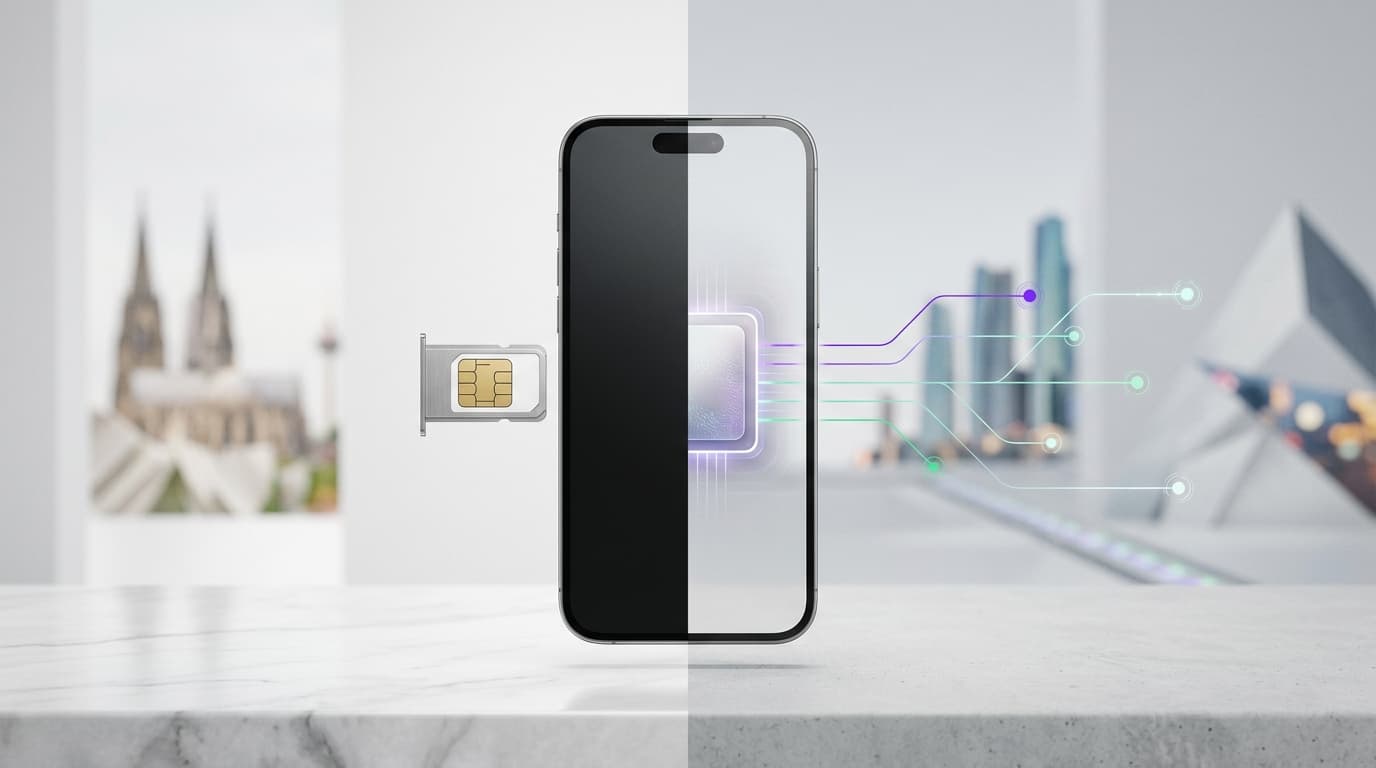
For decades, changing mobile networks usually meant changing a tiny plastic card inside your phone.
Today, that is no longer the only option.
An eSIM performs the core role of a traditional SIM digitally, without requiring you to insert or remove a physical card.
That difference might sound small, but it can change how you activate mobile service, switch plans, use two lines and stay connected while traveling.
So is an eSIM better than a physical SIM?
For many travelers, an eSIM can be more convenient because a travel data plan can be purchased and installed digitally while the existing home SIM remains in the phone on compatible devices.
But physical SIMs still have advantages, particularly for older devices, destinations or carriers where eSIM support is limited.
Here's how the two compare.
An eSIM is a digital SIM built into a compatible device, while a physical SIM is a removable card inserted into a SIM tray.
Both can connect your phone to a mobile network.
The main difference is how the mobile plan is provisioned.
| Feature | eSIM | Physical SIM |
|---|---|---|
| Physical card required | No | Yes |
| SIM tray required | No | Yes |
| Digital installation | Yes | No |
| Can store multiple profiles | On supported devices | Requires separate cards |
| Useful for travel | Yes | Yes |
| Can use alongside another SIM | On supported devices | On supported devices |
| Easy physical removal | Not applicable | Yes |
| Device compatibility | Requires eSIM support | Requires compatible SIM slot |
| Can be lost or physically damaged | No removable card | Yes |
| Network performance | Depends on network and plan | Depends on network and plan |
Neither technology automatically gives you faster mobile data.
Your actual experience depends more on the carrier, local network, coverage, congestion, device capabilities and plan than on whether the SIM itself is physical or digital.
A physical SIM is the small removable card traditionally inserted into a mobile phone.
SIM stands for Subscriber Identity Module.
The SIM allows a mobile network to identify your subscription and connect your device to the appropriate cellular service.
Modern smartphones that still use physical SIMs typically use a nano-SIM.
To change a physical SIM, you normally:
This system is familiar and still widely used around the world.
An eSIM is an embedded SIM.
Instead of inserting a removable plastic card, the SIM technology is built into the device.
A compatible mobile plan can then be provisioned digitally.
Depending on the provider and device, an eSIM may be installed using:
Once installed, the eSIM appears in your phone's cellular or SIM settings.
You can then manage it without opening a SIM tray.
The terms are sometimes used interchangeably online, but eSIM has a specific technical meaning.
An eSIM uses an embedded component inside a compatible device onto which a mobile profile can be provisioned.
The important point for travelers is simpler:
you don't receive a physical plastic SIM card.
The mobile plan is installed digitally onto a compatible device.
For cellular connectivity, yes.
Both technologies allow a compatible device to connect to a mobile network.
Depending on the plan, that connectivity may include:
The services included depend on the mobile plan rather than simply whether it uses an eSIM or physical SIM.
For example, many travel eSIMs focus primarily on mobile data.
Your regular carrier SIM, on the other hand, may include a phone number, calls, SMS and mobile data.
The biggest difference is physical versus digital provisioning.
A physical SIM requires an actual card.
An eSIM does not.
That affects almost every part of the experience.
With a physical SIM, changing service may require obtaining, inserting and storing another card.
With an eSIM, an eligible plan can be installed digitally without physically opening the phone.
For travelers, that can be particularly useful.
You can purchase a travel eSIM before departure, install it while you have reliable Wi-Fi and then use it at your destination according to the plan's activation rules.
Travel is where the practical difference becomes especially noticeable.
Imagine you're traveling abroad but want to keep your regular phone number available.
With a traditional physical-SIM-only setup, you might need to remove your home SIM and replace it with a local SIM.
That means storing the tiny original SIM somewhere safe until you return.
With an eSIM-compatible Dual SIM phone, another option is available.
You can keep your home SIM and add a travel eSIM digitally.
A typical setup might look like this:
| Home line | Travel eSIM |
|---|---|
| Keep existing number | Provides travel mobile data |
| Remains installed | Installed digitally |
| Data Roaming OFF | Data Roaming ON when required |
| Available for SMS/calls if needed | Selected for mobile data |
Carrier charges may still apply to your home line if you use calls, SMS or roaming services abroad.
On many compatible phones, yes.
This is commonly called Dual SIM.
A phone can potentially use:
The exact combinations depend on the phone, market and carrier.
This can be particularly useful when traveling because you may be able to keep your normal number active while using a separate travel eSIM for mobile data.
Your phone can then assign different roles to each line.
For example:
Home SIM = calls and SMS.
Travel eSIM = mobile data.
We'll cover this setup in more detail in our dedicated Dual SIM guide.
Many modern Dual SIM devices support two active lines through Dual SIM Dual Standby.
However, this doesn't necessarily mean both lines can use mobile data simultaneously.
For example, compatible iPhones can keep two lines available for calls and messages while using one cellular data network at a time.
The exact behavior varies by phone, operating system and carrier.
Apple has been moving increasingly toward eSIM across the iPhone lineup.
Compatible iPhones can support Dual SIM configurations, including a physical SIM plus an eSIM on supported models.
More recent iPhones can also support two active eSIMs.
However, physical SIM availability now varies significantly by market and model.
Some iPhones are eSIM-only and don't have a physical SIM tray, while other regional versions continue to support physical nano-SIM cards.
That means you should check the exact model and country of purchase rather than assuming every version of an iPhone has the same SIM configuration.
For travelers, an unlocked compatible iPhone can use a travel eSIM alongside another line where the device configuration supports it.
Many Samsung Galaxy devices support eSIM alongside physical SIM technology.
On supported Galaxy phones, eSIM management is generally available through:
Settings > Connections > SIM manager
Depending on the Galaxy model and region, possible configurations can include:
Samsung specifically notes that eSIM functionality can vary depending on the country and carrier.
Always check the exact Galaxy model before purchasing an eSIM.
Google Pixel phones have also expanded eSIM and Dual SIM support.
Many Pixel models support using a physical SIM alongside an eSIM.
On eligible newer Pixel devices, two eSIM profiles can also be active simultaneously when supported by the carrier.
Physical SIM support isn't universal across the newest models.
For example, some U.S. Pixel models are now eSIM-only.
This is another reason to check the exact model and region rather than relying only on the phone's product name.
Not inherently.
An eSIM isn't automatically faster than a physical SIM, and a physical SIM isn't automatically faster than an eSIM.
Mobile-data speed depends on factors such as:
If an eSIM and physical SIM were using equivalent plans on the same network under the same conditions, the physical format of the SIM itself would not be the main reason for a speed difference.
Not simply because it's an eSIM.
Signal strength depends primarily on the network, location, device antennas, supported frequencies and local conditions.
Switching from a physical SIM to an eSIM does not magically increase cellular signal.
However, a travel eSIM may give you access to a different supported network than your home SIM, which can change your real-world coverage experience.
That difference comes from the network arrangement, not from the SIM being digital.
There are some security advantages to eSIM.
A physical SIM can be removed from a phone.
An eSIM profile isn't a removable plastic card, so someone cannot simply open the SIM tray and take the eSIM out.
Google, for example, describes eSIMs as less prone to physical damage and more secure because they're embedded in the device.
But eSIM doesn't eliminate every mobile-security risk.
Account security, device passcodes, phishing, carrier-account protection and safe handling of personal information still matter.
You can't physically lose an eSIM card because there isn't a removable card to lose.
That's useful when traveling.
Anyone who has changed physical SIMs abroad knows how easy it is to misplace a tiny nano-SIM.
With an eSIM, the profile remains digital.
However, deleting an eSIM profile is different from losing a physical SIM and may affect whether it can be reinstalled.
Always check your provider's reinstallation rules before deleting an eSIM.
Yes.
Physical SIMs can potentially be:
Modern nano-SIMs are generally durable, but they remain physical objects.
An eSIM removes those particular risks because there is no removable card.
For many travelers, it can be.
You don't need to visit a shop or wait for a physical card to arrive if the provider allows online purchase and digital installation.
With Figabytes, eligible travel eSIMs can be purchased digitally.
Depending on the device and plan, installation methods can include QR, manual or supported direct-install options.
You can often install your travel eSIM before departure while connected to reliable Wi-Fi.
The plan's activation rules determine when its validity begins.
You generally need an internet connection to download and install an eSIM profile.
That's why installing a travel eSIM before leaving home, your hotel or another location with reliable Wi-Fi can be useful.
Once the eSIM is installed and connected to its supported cellular network, it can provide mobile data according to the plan.
Yes, an eSIM profile can be deleted from your device settings.
But don't delete a travel eSIM simply because you've finished using it without first checking whether the provider allows reinstallation or reuse.
Some eSIMs are designed for one installation.
Others may support reinstallation under specific conditions.
Eligible Figabytes eSIMs can support reinstallation, but availability depends on the individual eSIM's status.
If you see a Reinstall status in your Figabytes account, that eSIM may be eligible to install again on a compatible device.
Sometimes.
Unlike moving a physical SIM card from one phone to another, moving an eSIM depends on the device, carrier and eSIM provider.
Some carrier eSIMs support built-in transfer tools.
Some travel eSIMs support reinstallation.
Others are tied to the original device or installation.
For eligible Figabytes eSIMs, the Reinstall feature can allow an eSIM to be installed again on another compatible device.
Only one device can use that eSIM at a time, and reinstalling it does not reset the remaining data, validity or expiration.
Always check the eSIM status before deleting it from the original phone.
In many situations, yes.
If two unlocked compatible phones accept the same physical SIM size and carrier, you can often remove the SIM from one device and insert it into the other.
That physical portability remains one advantage of a traditional SIM.
With eSIM, transfers depend more heavily on provider and device support.
The trade-off is that an eSIM doesn't require carrying or handling a tiny physical card.
Many modern smartphones can store multiple eSIM profiles.
That doesn't necessarily mean all of them can be active at the same time.
For travelers, storing multiple profiles can be useful if you frequently visit different destinations or maintain several mobile plans.
The number of profiles that can be stored or simultaneously activated varies by device.
It depends on the plan.
eSIM is a technology, not a guarantee of a phone number.
A traditional carrier eSIM may include:
A travel eSIM may instead be data-only.
The same principle applies to physical SIMs.
The services you receive are determined by the plan, not by whether the SIM is physical or embedded.
Yes.
WhatsApp uses an internet connection after your account has been registered.
If you use a travel eSIM for mobile data, your existing WhatsApp account can generally continue working with its existing registered number.
You don't normally need to change your WhatsApp number just because you've changed the SIM used for mobile data.
Often, yes, if your phone supports Dual SIM and you keep your home line active.
You can use the travel eSIM for mobile data while your home SIM remains available for SMS.
This can help with:
Your home carrier's international roaming rules still apply, so check whether receiving SMS abroad creates any charges.
For travelers, the main advantages include:
These advantages become particularly noticeable for frequent international travelers.
eSIM isn't perfect.
Potential disadvantages include:
The best option therefore depends on your phone and how you use mobile service.
Physical SIMs still have several strengths:
For some travelers, particularly those using older phones, a physical SIM may still be the simplest option.
The trade-offs include:
These limitations are part of the reason eSIM adoption continues to grow.
For many travelers with a compatible unlocked phone, an eSIM can be the more convenient option.
You can potentially:
A physical SIM can still make sense when:
There isn't one answer for every traveler.
Figabytes provides travel eSIM plans that can be purchased digitally for compatible devices.
Instead of waiting until you arrive to find a physical SIM shop, you can browse available destination and regional plans before traveling.
Choose your destination, select an eligible plan and install the eSIM on your compatible device.
For iPhone users, Figabytes is also available through the Figabytes iOS app.
Travelers who prefer the web can continue using Figabytes through the website.
Before purchasing any travel eSIM, check four things:
Don't rely only on the phone model name.
Regional variants of the same device can have different SIM capabilities.
An eSIM is digitally provisioned on an embedded component inside your device. A physical SIM is a removable card inserted into the phone.
It depends on your needs. eSIM can be particularly convenient for travel and Dual SIM use, while physical SIMs remain useful for older devices and easy physical transfers between compatible phones.
Not inherently. Speed depends mainly on the network, plan, coverage, congestion and device rather than whether the SIM is physical or digital.
Not automatically. Signal quality depends on the network, location, device and supported frequencies.
Many compatible Dual SIM phones support using one physical SIM and one eSIM at the same time. Exact capabilities vary by model, market and carrier.
Some newer phones support two active eSIMs. Compatibility depends on the device and carrier.
Yes, on compatible Dual SIM phones you can often keep your home line active while using the travel eSIM for mobile data.
Not always. Some eSIM plans include calls and SMS, while many travel eSIMs are data-only.
Often yes on compatible Dual SIM devices, provided your home SIM remains active and your carrier supports service at your destination.
Yes. Your existing WhatsApp account can generally continue using the mobile data connection from your travel eSIM.
Yes, provided your phone and physical SIM remain compatible and active. You can change your preferred cellular line through your phone's settings.
Not necessarily. On many Dual SIM phones, the physical SIM can remain installed while an eSIM is active.
Sometimes. Transfer and reinstallation rules depend on the carrier, eSIM provider and devices involved.
An eSIM removes the risk of physically losing or damaging a removable SIM card. However, normal device and account-security precautions still apply.
No. eSIM support depends on the phone model, regional variant, carrier and sometimes software configuration.
eSIM and physical SIM technology ultimately serve the same basic purpose: connecting your device to a mobile network.
The difference is how that connection is provisioned and managed.
A physical SIM is removable, familiar and easy to move manually between compatible phones.
An eSIM is digital, requires no physical card and can make it easier to add another mobile plan without removing your existing SIM.
For international travelers with a compatible unlocked phone, that flexibility is particularly useful.
You can keep your regular line and add a travel eSIM for mobile data, giving you more control over how you stay connected abroad.
Before choosing either option, check your exact phone model, destination, network requirements and plan conditions.
Last checked: October 4, 2026

