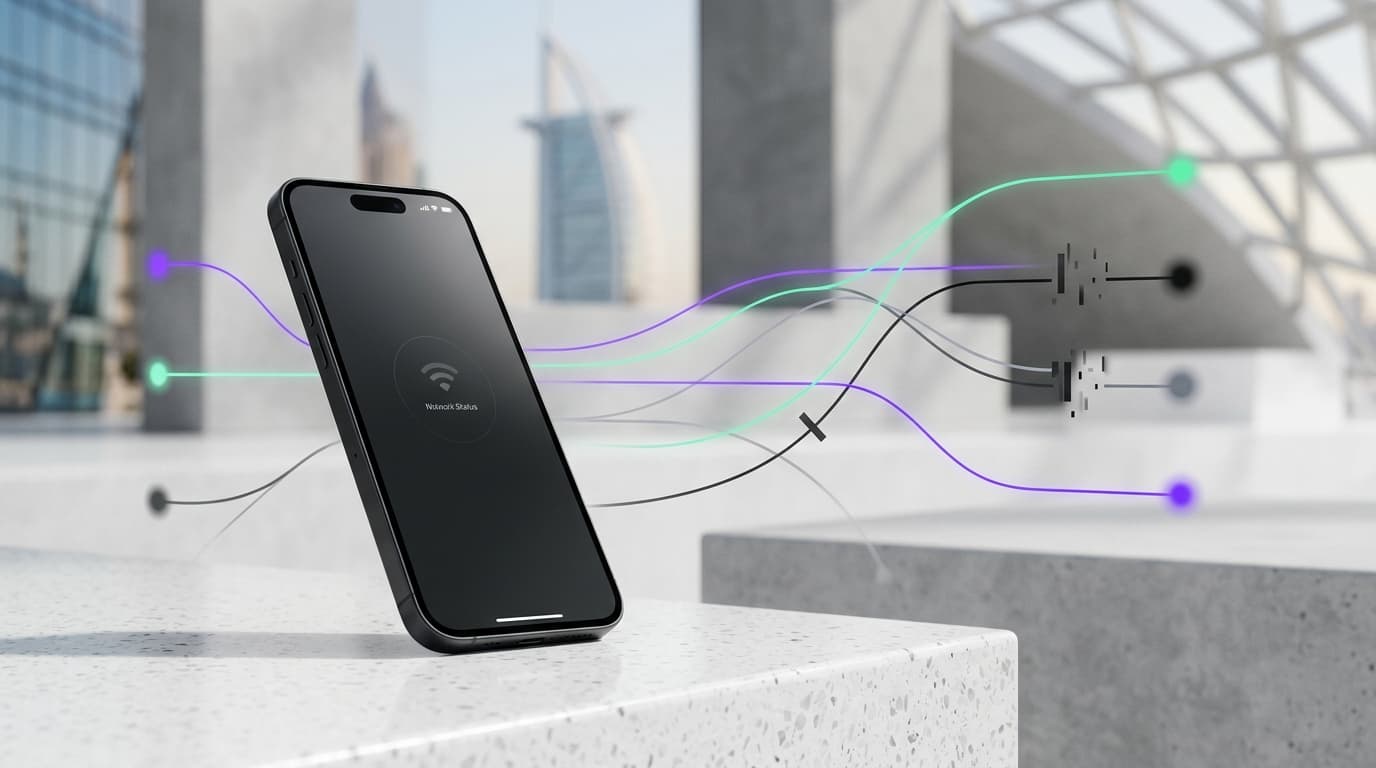
You've purchased a travel eSIM, installed it on your phone, and arrived at your destination.
But something isn't working.
Maybe the eSIM provider's website won't open. Perhaps you can't complete a purchase, your QR code won't install, or your phone shows signal but no internet connection.
In some destinations, these problems can be connected to local telecommunications regulations, restrictions on international eSIM providers, or limitations on how mobile services are sold and activated.
However, an important distinction is often overlooked:
A country restricting certain eSIM services does not necessarily mean all eSIM technology is banned.
In fact, an eSIM may be available through a local mobile operator even when some international travel eSIM providers face restrictions.
Understanding the difference can help you avoid unnecessary purchases, diagnose connection problems, and choose a practical alternative before or during your trip.
Some countries restrict how eSIM services can be purchased, activated, distributed, or accessed. These restrictions vary by country, mobile operator, provider, and sometimes the traveler's location.
An eSIM may fail for several different reasons:
These situations require different solutions.
For example, installing an eSIM before departure may help when a provider's website is inaccessible after arrival. However, it will not overcome a genuine prohibition on the service or create cellular coverage where none exists.
The safest approach is to check destination restrictions, purchase eligibility, device compatibility, and network coverage before traveling.
An eSIM-restricted country is a destination where certain eSIM-related services face legal, commercial, or technical limitations.
The restriction may affect international travel eSIM providers, local mobile operators, specific devices, or particular stages of the eSIM process.
It is important not to confuse these restrictions with a complete ban on eSIM technology.
A destination might allow local operators to issue eSIMs while restricting foreign providers from selling or activating travel eSIM plans.
Another destination might allow an already-installed travel eSIM to connect to a local network even though the provider's website cannot be accessed from within the country.
A third destination might have no relevant regulatory restriction at all, but a particular travel eSIM simply lacks a supported network there.
These are very different situations.
There is no single reason.
Restrictions can result from several factors, including telecommunications regulation, identity-verification requirements, licensing rules, network agreements, and national security policies.
Many countries require companies offering mobile services to comply with local telecommunications laws.
Depending on the jurisdiction, these rules may apply to mobile network operators, virtual network operators, resellers, or other connectivity providers.
An international eSIM provider may therefore be unable to offer certain services without the necessary commercial or regulatory arrangements.
This does not necessarily prevent local mobile operators from offering eSIM technology.
Some countries require mobile subscribers to register their identity before receiving cellular service.
Requirements may involve:
A travel eSIM provider may be unable to complete these requirements remotely.
In such cases, travelers may need to use an authorized local operator or another approved registration process.
Governments may regulate mobile communications to address security, fraud prevention, subscriber identification, and telecommunications oversight.
The specific rules and their application vary considerably.
A general security rationale should not be interpreted as evidence that a particular country has banned eSIMs.
A country may allow domestic operators to provide eSIM services while limiting certain international providers.
This can create a confusing experience for travelers.
A local eSIM may work normally, while a travel eSIM provider's website, checkout, or activation process is unavailable.
Not every eSIM limitation is regulatory.
Travel eSIM providers depend on commercial arrangements with network partners.
A provider may not offer a plan for a destination because it lacks an appropriate network agreement.
That is a coverage or commercial availability issue, not necessarily a government restriction.
Sometimes the country is not the problem.
Your phone may be carrier-locked, lack eSIM functionality, or have a regional hardware configuration that does not support the intended service.
A compatible phone must also support the necessary network technologies and frequency bands.
Understanding where the problem occurs is the first step toward solving it.
| Restriction type | What it means | Possible solution |
|---|---|---|
| Website restriction | Provider website cannot be accessed | Check lawful access options or contact support |
| Purchase restriction | Provider cannot sell plans in that location | Purchase before departure if permitted |
| Payment restriction | Checkout or payment is unavailable | Check accepted payment methods |
| Installation restriction | eSIM profile cannot be downloaded | Install before travel where permitted |
| Activation restriction | Profile cannot activate under local conditions | Check provider and destination rules |
| Network restriction | No supported cellular network is available | Use another authorized provider |
| Registration requirement | Identity verification is required | Complete the approved registration process |
| Device restriction | Phone does not support the eSIM | Check compatibility or use another device |
| Carrier lock | Phone cannot use another provider | Request an official carrier unlock |
| Data restriction | eSIM connects but data is unavailable | Check roaming, APN, plan and network settings |
A VPN, for example, might address some website-access problems, but it cannot resolve most of the other restrictions in this table.
Several destinations are frequently mentioned in discussions about travel eSIM restrictions.
However, these countries should not automatically be described as places where all eSIMs are banned.
Rules may apply to particular providers, purchasing methods, activation processes, or categories of mobile service.
The examples below are intended to help travelers identify what to verify, not to provide a permanent legal classification.
| Destination | What travelers should investigate | Recommended preparation |
|---|---|---|
| China | Local eSIM support, device restrictions, provider availability and internet access | Verify the exact device, plan and supported networks |
| Turkey | Access to international eSIM provider websites/apps and local sales or activation conditions | Check availability and install before arrival if permitted |
| United Arab Emirates | Provider website availability, service eligibility and supported local networks | Confirm purchase and activation requirements before departure |
| India | Provider availability, telecommunications rules and supported roaming networks | Verify the specific provider and plan |
| Egypt | Local registration requirements, device rules and travel eSIM availability | Check official requirements and network coverage |
| Saudi Arabia | Provider availability, registration conditions and network support | Verify the specific travel eSIM and local requirements |
| Other destinations | Local licensing, registration, network and device requirements | Check current official guidance |
These entries do not establish that every listed country currently bans travel eSIMs.
For example, Saudi Arabia and the UAE have established mobile services that include eSIM technology. Any restriction affecting a particular international travel eSIM provider should be assessed separately from local eSIM availability.
Likewise, China and Turkey involve different combinations of device, telecommunications, internet-access, and provider-specific considerations.
Because restrictions change, travelers should confirm current requirements through official telecommunications authorities, mobile operators, and their chosen eSIM provider.
China requires particular attention because device compatibility, local eSIM services, and international connectivity arrangements can differ.
Travelers should distinguish between:
These are not interchangeable.
An international travel eSIM may use a roaming arrangement that differs from a locally issued mobile subscription.
Before purchasing, confirm that your exact device supports the intended eSIM, the plan includes mainland China, and the provider identifies supported networks.
Also check whether any installation or activation steps must be completed before entering the country.
Do not assume that a phone supporting eSIM in another market will support the same configuration in mainland China.
Turkey is an important destination for travelers researching international eSIM restrictions.
Some international eSIM providers have reported access limitations affecting their websites or applications within Turkey.
However, website accessibility, the ability to purchase a plan, and the ability of an already-installed eSIM to connect to a supported mobile network are separate questions.
A traveler might encounter a website-access problem without necessarily losing an existing cellular data connection.
Before visiting Turkey:
If the eSIM is already installed, do not delete it simply because the website becomes inaccessible.
First determine whether the cellular connection itself is working.
The UAE supports eSIM technology through authorized mobile operators.
However, travelers should not assume that every international travel eSIM provider, website, application, or commercial service is equally available.
A provider's website being inaccessible does not automatically establish that all travel eSIM connectivity is prohibited.
Before traveling to the UAE, check:
Figabytes offers destination-specific travel eSIM information that travelers can check before purchasing.
Sometimes, yes.
For certain destinations, purchasing and installing a travel eSIM before departure can be more practical than waiting until arrival.
This is particularly relevant when a provider's website or application may be inaccessible inside the destination.
A typical preparation process is:
However, buying in advance does not override local laws, service restrictions, or network limitations.
An eSIM purchased outside a country is not automatically authorized to operate inside it.
A VPN may help with certain website-access problems, but it is not a universal eSIM solution.
A VPN creates an encrypted connection between your device and a VPN server.
Depending on the network and local rules, it may affect how websites are accessed.
However, a VPN does not change the underlying cellular capabilities of your phone or the legal conditions attached to mobile service.
Where lawful and permitted, a VPN may help a traveler access an otherwise unavailable website or account portal when the restriction is limited to internet access.
It may also provide privacy protection when using public Wi-Fi.
A VPN cannot:
A VPN also requires an existing internet connection.
If your eSIM has no cellular connectivity, simply enabling a VPN will not create one.
Check local laws and the provider's terms.
VPN availability and permitted uses vary by jurisdiction.
If a provider website is inaccessible, an official support channel or an authorized alternative may be more appropriate than attempting to circumvent a restriction.
Depending on the provider's terms, another person may be able to purchase a travel eSIM for you.
For example, a family member or friend outside the destination might purchase a plan and share its installation information.
However, this is not universally supported.
Important questions include:
A QR code is not necessarily a reusable installation credential.
Some eSIM profiles can only be installed once.
Sharing a QR code after it has already been used may therefore fail.
Figabytes supports reinstallation for eligible eSIMs.
An eligible eSIM with Reinstall status may be installed on another compatible device, including a device belonging to a family member or travel companion.
However:
This feature should not be confused with unrestricted account sharing or a way to bypass destination regulations.
Always follow the provider's instructions and applicable local requirements.
Sometimes.
A travel eSIM can be purchased in one country and used in another when the provider permits the purchase and the plan supports the destination.
For example, travelers frequently prepare destination-specific mobile data before departure.
The important distinction is between the location where the eSIM is purchased and the networks where it is authorized to operate.
Purchasing an eSIM abroad does not automatically guarantee that it will work in every country.
Check the plan's coverage list and activation conditions.
When an eSIM fails, the most effective approach is to identify the exact stage where the problem occurs.
Avoid immediately deleting the eSIM or purchasing another plan.
Start with the following diagnostic process.
Ask yourself:
The answers help narrow down the cause.
Check whether the plan includes the country you're visiting.
If you're using a regional or global eSIM, don't assume every country in the region is included.
A global eSIM does not necessarily provide worldwide coverage.
Review the exact destination list.
Confirm that your phone:
On many phones, dialing *#06# displays device identifiers.
An EID can help indicate eSIM capability, although it does not independently confirm that every provider or plan will work.
Open your phone's SIM settings.
If the eSIM is not visible, installation may not have completed.
If it is visible, check whether the line is enabled.
Do not repeatedly scan a QR code or delete the profile without checking whether the installation credentials can be reused.
For a Figabytes travel eSIM, a typical setup is:
These settings are especially important on Dual SIM phones.
Look at the cellular signal indicator.
If the phone shows no signal, the problem may involve network registration, coverage, device compatibility, or the plan.
If the phone shows signal but no internet, investigate mobile data settings, APN configuration, plan status, and network access.
Confirm:
An expired or exhausted plan cannot be repaired by changing phone settings.
If mobile data is connected but applications are not working, temporarily disable the VPN where safe and permitted.
A VPN configuration can sometimes interfere with connectivity.
Testing without it can help determine whether the problem is related to the VPN or the underlying cellular connection.
If the problem remains unresolved, collect the relevant details before contacting your provider.
This can significantly reduce troubleshooting time.
| Problem | Likely causes | Recommended checks |
|---|---|---|
| Website unavailable | Network or website restriction, outage | Check official support channels |
| Purchase fails | Payment or sales restriction | Confirm eligibility and payment support |
| QR code invalid | Used, expired or incorrect code | Verify installation credentials |
| eSIM cannot be added | Compatibility, lock or provisioning issue | Check device and carrier status |
| eSIM installed but inactive | Activation conditions not met | Review plan activation rules |
| No signal | Coverage or registration problem | Check supported networks |
| Signal but no internet | Roaming, APN, data selection | Review mobile settings |
| Connected to wrong SIM | Dual SIM configuration | Select travel eSIM for data |
| 4G/5G visible but apps fail | DNS, VPN, APN or network issue | Test connection and settings |
| Connection keeps dropping | Weak signal or congestion | Try another supported network |
| Slow internet | Congestion, plan policy or weak signal | Check network and plan conditions |
| Data stopped suddenly | Data exhausted or plan expired | Check remaining balance |
| Worked before, now fails | Network, validity or device changes | Review recent changes |
| Can't reinstall | Profile or provider restriction | Check reinstallation eligibility |
| Hotspot not working | Device, plan or APN restriction | Check tethering support |
If the eSIM appears in your phone settings but shows no service:
If none of the supported networks can be registered, contact the provider.
Do not assume the country has blocked eSIM technology.
The problem may be limited to the plan or network arrangement.
This is one of the most common travel eSIM problems.
Your phone may show LTE, 4G, or 5G while websites fail to load.
Check the following:
Try opening a simple website after each change.
Avoid changing multiple settings simultaneously because doing so makes it harder to identify the cause.
If your QR code fails:
Do not share your installation QR code publicly.
Treat it as a sensitive activation credential.
An eSIM does not provide cellular data simply because the phone has Wi-Fi access.
Wi-Fi may allow installation or access to the provider's account, but cellular connectivity still requires:
To test the actual cellular connection, temporarily disable Wi-Fi after confirming the travel eSIM is enabled.
Then try loading a website.
If the connection fails, investigate the cellular configuration rather than assuming the provider's website is blocked.
Regional and global travel eSIMs may support multiple destinations, but coverage is not universal.
If your eSIM worked in one country and stops after crossing a border:
Also check whether your plan has destination-specific limitations.
Possible explanations include:
For eligible Figabytes reusable eSIMs, check whether the profile has Reinstall status before attempting to use it on another compatible device.
Do not assume that copying installation details from one phone to another will work.
A VPN connection indicator does not prove that cellular service is working.
If your eSIM has no network connection, the VPN cannot create one.
If cellular data is available but certain websites fail:
If the underlying cellular connection is unavailable, focus on network registration and mobile data settings first.
When contacting support, provide enough information to identify the issue without exposing sensitive account credentials.
Useful diagnostic details include:
| Information | Why it matters |
|---|---|
| Destination country | Confirms geographic coverage |
| City or general area | Helps investigate network availability |
| Device brand and model | Checks compatibility |
| Operating system version | Identifies software-related issues |
| Carrier-lock status | Checks provider restrictions |
| eSIM plan | Identifies purchased service |
| Installation date | Helps establish the timeline |
| First connection date | Helps assess activation |
| Current plan status | Confirms validity |
| Remaining data | Checks exhaustion |
| Network name | Identifies connected operator |
| Signal status | Distinguishes registration from data problems |
| Data Roaming setting | Checks connectivity configuration |
| Selected mobile data SIM | Identifies Dual SIM issues |
| APN configuration | Helps diagnose data access |
| VPN status | Identifies possible interference |
| Error message | Helps identify failure type |
Do not send passwords, payment-card details, one-time verification codes, or full eSIM activation credentials through unsecured channels.
Only provide device identifiers through an official support process when necessary.
For Figabytes, understanding where users experience restrictions can help distinguish actual network problems from website, checkout, or installation limitations.
A useful internal diagnostic framework separates the customer journey into five stages.
Questions:
Useful measurements:
Questions:
Useful measurements:
Questions:
Useful measurements:
Questions:
Useful measurements:
Questions:
Useful measurements:
Not all these events can be measured through website analytics alone.
For example, cellular network registration and actual mobile data usage may require information from connectivity partners or provisioning systems.
A website analytics platform cannot independently confirm that an eSIM has registered with a mobile network.
For Figabytes, a useful ongoing monitoring framework would include:
| Metric | Purpose |
|---|---|
| Destination page traffic | Identify demand |
| Checkout conversion by country | Detect commercial friction |
| Payment failures by country | Identify payment issues |
| Installation success rate | Detect provisioning problems |
| Activation success rate | Identify network or activation issues |
| Time to first successful connection | Measure onboarding |
| Support tickets by destination | Identify recurring problems |
| Network failure categories | Distinguish technical causes |
| Refund requests by destination | Identify customer impact |
| Repeat purchases | Measure longer-term experience |
These metrics should be interpreted carefully.
A sudden drop in conversions from one country does not automatically prove that the government has blocked an eSIM service.
It could also reflect a payment outage, tracking issue, website problem, pricing change, or reduced demand.
The best alternative depends on the type of restriction.
If an international travel eSIM is unavailable, an authorized local operator may offer a suitable mobile plan.
You may need to complete local registration or identity verification.
Your regular carrier may offer roaming packages for the destination.
Compare prices and coverage before enabling roaming.
Wi-Fi can provide temporary internet access when cellular service is unavailable.
However, availability, speed, and security can vary.
Avoid sensitive transactions on untrusted networks unless you have appropriate security protections.
If one destination-specific plan is unavailable, another eligible regional or global plan may support the destination.
Always check the exact coverage list.
If an eSIM is already installed but not working, contact support before purchasing another plan.
The issue may be related to settings rather than availability.
A little preparation can prevent many avoidable problems.
Before purchasing, visit Figabytes and search for your destination.
Check:
Do not assume that a destination is supported simply because it appears geographically within a regional plan's name.
Coverage must be confirmed against the actual plan.
There is no reliable permanent list covering every type of eSIM restriction. Countries may regulate local eSIM issuance, international travel eSIM sales, activation, registration, or network access differently. Verify current rules for the specific destination and provider.
Certain eSIM services may be restricted or subject to licensing and registration requirements. This does not necessarily mean all eSIM technology is illegal in that country.
Possibly. It depends on the specific restriction, provider, plan, device, and supported networks. An already-installed eSIM may work in some situations where the provider's website is inaccessible, but this is not guaranteed.
Sometimes. Purchasing and installing before departure may be useful when permitted, particularly if provider access is limited after arrival. It does not override local restrictions.
A VPN may help with certain website-access issues where lawful, but it cannot bypass cellular network requirements, carrier locks, registration rules, or genuine service prohibitions.
Some providers allow gifting or purchasing for another person. Check the provider's terms, installation rules, account ownership requirements, and local regulations.
Possibly, if the provider permits it and the installation credentials have not already been used. Some QR codes are single-use.
That depends on local rules, website accessibility, device compatibility, and the provider's installation process. Installing before departure may be preferable when permitted.
Common causes include incorrect mobile data settings, disabled Data Roaming, unsupported networks, expired plans, exhausted data, APN issues, or activation restrictions.
Check whether the travel eSIM is selected for mobile data, Data Roaming is enabled where required, the APN is correct, and the plan remains active.
No. A VPN cannot add a destination to an eSIM's coverage or establish cellular service where the provider has no supported network.
Often, yes. An authorized local operator may offer physical SIM or eSIM services, subject to registration and eligibility requirements.
No. Global eSIM plans cover a defined list of destinations. Always check the actual coverage list.
Availability depends on the destination, plan, applicable restrictions, and supported networks. Check the current Figabytes destination information before purchasing.
Not immediately. Deleting an eSIM can affect reinstallation eligibility. Check your provider's instructions and contact support first.
Some eSIMs support transfer or reinstallation. Eligible Figabytes eSIMs may support reinstallation on another compatible device, subject to their status and conditions.
You may still have cellular connectivity through a supported network even when the website is inaccessible. Avoid deleting a working eSIM and save important account information before traveling.
Start by identifying whether the issue affects website access, purchasing, installation, network registration, or data usage. Then compare the symptoms against official destination rules and the provider's technical guidance.
Not every eSIM problem in another country is caused by a government restriction.
A provider's website may be inaccessible while an installed eSIM still works.
A local operator may support eSIM even when some international providers face limitations.
And a travel eSIM may fail because of an incorrect setting rather than a regulatory restriction.
The most useful approach is to identify exactly where the problem occurs.
Check the destination, provider, device, plan, installation status, network registration, and mobile data configuration.
If you're traveling to a destination with known restrictions, prepare your connectivity before departure when permitted and keep a backup option available.
And if your eSIM stops working, diagnose the issue before deleting the profile or purchasing another plan.
The following resources provide additional discussion of travel eSIM restrictions and troubleshooting. Third-party country lists should be verified against current official telecommunications guidance before relying on them.
Editorial review: October 18, 2026
Country-specific restrictions should be checked again before publication or travel.

