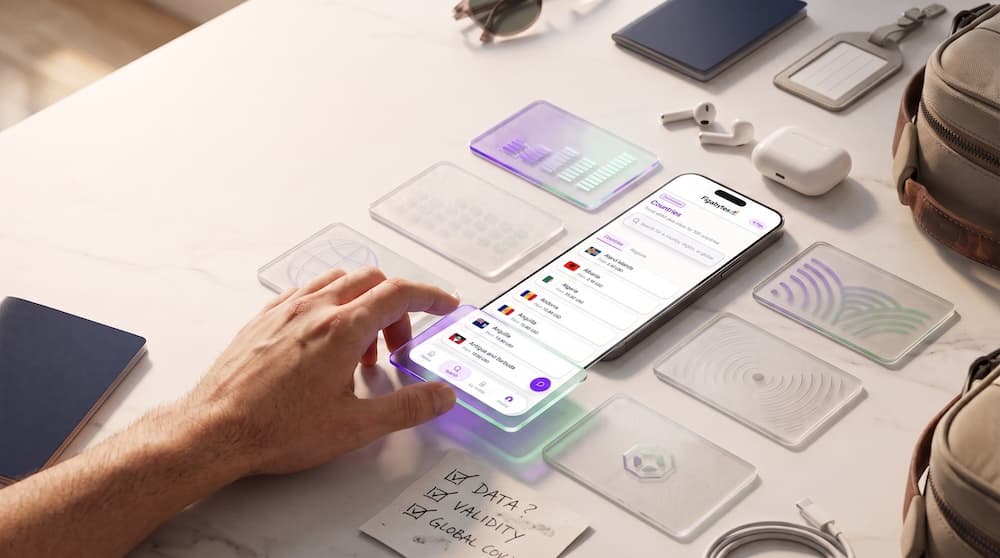
Search for the best eSIM for travel and you will find hundreds of plans, providers, comparison websites, and recommendations.
That creates a new problem for travelers.
How do you actually compare eSIM plans and know which one is right for your trip?
Most travel eSIMs use the same basic technology. The meaningful differences are usually found in the plan itself, including coverage, data allowance, validity, price, supported networks, activation process, and what happens if you need help.
Figabytes is designed around making those decisions simpler.
Do not choose an eSIM based only on the provider name.
Before buying, compare these factors:
The best eSIM is the one that matches how and where you actually travel.
The first question should be simple:
Where are you going?
If you are visiting one country, a country-specific eSIM may be enough.
If your itinerary includes several countries, a regional plan can be more convenient.
For example, someone traveling through several European countries may prefer one regional eSIM instead of purchasing a separate plan every time they cross a border.
Figabytes offers destination and regional options so travelers can choose based on their actual itinerary.
A cheap-looking eSIM is not automatically the best value.
Imagine two plans:
| Plan | Data | Validity | Price |
|---|---|---|---|
| Plan A | 1 GB | 7 days | $4 |
| Plan B | 10 GB | 30 days | $18 |
Plan A has the lower purchase price.
But Plan B may provide significantly better value for someone staying longer or using more mobile data.
This is why travelers should consider both the total price and what they receive for it.
Price per GB can help you compare plans with different data allowances.
For example:
| Data | Price | Approx. price per GB |
|---|---|---|
| 1 GB | $5 | $5.00 |
| 5 GB | $14 | $2.80 |
| 10 GB | $22 | $2.20 |
Larger packages can sometimes offer better value, but buying more data than you will actually use is not necessarily a saving.
Choose based on your expected usage.
Your data needs depend heavily on what you do while traveling.
Mostly:
A smaller package may be enough.
Including:
Consider a medium-sized package.
Including:
A larger data package or unlimited-style option may make more sense.
Data allowance is only half of the comparison.
You also need to know how long you can use it.
A 20 GB plan valid for 7 days is very different from a 20 GB plan valid for 30 days.
Match the validity period to your trip.
For a four-day city break, a short-validity plan could be ideal.
For a month-long trip, longer validity becomes much more important.
This is another important comparison.
Usually makes sense when:
Can make more sense when:
Instead of installing a new eSIM for every destination, one compatible regional plan can simplify the journey.
Two eSIMs covering the same country are not necessarily identical.
Travel eSIM services connect through mobile network partners.
Before purchasing, check the plan information available for your destination and consider:
Coverage matters more than simply choosing the cheapest plan.
Travelers increasingly search specifically for 5G eSIM plans.
However, seeing 5G advertised does not mean you will receive 5G everywhere.
Your actual connection can depend on:
In areas without suitable 5G coverage, your device may connect using 4G or LTE instead.
Travel eSIM setup should not become another travel problem.
A good installation experience should provide clear instructions for getting the eSIM onto your device.
With Figabytes, installation information is provided after purchase so you can prepare your eSIM before traveling.
Depending on the plan and device, installation may involve methods such as a QR code or supported digital installation flow.
This detail is easy to overlook.
Buying an eSIM, installing an eSIM, and activating its data plan are not always the same thing.
Some travel eSIM plans activate when they first connect to a supported destination network.
Other plans may have different activation conditions.
Always check the activation information associated with the plan before installing or enabling it.
This is especially important if you are buying your eSIM weeks before your trip.
If you work while traveling, hotspot support can be important.
You may want to share your mobile connection with:
Check whether tethering or hotspot use is supported by the specific plan you are considering.
This is particularly important for remote workers and business travelers.
Running out of data halfway through a trip is frustrating.
When comparing eSIM providers, consider what happens when your package runs low.
Ask:
The cheapest initial plan may not always provide the easiest experience later.
Travel connectivity problems rarely happen at convenient times.
You might need help when:
This is why customer support should be part of any serious eSIM comparison.
Figabytes focuses on keeping the travel connectivity experience simple while providing support when travelers need assistance.
Even the best travel eSIM will not help if your device cannot use it.
Before purchasing, confirm that your phone:
Many recent iPhone, Samsung Galaxy, Google Pixel, and other devices support eSIM, but availability can differ by model and region.
Always check the exact model.
Not necessarily.
An eSIM is a mobile network profile installed directly on your device.
Figabytes does not require a dedicated mobile app to use your travel data.
You can purchase your plan online, follow the installation instructions, and manage your travel connectivity from your compatible device.
For travelers who prefer fewer apps, this can keep the process simple.
Figabytes focuses on the factors travelers actually care about when comparing eSIMs:
The goal is not to make eSIM technology more complicated.
It is to make getting connected abroad easier.
Before purchasing any travel eSIM, compare:
| Question | What to check |
|---|---|
| Where am I traveling? | Country or regional coverage |
| How long is my trip? | Plan validity |
| How much data do I need? | GB allowance |
| What am I paying? | Total price |
| Is it good value? | Price per GB |
| Which networks are available? | Network information |
| Is 5G available? | Plan and destination support |
| Can I use hotspot? | Tethering policy |
| When does it activate? | Activation conditions |
| Can I add more data? | Top-up availability |
| Is my phone compatible? | Device and carrier lock |
| What happens if something goes wrong? | Support options |
There is no single eSIM plan that is best for every traveler.
Someone spending three days in one country has completely different requirements from someone traveling through six countries for a month.
The better question is:
Which eSIM gives me the right combination of coverage, data, validity, price, and convenience for my trip?
That is the comparison that matters.
Figabytes is designed for travelers looking for a straightforward way to purchase and use mobile data abroad.
It can be particularly useful if you want:
As with any eSIM, check the specific destination plan before purchasing to make sure its coverage, validity, and data allowance match your trip.
For many modern travelers, eSIM removes several steps from getting connected.
| Physical travel SIM | Travel eSIM |
|---|---|
| Requires physical card | Digital profile |
| May require store visit | Can be purchased online |
| SIM tray required | No card swapping |
| Home SIM may need removal | Can coexist on supported devices |
| Physical card can be misplaced | Stored digitally |
| Setup often happens after arrival | Can often be prepared beforehand |
Physical SIM cards still have their uses, particularly for devices without eSIM support.
But for compatible smartphones, eSIM can make international connectivity considerably more convenient.
Traditional carrier roaming is convenient because your existing SIM continues working abroad.
The drawback is that international roaming prices and allowances vary significantly between carriers.
Travel eSIMs provide another option.
Instead of relying on your home carrier for mobile data abroad, you can use a dedicated travel data plan while potentially keeping your main number available on compatible Dual SIM devices.
Before traveling, compare your carrier's roaming offer with the available Figabytes plan for your destination.
The growing number of eSIM providers is good news for travelers, but it also makes choosing a plan more complicated.
Do not choose based on a brand name or the cheapest advertised price alone.
Compare the things that affect your actual trip:
coverage, data, validity, networks, activation, hotspot support, top-ups, compatibility, support, and total cost.
Once those factors are clear, finding the right travel eSIM becomes much easier.
Choose your destination, compare the available data options, and prepare your travel connectivity before departure.

