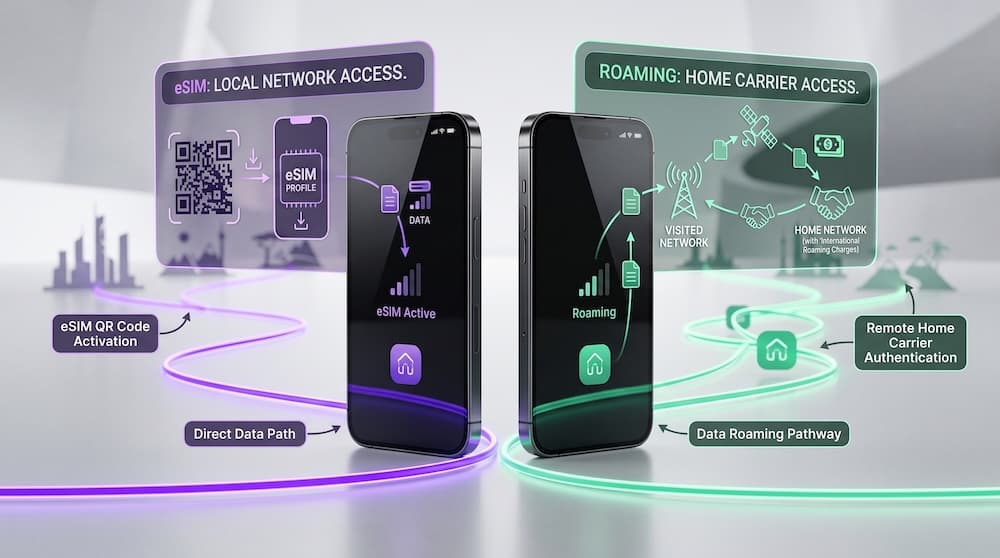
When traveling abroad, you usually have two simple ways to keep using mobile data: activate international roaming with your existing carrier or install a travel eSIM.
Both can keep you connected.
But they work differently, charge differently and suit different types of travelers.
International roaming keeps you on your normal mobile plan while abroad. A travel eSIM gives you a separate digital data plan for your destination.
This guide explains the difference, where each option makes sense and what to check before choosing.
A travel eSIM can be a better option if you mainly need mobile data abroad and want to know the cost before your trip.
International roaming can be more convenient if you want to continue using your existing carrier with minimal setup, especially when calls and SMS on your normal number are important.
For many travelers, the most practical setup is to keep the primary SIM active for their normal number while using a travel eSIM for mobile data.
The better option depends on your carrier, destination, trip length and data usage.
| Feature | Travel eSIM | International roaming |
|---|---|---|
| Uses your home mobile plan | No | Yes |
| Separate travel data package | Yes | Usually no |
| Know data price before travel | Usually | Depends on carrier |
| Keep primary SIM installed | Yes on compatible devices | Yes |
| Keep existing number | Yes, primary SIM can remain active | Yes |
| Calls and SMS | Often data-only | Usually supported through home number |
| Multi-country plans | Available | Depends on roaming package |
| Installation required | Yes | Usually no |
| Physical SIM swap | No | No |
| Works immediately after setup | Usually | Usually |
| Risk of unexpected roaming data | Low if configured correctly | Depends on carrier and plan |
| Requires eSIM-compatible phone | Yes | No |
International roaming allows your existing mobile carrier to connect your phone to another mobile network while you are outside your home country.
Your phone still uses your normal:
Your home carrier works with partner networks in the destination.
Depending on your plan, you may be charged through:
There is no universal roaming price.
The cost depends entirely on your home carrier, destination and subscription.
A travel eSIM is a digital SIM profile that gives your phone access to mobile connectivity in another destination.
Instead of replacing your physical SIM, the eSIM is downloaded to a compatible phone.
Travelers can purchase:
Figabytes, for example, currently offers travel eSIM plans covering 200+ destinations. oai_citation:0‡Figabytes
A regional or global plan can also provide connectivity across several countries without changing eSIMs at every border.
The main difference is who provides your travel data.
With international roaming:
your home mobile carrier remains responsible for the connection and billing.
With a travel eSIM:
a separate travel connectivity provider supplies the data package.
Your normal SIM can remain installed and active.
This separation can give travelers more control over mobile data costs while still allowing them to keep their normal number.
It can be, but not always.
A travel eSIM normally has a predefined package price.
For example, you might purchase:
You know the package cost before using the data.
Roaming pricing varies much more widely.
One mobile operator may include international roaming in your existing plan.
Another may charge a daily fee.
Another may sell a separate travel bundle.
Because of this, there is no honest way to say that an eSIM is always cheaper than roaming.
The correct comparison is:
total eSIM price for your trip
versus
total roaming charge from your carrier for the same trip.
Roaming costs can accumulate when carriers charge by:
Daily roaming passes can also become expensive on longer trips.
For example, a daily charge that seems reasonable for a two-day business trip can become much more significant over two or three weeks.
The exact cost depends on the carrier, so always check your roaming tariff before leaving.
Travel eSIM providers purchase connectivity through international network partnerships and sell prepaid packages directly to travelers.
Instead of paying your home carrier's roaming tariff, you purchase a dedicated data allowance.
That can make costs easier to predict.
For example, Figabytes currently offers country, regional and global packages with predefined data allowances and validity periods. oai_citation:1‡Figabytes
The amount you actually save depends on what your home carrier would otherwise charge.
International roaming can make sense when convenience matters more than price comparison.
It may be suitable when:
Roaming should not automatically be treated as a bad option.
Some modern mobile plans include generous international allowances.
A travel eSIM may be more suitable when:
The ability to shop for connectivity separately from your home carrier gives travelers more flexibility.
Yes, on compatible dual-SIM phones.
This can be one of the most practical ways to travel.
You can configure:
Primary SIM: for your existing number, incoming SMS and calls
Travel eSIM: for mobile data
Your phone then uses the eSIM for internet access while your normal SIM remains available.
However, you need to configure the device carefully so the primary SIM does not accidentally use roaming data.
For many international travelers, this is the most useful setup.
Keep your home SIM active.
Then select the travel eSIM as the mobile-data line.
This allows you to keep access to:
while using the travel eSIM for internet access.
Make sure data roaming is disabled on the home SIM if you want to avoid carrier data charges.
Yes.
Adding a travel eSIM does not normally replace your existing SIM or phone number.
On a compatible dual-SIM phone, your primary SIM can remain active.
You can continue receiving communication on your existing number while using the travel eSIM for data.
Whether incoming calls or SMS generate roaming charges depends on your home carrier.
Yes.
WhatsApp is linked to your registered phone number, not to whichever SIM is currently providing mobile data.
Installing a travel eSIM does not normally:
Your eSIM simply provides the internet connection.
Many travel eSIM plans are data-only.
That means they provide internet access but may not include:
You can still use internet-based calling and messaging services where permitted.
If traditional calls or SMS are important, check the specific eSIM before purchasing.
International roaming often has an advantage here because your normal mobile number remains directly connected through your home carrier.
Keeping your primary SIM active can be useful for receiving SMS verification codes.
A travel eSIM can then handle mobile data.
However, check your carrier's roaming policy because receiving SMS abroad may be free with some carriers and chargeable with others.
Also remember that certain banks and services may use app-based verification instead.
For a very short trip, either option can make sense.
If your carrier offers an inexpensive daily roaming package, activating roaming for two days may be the simplest approach.
If the destination has a low-cost eSIM plan, purchasing a small data package can also be economical.
Compare the total price rather than assuming one method will always win.
A travel eSIM becomes more attractive as the trip gets longer, particularly when your carrier charges a roaming fee each day.
For a two-week trip, compare:
14 days of carrier roaming charges
against
one travel eSIM covering the full period.
Also compare the included amount of data.
A low-cost roaming pass with very little data may not be equivalent to a 10 GB travel eSIM.
Travel eSIMs can be particularly useful for longer travel because you can choose:
Some providers also support top-ups or reusable eSIMs.
Figabytes plans generally have defined validity periods, and validity commonly begins when the eSIM first connects to a supported local network or according to the plan's activation rules. oai_citation:2‡Figabytes
A regional eSIM can be particularly useful for multi-country travel.
For example, rather than activating roaming separately in:
France
Spain
Italy
Germany
and Switzerland,
you can purchase a regional Europe eSIM that covers several destinations.
Figabytes currently offers multiple regional plans as well as a global eSIM covering 105 countries across 199 networks. oai_citation:3‡Figabytes
Always check that every country on your itinerary is included.
No.
They may feel similar because both can provide connectivity across several countries, but the billing relationship is different.
A global eSIM is a prepaid travel connectivity product.
International roaming uses your existing home carrier.
With a global eSIM, you generally purchase data in advance.
With roaming, charges are determined by your existing carrier agreement.
It can be.
If data roaming is enabled on your normal SIM, your phone may connect to a foreign partner network after you land.
Whether you are charged depends on your carrier and roaming plan.
This is why travelers who intend to use an eSIM for data should carefully check their cellular settings.
Yes.
Having a travel eSIM installed does not automatically prevent your primary SIM from using roaming data.
Potential causes include:
Your phone settings matter.
A typical configuration is:
Figabytes recommends selecting the Figabytes line for cellular data while keeping the primary line for voice and SMS. oai_citation:4‡Figabytes
Not necessarily.
Installation and activation are different.
With many travel eSIMs, you can install the profile before your trip without immediately starting the data package.
For Figabytes, most packages begin when the eSIM first connects to a supported local network or when manually activated according to the specific plan. oai_citation:5‡Figabytes
Always check your plan's activation conditions before installing it.
Usually, yes.
Your phone needs internet access to download the eSIM profile.
Installing while you are still at home or at your hotel can make setup easier because you have reliable Wi-Fi.
Once the eSIM is installed and connected to a supported network, it can provide mobile data.
Usually, yes.
An eSIM-compatible phone may still be locked to a particular mobile carrier.
A carrier-locked device can prevent you from adding a travel eSIM from another provider.
Check both:
before purchasing.
No.
eSIM support depends on:
Recent iPhones, Samsung Galaxy models, Google Pixel phones and selected devices from other manufacturers support eSIM.
Always check your exact model before buying.
Modern compatible iPhones can make the eSIM-and-primary-SIM combination particularly convenient.
You can normally choose separate lines for:
This allows your normal number to remain active while using a travel eSIM for data.
The exact menu names differ by iOS version.
Compatible Samsung Galaxy, Google Pixel and other Android phones can also use travel eSIMs.
The basic principle is similar:
keep the home SIM active
select the eSIM for mobile data
disable unwanted roaming on the home line.
Menu names vary by manufacturer.
Travel eSIMs can often support hotspot or tethering, depending on the provider and plan.
This can be useful when connecting:
Roaming plans may also permit hotspot use.
For both options, check:
Heavy laptop use can quickly consume a fixed data allowance.
Both travel eSIMs and international roaming can support 5G.
Actual 5G access depends on:
Neither eSIM nor roaming technology itself guarantees 5G.
A travel eSIM can be attractive for remote workers because you can compare large-data or unlimited packages before leaving.
Regional plans can also simplify working across multiple countries.
However, remote workers should check:
A roaming package provided by an employer may still be more convenient.
International roaming often has one advantage for business travelers: simplicity.
Your existing number continues working with minimal setup.
This can be important if:
A travel eSIM may still make sense for high data use or longer business trips.
Travel eSIMs can provide more control because each traveler can have an individual data package.
This allows parents or trip organizers to decide how much data each person receives.
Some providers also allow eligible eSIMs to be purchased or managed for another traveler.
If the family simply wants all existing phone lines to keep working, a carrier family roaming package may be easier.
Compare the total cost for the entire group.
Neither standard international roaming nor a normal travel eSIM should be assumed to cover maritime networks.
Cruise ships can connect phones to specialized satellite or maritime networks when offshore.
These services can be expensive and may not be included in:
Use caution around maritime network connections.
When the ship is close to land, a travel eSIM may connect to a supported terrestrial mobile network.
For short layovers, roaming can sometimes be simpler if your carrier already includes the destination.
A regional or global eSIM can be more useful if you have several layovers in different countries.
You avoid purchasing individual country plans for each stop.
Imagine a 10-day trip.
Your home carrier charges $10 per day for roaming.
Total roaming cost:
$100
If a travel eSIM providing enough data for the same 10 days costs $25, the eSIM would cost $75 less.
But if your mobile plan already includes international roaming at no additional charge, the roaming option could cost nothing extra.
This is why the correct answer always depends on your actual carrier.
Use this checklist:
| Question | Why it matters |
|---|---|
| What does my carrier charge? | Determines roaming cost |
| How many days am I traveling? | Daily roaming fees accumulate |
| How much data do I need? | Determines eSIM package size |
| Am I visiting several countries? | Regional eSIM may be useful |
| Do I need my normal number? | Primary SIM can remain active |
| Do I need traditional calls? | Roaming may be simpler |
| Does my phone support eSIM? | Required for travel eSIM |
| Is my phone unlocked? | Travel eSIM may require it |
| Do I need hotspot? | Plan restrictions differ |
| Is roaming already included? | May eliminate need for another plan |
Choose international roaming when:
Consider a travel eSIM when:
Yes.
Figabytes provides prepaid travel eSIM plans that can be used as an alternative data connection while traveling.
Current options include country, regional and global packages across 200+ destinations. oai_citation:6‡Figabytes
A Figabytes eSIM can be selected as the mobile-data line while the primary SIM remains available for voice and SMS on compatible phones. oai_citation:7‡Figabytes
Whether this costs less than roaming depends on your home carrier's rates.
It can be. Travel eSIMs normally offer prepaid data packages, while roaming prices depend on your home carrier. Compare the total eSIM cost with your carrier's total roaming charge for the same destination and trip length.
Neither is universally better. An eSIM can offer more control over data costs, while roaming can be more convenient and keep traditional calls and SMS working through your existing carrier.
Yes. On an eSIM-compatible unlocked phone, you can use a travel eSIM as your mobile-data connection rather than using your home SIM's roaming data.
Usually, you should disable data roaming on your home SIM if you want to avoid accidental roaming data charges. The travel eSIM may itself require Data Roaming to be enabled, depending on the provider.
Yes, on compatible dual-SIM devices. Keep your primary SIM active for your number while selecting the travel eSIM for cellular data.
Yes, if your primary SIM remains active and your carrier supports roaming SMS. Charges depend on your carrier.
Yes. Your existing WhatsApp account continues working using the data provided by the travel eSIM.
A data-only travel eSIM normally does not change your existing number. Your original SIM and number can remain active.
Yes. Regional and global eSIMs can provide connectivity across multiple supported countries. Check the exact coverage list before buying.
No. An eSIM and international roaming are separate things. If your primary SIM uses roaming services, your home carrier can still charge you even when a travel eSIM is installed.
Yes. If your primary SIM remains selected for cellular data or automatic data switching is enabled, your phone may use your carrier's roaming connection. Check your settings after arrival.
It can be particularly useful for longer trips because travelers can purchase 30-day, regional or global packages instead of paying repeated daily roaming fees.
It can be if your carrier includes roaming, offers an inexpensive travel package or you need maximum convenience and traditional calls through your normal number.
Travel eSIMs and international roaming solve the same basic problem but in different ways.
Roaming prioritizes continuity with your existing carrier.
Travel eSIMs give you a separate prepaid data connection and more freedom to compare plans.
For many travelers, the best setup is not necessarily one or the other.
It can be both:
your existing SIM for your normal number
plus
a travel eSIM for mobile data.
Before traveling, compare your carrier's actual roaming cost against a travel eSIM offering the data and validity you need.
Explore Figabytes travel eSIM plans
Information was checked using current Figabytes destination and Help Center documentation in August 2026.
Figabytes:
Roaming costs vary by mobile carrier, destination and subscription. Travelers should check their own carrier's current roaming tariff before comparing it with a travel eSIM.
Last checked: August 31, 2026.

