Moving abroad to study creates a different connectivity problem from taking a short holiday.
You may need mobile data immediately after landing for:
You may also be staying for several months rather than several days.
That means the best eSIM for studying abroad is not necessarily the cheapest short-term travel plan.
Students should consider data allowance, validity, local phone-number requirements, hotspot, top-ups, multi-country travel and whether they eventually need a local SIM or contract.
For many international students, an eSIM is most useful as immediate connectivity before departure and during the first days or weeks abroad.
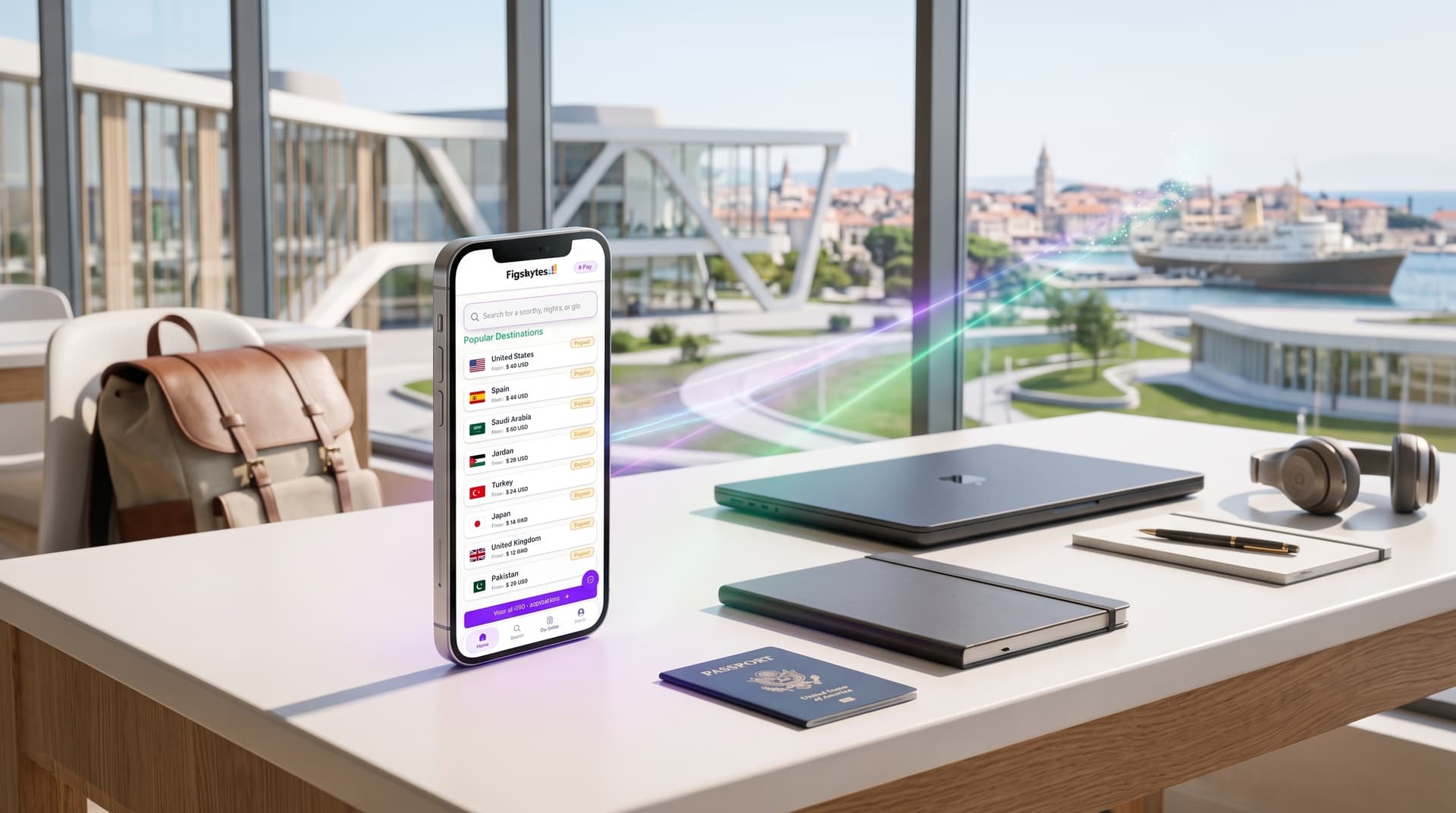
Figabytes may suit students who want prepaid country or regional data without downloading a dedicated app.
Ubigi can be worth considering for longer stays because selected destinations have monthly and annual plans on a reusable eSIM.
Roamless can work well for students who frequently travel between countries because purchased FLEX credits do not expire and can be used across 200+ destinations.
Saily offers an app-centered travel service and currently also offers an optional US phone number, which can be relevant for students who specifically need a US number.
For a full academic year, compare travel eSIM costs with local student mobile plans before deciding to use a travel eSIM permanently.
| Provider | Country plans | Regional / global | Long-term options | App required | Local number option | Useful for |
|---|---|---|---|---|---|---|
| Figabytes | Yes | Yes | Depends on plan | No | Primarily data | Simple prepaid connectivity |
| Ubigi | Yes | Yes | Monthly / annual selected plans | No | Primarily data | Longer stays and reusable eSIM |
| Roamless | FIX | Global FLEX | FLEX credits do not expire | No | In-app calling options | Students traveling frequently |
| Saily | Yes | Yes | Depends on plan | App-centered | Optional US number | US number + app features |
| Airalo | Yes | Yes | Depends on destination | No | Product dependent | Broad international catalog |
| Nomad | Yes | Yes | Selected plans | No | Primarily data | Fixed and unlimited choices |
| Holafly | Yes | Regional | Trip-duration model | No | Primarily data | Unlimited-data trips |
Last checked: August 31, 2026.
An eSIM can provide internet access before you have:
You can buy and install the eSIM before departure.
When you arrive, you can potentially connect without searching for an airport SIM kiosk.
This makes an eSIM particularly useful during the transition between your home country and your new university city.
Usually, yes.
Installing before departure gives you:
Check when the plan validity begins.
Installation and activation are not always the same thing.
For many Figabytes plans, simply installing the eSIM does not normally begin the data validity. Validity generally begins when the plan connects to a supported destination network or according to its specific activation method.
A travel eSIM can immediately help with:
Having mobile data before leaving the airport can make the first day considerably easier.
It depends.
For a short exchange program, a travel eSIM may be sufficient for the entire stay.
For a semester lasting four to six months, compare:
For a full academic year, a local mobile plan may eventually provide better value, particularly if you need large monthly allowances or a local phone number.
A useful approach is:
Travel eSIM first
then
compare local options after settling in.
| Travel eSIM | Local SIM / mobile plan |
|---|---|
| Buy before departure | Usually arrange after arrival |
| Immediate connectivity | May require visiting a provider |
| No physical SIM required | Physical SIM or local eSIM |
| Good for first days/weeks | Often stronger for long stays |
| Easy for international travel | Optimized for one country |
| Often data-focused | More likely to include local number |
| Prepaid options | Prepaid or monthly contract |
| No local documents in many cases | Some plans may require local details |
Neither option is universally better.
Consider a local plan if you:
You can still keep your travel eSIM installed as backup connectivity if the provider supports reuse.
Yes, on compatible Dual SIM phones.
A common configuration is:
Home SIM or eSIM: existing number, SMS and verification
Travel eSIM: mobile data
This can be particularly useful for students who still receive messages from:
Be aware that your home mobile provider may charge for roaming activity.
Yes.
Changing the SIM used for mobile data does not normally change the number registered to WhatsApp.
For example, you can keep:
Egyptian number: WhatsApp registration
European eSIM: mobile internet
WhatsApp continues operating over the new data connection.
You generally do not need to change your WhatsApp number simply because you are studying abroad.
Potentially, yes.
If your original SIM or eSIM remains active, SMS verification codes may continue arriving.
Your travel eSIM can provide mobile data while your home line remains enabled for SMS.
However, you should check:
Do this before leaving your home country.
If you want to avoid accidental mobile-data roaming charges, usually yes.
A common configuration is:
Home line: Data Roaming Off
Travel eSIM: Data Roaming On when required
Mobile Data: Travel eSIM
This allows the travel eSIM to handle internet access while keeping the original line available for other services.
Yes, on compatible devices.
Dual SIM can be particularly useful for students.
For example:
Line 1: Home country number
Line 2: Study-abroad eSIM
Later, you could replace the travel line with:
Local student number
while keeping the original line stored or active as needed.
Figabytes may suit students who prefer not to install another mobile app.
Figabytes is managed through:
There is no dedicated Figabytes app.
Students can purchase country, regional and global plans through the website.
Figabytes can be useful for students who want straightforward prepaid connectivity.
Options include:
This may suit:
Eligible Figabytes eSIMs can also support reinstallation.
Eligible ones can.
When a Figabytes eSIM displays Reinstall status, it can be installed again on a compatible device.
Reinstalling does not:
Not every Figabytes eSIM is reusable.
Check the status in My eSIMs before deleting the profile.
Ubigi can be particularly interesting for longer stays because its catalog includes:
That gives students more options than a typical 7-day or 30-day tourist package.
Availability varies by country.
Yes, in selected destinations.
For example, its current UAE annual product provides:
2 GB per month
for 12 months
24 GB total
for $49 paid upfront.
The allowance renews monthly.
Prices checked: August 31, 2026.
This type of structure can suit someone who needs relatively light but regular connectivity over an extended period.
However, Ubigi currently has specific restrictions for its UAE service, so students should always review the local product conditions.
Roamless may be particularly useful for students who travel frequently during their studies.
For example, a student based in France might travel during university breaks to:
Roamless FLEX purchased credits currently work across more than 200 destinations.
Purchased FLEX credits do not expire.
This means unused purchased credit can remain available for later travel rather than expiring after one short trip.
Students often travel irregularly.
You may not know in September where you will travel in December or during spring break.
A pay-as-you-go balance that does not expire can remain available as:
The amount of data received from the balance differs by destination because FLEX pricing varies by country.
Saily provides travel data through an app-centered experience and covers more than 200 destinations.
It can also be relevant to students because it has expanded beyond data-only functionality.
Saily currently offers an optional US phone number.
Yes.
Saily introduced an optional US +1 number in 2026.
Its current offering allows users to obtain a US wireless number and add calling or SMS functionality.
This can be useful for students who specifically need a US number for supported services.
It is separate from simply buying travel data.
Students should check current pricing and service limitations before using it as a replacement for a full local US mobile contract.
Not necessarily during your first days abroad.
Many essential services work through:
But a local number may eventually be useful for:
Requirements vary by country.
This is one reason a travel eSIM can be a good arrival solution without necessarily being the permanent solution for an entire degree.
Exchange students staying for several weeks or one semester should compare:
A regional eSIM can be particularly useful if the exchange includes weekend travel.
For example, a student based in Italy may also visit:
France → Switzerland → Austria → Germany.
One compatible Europe regional plan can be more convenient than buying a new connection for every trip.
Students participating in Erasmus or similar European exchange programs often need connectivity across multiple countries.
A regional European eSIM can be useful for:
Always check the included country list.
Europe packages from different providers do not necessarily cover exactly the same destinations.
Europe has strong regional eSIM options.
Figabytes Europe Extra currently covers:
37 countries
across
61 networks.
Current Figabytes Europe Extra plans include:
| Data | Validity | Price |
|---|---|---|
| 1 GB | 7 days | $2.68 |
| 5 GB | 30 days | $9.44 |
| 10 GB | 30 days | $15.50 |
| 20 GB | 30 days | $26.78 |
Short-duration unlimited options are also currently available.
Prices checked: August 31, 2026.
For a semester, students should calculate the cost of repeatedly purchasing 30-day packages and compare it with local monthly plans.
It can be if university and accommodation Wi-Fi handle most high-volume activity.
10 GB can provide a useful mobile allowance for:
It can disappear much faster with:
A useful starting point is:
| Student usage | Suggested mobile data |
|---|---|
| Mainly Wi-Fi | 3 to 5 GB |
| Light mobile use | 5 to 10 GB |
| Moderate | 10 to 20 GB |
| Heavy social/video | 20 to 50 GB+ |
| Frequent hotspot | 50 GB+ |
| Mobile data as main internet | Large plan or local unlimited option |
These are planning ranges rather than fixed requirements.
Actual usage depends heavily on Wi-Fi access.
Not necessarily.
If you have reliable:
your mobile data may mainly be used outside university.
In that situation, a fixed 10 GB or 20 GB package can be more economical.
Unlimited data becomes more relevant when you rely heavily on mobile internet or hotspot.
| Fixed data | Unlimited data |
|---|---|
| Often cheaper for light use | Better for heavy usage |
| Clear allowance | Less concern about total GB |
| Can run out | May have Fair Usage Policy |
| Easy to budget | May throttle after threshold |
| Good with campus Wi-Fi | Useful without reliable Wi-Fi |
Always check high-speed and hotspot policies on unlimited products.
Many eSIM plans permit hotspot, depending on the provider and package.
This can help when you need to connect:
But hotspot can consume data quickly.
It should not automatically be treated as a replacement for dorm or home broadband.
Yes.
A sufficiently stable mobile connection can support:
However, long video classes can consume substantial data.
Campus or accommodation Wi-Fi is usually more appropriate for everyday online study.
It can temporarily.
For example, an eSIM can be valuable when:
For long-term daily laptop use, compare mobile-data costs with fixed broadband or included university Wi-Fi.
Some cellular-enabled laptops can support eSIM directly.
Most students will instead connect their laptop through:
If you intend to tether frequently, check:
before purchasing.
Many cellular iPad models support eSIM.
This can be useful for students who take an iPad to:
Check the exact device model and provider compatibility before buying.
Students in the US should consider whether they eventually need a US phone number.
Travel eSIMs can solve immediate mobile-data needs after arrival.
For a semester or full degree, a local US mobile plan may become more practical because many local services use US phone numbers.
Saily's optional US number provides another possibility for specific use cases, but compare it with traditional US mobile plans if you need full local cellular service.
A travel eSIM can provide immediate data when arriving at:
Students staying for several months should also compare local UK prepaid and monthly plans after arrival.
A regional Europe plan can be useful if you expect frequent trips to continental Europe, provided the UK is included in the specific regional package.
Japan has several competitive eSIM providers, including:
Ubigi has a particularly established Japan offering and reusable model.
Students should compare:
For a long degree program, also compare Japanese local mobile options after arrival.
Students traveling to the UAE should arrange connectivity before departure where possible.
Some international providers have restrictions affecting purchases, websites or apps from inside the UAE.
Figabytes offers UAE country plans through its website.
Ubigi currently advises customers to install and activate before flying because its app and website are inaccessible from inside the UAE.
Its current UAE product also carries additional eligibility restrictions that should be checked before purchase.
You can turn off the study-abroad eSIM when you do not need it.
Whether it can later be reused depends on the provider.
Do not immediately delete it.
Check whether it supports:
Deleting a reusable profile can create unnecessary work.
Modern compatible phones can store multiple eSIM profiles.
For example:
Home carrier eSIM
Study-country eSIM
Travel eSIM
You can activate the appropriate combination depending on the device's Dual SIM capabilities.
This can be especially useful for students who travel during holidays.
Often, yes, at least initially.
Keeping it can preserve access to:
But make sure you understand:
You may not need to pay for an expensive home data package if the line is only retained for your number.
A practical setup is:
Do not assume that adding a travel eSIM automatically disables home-carrier roaming.
Yes, depending on the provider's purchase and account model.
With eligible Figabytes eSIMs, an eSIM in Reinstall status can also be installed on another compatible device while remaining associated with the original account.
This can be useful when a parent manages connectivity for a student.
The eSIM can only be installed on one device at a time.
For an eligible Figabytes eSIM associated with the parent's account, the original account owner can continue checking information such as:
Reinstalling it on another compatible phone does not transfer account ownership.
Your options depend on the provider.
Do not assume every eSIM can automatically be recovered.
Some providers allow:
Others may require support.
Eligible Figabytes eSIMs in Reinstall status can be installed again on another compatible device.
Ubigi also provides eSIM retrieval procedures, subject to its current limits and conditions.
Students who expect international trips should consider:
Regional eSIM: useful when travel stays within one region.
Global eSIM: useful for broader itineraries.
Pay-as-you-go: useful for irregular travel.
Roamless can be particularly interesting for this scenario because purchased FLEX credit currently does not expire and works across 200+ supported destinations.
It can be, but global convenience can cost more.
Figabytes currently offers a Global product covering:
105 countries
and
199 networks.
However, a student living in one country for months may get better value from a country-specific or local mobile plan.
Global products are generally more compelling when frequent international travel is part of the plan.
Not automatically.
Compare:
Saving a small amount is less useful if the plan expires before the end of your trip or does not support the services you need.
A two-week summer course and a four-year degree need different solutions.
If yes, research local plans as well as travel eSIMs.
Consider how much Wi-Fi your campus and accommodation provide.
Confirm that it:
A cheap 7-day plan will not solve a four-month connectivity requirement.
This matters if you may need laptop backup connectivity.
Exchange students often travel more than traditional tourists.
Do the setup while you still have reliable Wi-Fi and time to troubleshoot.
For a program lasting:
1 to 4 weeks
a travel eSIM may be all you need.
Choose a package covering:
There may be little benefit in arranging a local contract.
For a semester:
This removes pressure to choose a long-term mobile provider before you even arrive.
For a year abroad:
Arrival: travel eSIM.
First weeks: research local options.
Long term: choose whichever provides the best balance of data, local number and monthly cost.
Backup: keep a reusable or global eSIM available if useful.
This approach combines immediate connectivity with longer-term value.
The best option depends on the destination and length of study. Figabytes, Ubigi, Roamless, Saily and other providers offer different models. For long stays, also compare local mobile plans.
Yes, buying and installing before departure can give you immediate mobile data when you arrive.
Yes, if suitable plans are available, but compare the total cost with local monthly mobile plans.
An eSIM is usually more convenient for immediate arrival. A local SIM or local eSIM may offer better long-term value or a local phone number.
Not always, but a local number can become useful for banks, employers, landlords, deliveries and local services.
Yes, on compatible Dual SIM devices.
Yes. A travel eSIM providing data does not normally change your WhatsApp registration.
Potentially, yes, if your original mobile line remains active and the carrier supports SMS abroad.
No. Figabytes is managed through its website and My eSIMs.
It can be useful for prepaid country or regional data, particularly during arrival and shorter study programs. For a long semester, compare repeated plan costs with local options.
Yes, in selected destinations. Ubigi sells one-off, monthly and annual products on its reusable eSIM.
Purchased Roamless FLEX credits currently do not expire.
It can be useful for frequent cross-border trips because purchased FLEX credits work across more than 200 supported destinations and remain available between trips.
Yes. Saily currently offers an optional US +1 number with voice and SMS options.
Students who primarily use campus and home Wi-Fi may only need 5 to 10 GB of mobile data. Heavy social video, hotspot and streaming can require 20 to 50 GB or more.
It depends on your Wi-Fi access and mobile usage. Check Fair Usage Policies and hotspot rules before choosing unlimited data.
Many plans permit tethering, but verify the specific plan.
Many modern phones can store multiple profiles, although the number that can be active simultaneously varies by device.
Not simply because you have finished the first data package. Check whether the profile can be topped up, reused or reinstalled first.
Yes, depending on the provider. Eligible Figabytes eSIMs can also be reinstalled on another compatible device while remaining associated with the original account.
For most students, the best study-abroad connectivity strategy has two stages.
Before departure and after arrival:
use a travel eSIM so you have internet immediately.
After settling in:
compare the cost and benefits of keeping the travel eSIM with local prepaid, monthly or student mobile plans.
Figabytes offers a straightforward website-first option for country, regional and global prepaid connectivity without requiring an app.
Ubigi provides reusable connectivity and selected monthly or annual products that can make more sense for longer stays.
Roamless offers a flexible model for students who travel regularly because purchased FLEX credits do not expire.
Saily adds another option for students who value app management and, in relevant cases, an optional US phone number.
The best choice depends on:
destination + study duration + data usage + local number + Wi-Fi + international travel + monthly cost.
For many students, the most practical solution is not choosing between a travel eSIM and a local SIM before departure.
It is using an eSIM to stay connected immediately, then deciding on the best long-term option after arriving.
Figabytes:
Roamless:
Ubigi:
Saily:
Last checked: August 31, 2026.
Prices, country coverage, plan validity, local-number features, hotspot policies and provider restrictions can change. Students should also compare local mobile plans for long-term stays.

