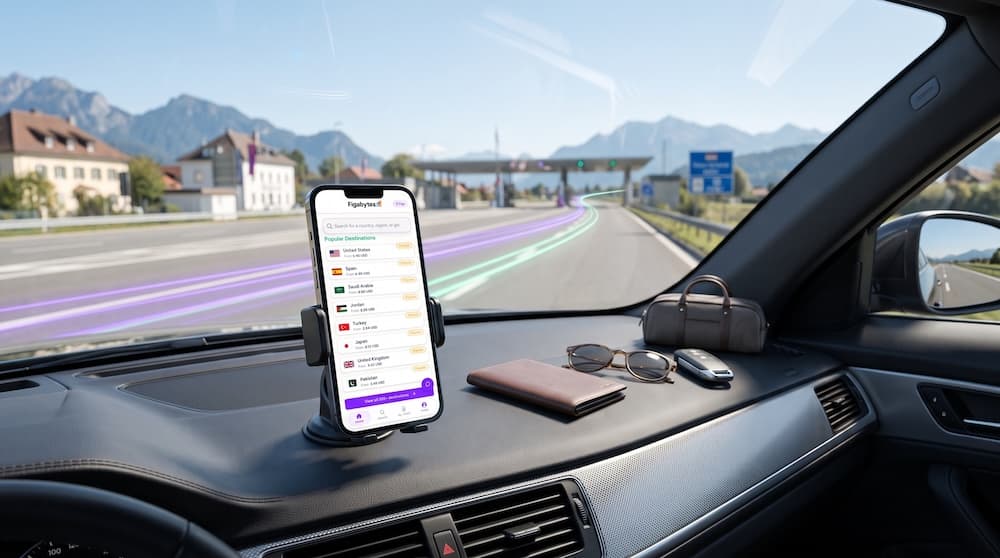
Mobile connectivity becomes especially important on a road trip.
You may depend on your phone for:
International road trips create another challenge.
The mobile network can change as soon as you cross a border.
A country-specific eSIM may stop working, while a suitable regional or global eSIM can continue connecting through supported networks in the next country.
For road trips, the best eSIM is therefore not necessarily the one with the lowest price per GB. Coverage across the entire route matters just as much.
For a road trip inside one country, a country-specific eSIM can provide a simple and potentially economical option.
For cross-border driving, a regional eSIM is often more practical because one plan can cover several countries without requiring you to purchase and configure a new eSIM at every border.
A global eSIM can make more sense for itineraries crossing multiple regions.
Figabytes offers country, regional and global prepaid eSIMs without requiring a dedicated app. Roamless offers another useful model for cross-border travel through one global eSIM and purchased FLEX credits that work across 200+ supported destinations without expiring.
The best choice depends on your exact driving route, supported countries, local networks, data requirement and whether you need backup connectivity.
| Trip type | Connectivity approach |
|---|---|
| One country | Country eSIM |
| Several European countries | Europe regional eSIM |
| GCC / Middle East road trip | Regional plan if all countries are included |
| US + Canada | North America regional eSIM |
| Several countries across regions | Global eSIM |
| Frequent unpredictable border crossings | Reusable / pay-as-you-go global eSIM |
| Remote driving | Primary + backup connectivity |
Always check the exact country list rather than relying only on the name of the region.
When traveling by plane, losing mobile data for an hour may simply mean waiting until you reach hotel Wi-Fi.
When driving, connectivity can affect the journey itself.
You may need data to:
This makes network coverage particularly important.
Yes.
An eSIM can be particularly useful for international driving because compatible phones can switch between travel connectivity without physically replacing SIM cards.
For cross-border travel, you can use:
The best structure depends on the route.
A country plan makes sense when your trip remains inside one destination.
Example:
Los Angeles → Las Vegas → Grand Canyon → San Diego
If your road trip crosses borders:
Paris → Brussels → Amsterdam → Cologne
a regional Europe eSIM may be considerably more convenient.
| Country eSIM | Regional eSIM |
|---|---|
| One destination | Several supported countries |
| Often targeted pricing | Easier border crossings |
| Simple for domestic road trips | Good for international driving |
| May stop working after border | Can continue where next country is included |
| One country's networks | Multiple countries and networks |
If the next country is included in your plan, your phone should search for a supported local network after crossing the border.
The process may not always be instantaneous.
You may briefly see:
The phone then attempts to register on a supported partner network.
If it does not reconnect, basic troubleshooting can include:
Do this only when safely parked. Never troubleshoot your phone while driving.
Not if your existing plan includes the next country.
This is one of the main advantages of regional and global eSIMs.
Instead of:
France eSIM
then
Belgium eSIM
then
Netherlands eSIM
then
Germany eSIM
you may be able to use one Europe regional plan for the entire journey.
Check every destination before departure.
Europe is one of the strongest use cases for regional eSIM connectivity.
A road trip could easily involve:
Spain → France → Switzerland → Italy → Austria → Germany.
Using one compatible regional plan can reduce repeated installation and plan management.
Figabytes Europe Extra currently covers:
37 countries
across
61 networks.
Current plans include:
| Data | Validity | Price |
|---|---|---|
| 1 GB | 7 days | $2.68 |
| 5 GB | 30 days | $9.44 |
| 10 GB | 30 days | $15.50 |
| 20 GB | 30 days | $26.78 |
Short-duration unlimited options are also currently listed.
Prices checked: August 31, 2026.
Not necessarily.
The terms:
Europe
European Union
Schengen Area
are not interchangeable.
A provider's Europe package may include some non-EU destinations and exclude others.
Pay particular attention to routes involving:
Check the actual country list before driving across the border.
A Balkan road trip may involve several countries in a relatively short distance.
For example:
Croatia → Montenegro → Albania → North Macedonia → Greece.
Regional coverage can vary significantly between eSIM providers.
Do not assume a generic Europe plan covers the entire route.
Check each country individually.
If one regional plan does not cover the whole itinerary, alternatives include:
A route from Turkey into Europe may include:
Turkey → Bulgaria → Serbia → Hungary → Austria → Germany.
This is another itinerary where the definition of Europe matters.
Before buying a regional plan, confirm Turkey and every Balkan transit country are included.
If not, combining a Turkey eSIM with a Europe regional plan may be more practical.
For a road trip entirely within the United States, a US destination eSIM can be sufficient.
Figabytes currently offers US plans including:
| Data | Validity | Price |
|---|---|---|
| 1 GB | 7 days | $3.48 |
| 5 GB | 30 days | $12.76 |
| 10 GB | 30 days | $22.26 |
| 20 GB | 30 days | $39.76 |
Short-duration unlimited options are also currently available.
The current Figabytes US destination page lists access through two networks.
Prices checked: August 31, 2026.
For road trips, network coverage along the route matters more than coverage in the arrival city alone.
If your route crosses between the United States and Canada, compare a North America regional eSIM with separate country plans.
Figabytes currently offers a North America regional product covering:
3 countries
and
7 networks.
Current fixed-data options include:
| Data | Price |
|---|---|
| 1 GB | $5.20 |
| 5 GB | $21.50 |
| 10 GB | $39.00 |
| 20 GB | $68.00 |
Short-duration unlimited options are also currently listed.
Prices checked: August 31, 2026.
A regional product can simplify routes such as:
Seattle → Vancouver
or
New York → Toronto → Montreal.
Driving across GCC countries creates another strong regional-connectivity use case.
Potential itineraries include:
UAE → Saudi Arabia
UAE → Saudi Arabia → Bahrain
Saudi Arabia → Qatar
Saudi Arabia → Kuwait
A regional Middle East plan may be useful if every country on the route is included.
Figabytes currently offers a Middle East regional product covering 10 countries.
Always check the exact route before purchasing.
A UAE to Saudi Arabia road trip can involve long driving distances.
Mobile data may be useful for:
A regional product that includes both countries can reduce the need to switch eSIMs at the border.
Alternatively, separate UAE and Saudi Arabia plans can work if the regional option does not match your data needs.
Only where a supported mobile network provides coverage.
An eSIM does not create cellular coverage.
This is important for road trips through:
A provider may advertise nationwide destination coverage while individual partner networks still have geographic dead zones.
Download essential information before driving into remote areas.
Not necessarily.
Navigation, messaging and music streaming can work well over a stable 4G connection.
5G can provide faster speeds, but for driving the priority is usually:
coverage
before
maximum speed.
A stable 4G connection across a rural highway can be more useful than extremely fast 5G available only in a city center.
Two eSIM providers selling data for the same country may use different local mobile networks.
Those networks may perform differently along your route.
This is particularly important when driving through:
If connectivity is important, check which local network or networks the plan uses where that information is available.
It can be.
Access to multiple supported networks may provide more flexibility than being limited to one partner.
However, multiple networks do not guarantee continuous coverage.
Actual connectivity still depends on:
For remote or important journeys, it can be useful.
A backup provider may connect through another local network when your main eSIM has weak coverage.
A practical setup could be:
Primary: regional or country eSIM
Backup: global or pay-as-you-go eSIM
Offline: downloaded maps
This creates three layers of navigation resilience.
Roamless can be particularly relevant as backup connectivity.
Its FLEX product uses one global eSIM across more than 200 supported destinations.
Purchased FLEX credits do not expire.
That means a traveler can keep a small balance available for:
The amount of data received from the balance depends on the destination's FLEX rate.
Figabytes can suit road travelers who want:
There is no dedicated Figabytes app.
For a planned cross-border route, a regional Figabytes product can be useful when all countries on the itinerary are included.
For routes crossing several regions, Figabytes currently offers a Global eSIM covering:
105 countries
across
199 networks.
Current fixed-data options include:
| Data | Validity | Price |
|---|---|---|
| 1 GB | 7 days | $16.12 |
| 5 GB | 30 days | $71.88 |
| 10 GB | 30 days | $131.94 |
| 20 GB | 30 days | $237.04 |
Prices checked: August 31, 2026.
Global plans can provide convenience but may not offer the lowest price per GB.
For a route concentrated in one region, compare regional options first.
Navigation itself may use less data than travelers expect.
The larger data consumers are often:
A practical starting point:
| Road trip usage | Suggested data |
|---|---|
| Maps + messaging | 1 to 3 GB |
| Maps + music + browsing | 3 to 5 GB |
| Moderate social use | 5 to 10 GB |
| Heavy social/video | 10 to 20 GB+ |
| Frequent hotspot | 20 GB+ |
Trip length also matters.
Often, yes.
Five gigabytes can be enough for:
especially if:
For many travelers, yes.
10 GB provides more room for:
Heavy video streaming or cloud backup can consume it quickly.
Not necessarily.
If your main uses are:
Maps + WhatsApp + Spotify
a fixed-data plan may be sufficient.
Unlimited becomes more relevant if:
Check the Fair Usage Policy before choosing an unlimited plan.
Yes.
Google Maps can use travel eSIM data for:
You should also download offline maps before departure.
This gives you navigation backup when mobile coverage disappears.
Yes.
Apple Maps uses the active mobile-data connection.
On compatible iPhones, your travel eSIM can provide data while your normal line remains available for calls or SMS.
Yes.
Waze uses mobile data for features including:
Its usefulness depends on having an active connection.
Download or save critical route information when traveling through areas with uncertain coverage.
Yes.
This is one of the most important road-trip precautions.
An eSIM can lose signal where the underlying network has no coverage.
Offline maps give you another navigation option.
Before leaving:
Connectivity should improve your trip, not become a single point of failure.
Yes.
Apple CarPlay uses your iPhone's connectivity.
If the travel eSIM is selected for mobile data, compatible CarPlay apps can use that connection.
This can include:
The exact apps depend on your phone and CarPlay configuration.
Yes.
Android Auto can use the phone's active mobile-data connection.
If the eSIM provides the data connection, supported navigation and communication apps can use it.
Yes.
But music streaming consumes data continuously.
For long road trips, download:
over Wi-Fi before departure.
This reduces mobile-data consumption and keeps entertainment working through coverage gaps.
Yes, where the charging service uses an internet-connected mobile app.
Mobile data can be particularly important for EV road trips because you may need to:
Download important charging apps before leaving.
Do not assume every charger can be used without mobile connectivity.
EV road trips can be more connectivity-dependent than petrol-car journeys.
Before entering remote areas:
An eSIM is useful, but it should not be the only part of the plan.
Yes, where toll or road services use internet-connected apps.
Requirements vary significantly by country.
Some countries use:
Research the road rules separately before crossing borders.
Often, yes, when the eSIM plan permits tethering.
Passengers can potentially connect:
This can be useful on family road trips.
But hotspot can increase data consumption significantly.
It can be if everyone stays together and one phone shares hotspot.
However, separate connectivity may be useful if:
One hotspot also creates a single point of failure.
Families should prioritize:
If children stream video, fixed 5 GB or 10 GB packages may disappear quickly.
Downloading entertainment before departure can dramatically reduce consumption.
Yes, on compatible Dual SIM devices.
A typical setup is:
Home SIM/eSIM: calls + SMS
Travel eSIM: mobile data
Turn off unwanted Data Roaming on the home line if you want to reduce the risk of roaming data charges.
Yes.
Your existing WhatsApp number normally remains unchanged.
The travel eSIM simply provides the internet connection.
This is useful for:
Yes.
Apps such as WhatsApp and Google Maps can use the travel eSIM's mobile-data connection for supported location-sharing features.
Remember that GPS itself does not require mobile data, but sharing and loading live online information does.
No.
GPS positioning itself does not require an eSIM.
Your phone can determine its location using satellite signals.
Mobile data is useful for:
This is why offline maps can continue providing basic navigation when cellular coverage disappears.
Your eSIM cannot connect until a supported network becomes available again.
During the outage:
Preparation matters more than trying to guarantee continuous signal.
Some travel eSIMs support manual network selection when several partner networks are available.
This can help if automatic selection connects to a weaker network.
Only change network settings when:
Never manipulate phone settings while driving.
No.
Set up:
before starting the journey.
If something needs to be changed, stop somewhere safe or have a passenger handle it.
Before departure.
Install while you have:
Then verify:
For many Figabytes plans, installation alone does not normally start validity.
Before reaching the border:
After crossing, give the phone time to register on the new network.
When safely parked:
Do not delete the eSIM as an early troubleshooting step.
Not automatically.
The profile may support:
Eligible Figabytes eSIMs showing Reinstall status can be installed again on a compatible device.
Check the status before deleting anything.
Eligible Figabytes eSIMs in Reinstall status can be installed again on another compatible device.
Only one device can use the eSIM at a time.
Reinstallation does not:
Not every Figabytes eSIM is reusable.
Choose a country eSIM.
Check regional eSIMs first.
Compare global connectivity.
Add a backup eSIM and offline maps.
Consider a reusable or pay-as-you-go global backup.
The route should determine the connectivity strategy.
Before leaving:
For one country, a country eSIM can be sufficient. For cross-border trips, regional or global eSIMs are often more convenient.
Yes, if the next country is included and a supported partner network is available.
No. A regional or global eSIM can cover multiple supported countries.
Yes, particularly when the route crosses several supported European countries.
Yes. Figabytes Europe Extra currently covers 37 countries and 61 networks.
Yes. Figabytes currently offers a North America regional product covering three countries and seven networks.
Yes. The current Figabytes Global product covers 105 countries and 199 networks.
Its FLEX product currently works across 200+ supported destinations using one global eSIM.
Purchased FLEX credits currently do not expire.
Yes. Google Maps can use the travel eSIM's mobile-data connection.
Yes. GPS positioning can work without cellular data, although live maps, traffic and online searches may require internet access.
Yes. Mobile networks can have coverage gaps, particularly in rural areas.
Yes. CarPlay can use the iPhone's active mobile-data connection.
Yes. Android Auto can use mobile data supplied through the phone's active eSIM.
Often, yes, if the eSIM plan supports tethering.
Around 3 to 5 GB may be enough for maps, messaging and moderate use. Social video, hotspot and streaming can require 10 to 20 GB or more.
Not necessarily. Fixed data can be sufficient when maps, music and entertainment are downloaded in advance.
No. Stable coverage is generally more important than maximum speed.
Yes, on compatible Dual SIM devices.
Yes. The travel eSIM can provide data without changing your WhatsApp number.
The phone will reconnect when a supported network becomes available. Offline maps and downloaded content can continue working during coverage gaps.
A backup provider can be useful for routes where connectivity is particularly important, especially if the providers use different local networks.
Road trips change what matters when choosing an eSIM.
The lowest price or largest data allowance is not enough.
You also need to think about:
route + countries + networks + rural coverage + border crossings + offline navigation + backup connectivity.
For a domestic road trip, a country-specific eSIM can be the simplest option.
For driving through several neighboring countries, a regional eSIM can reduce the need to switch plans at every border.
For complex international routes, a global eSIM can provide broader convenience.
Figabytes offers country, regional and global prepaid connectivity without requiring a dedicated app.
Roamless provides another useful model for road travelers through one global eSIM and non-expiring purchased FLEX credits.
But no eSIM can guarantee signal everywhere.
For road travel, the strongest connectivity plan combines:
travel eSIM + appropriate regional coverage + offline maps + backup connectivity where necessary.
That way, losing mobile signal does not mean losing your route.
Figabytes:
Roamless:
Apple:
Google:
Last checked: August 31, 2026.
Prices, country coverage, supported networks, regional plan definitions, road conditions and eSIM features can change. Always check the exact itinerary and current provider details before departure.

