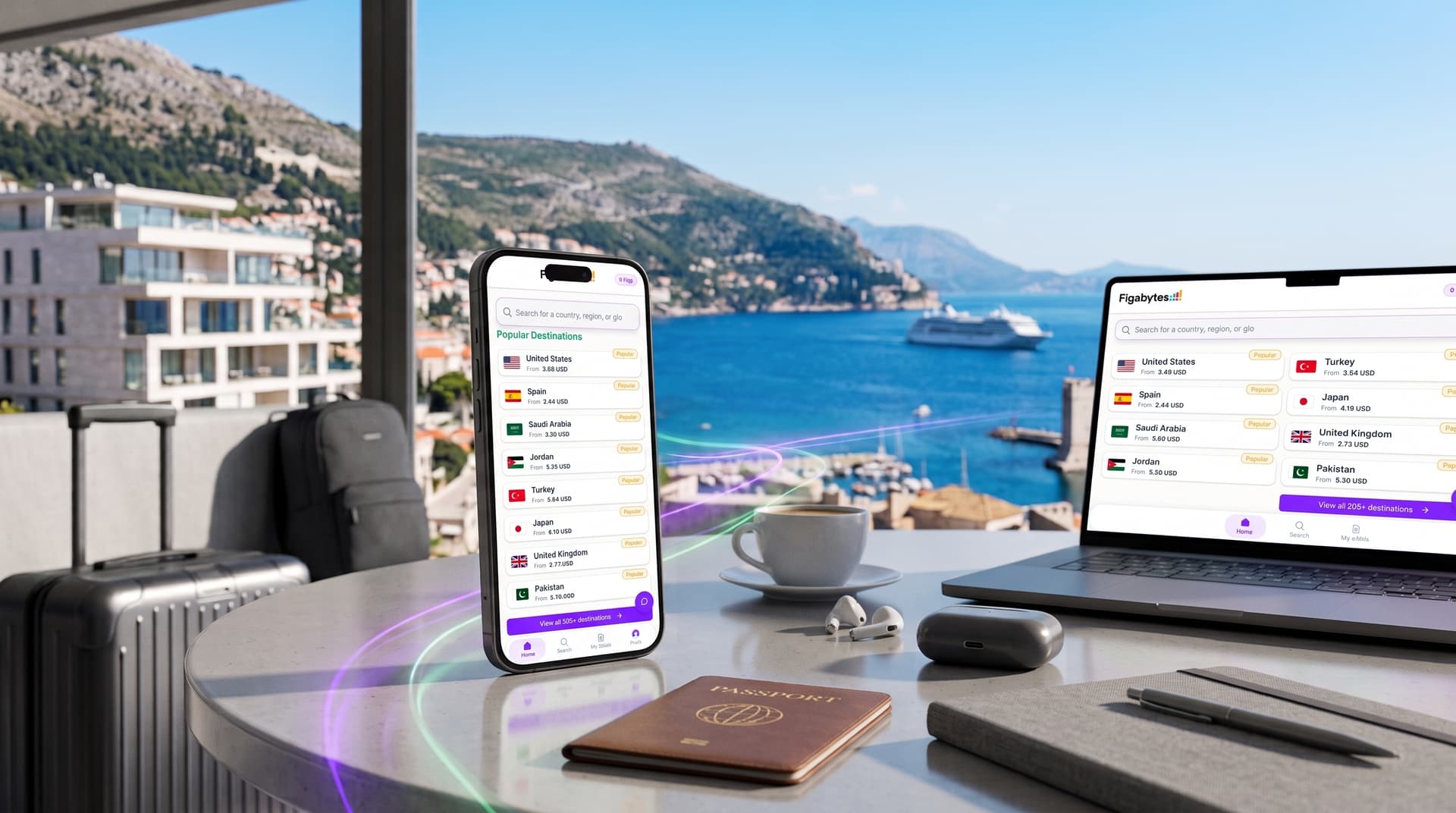
Digital nomads need more from an eSIM than occasional maps and messaging.
Remote work can involve:
That changes how you should choose a travel eSIM.
A plan that works well for a five-day holiday may not be suitable for someone working remotely for several months.
The best eSIM for digital nomads depends on where you travel, how much data you use, whether hotspot is supported and how often you cross borders.
There is no single best eSIM for every digital nomad.
Figabytes may suit remote workers who prefer country, regional or global prepaid plans managed entirely through the web without a dedicated app.
Roamless is particularly interesting for frequent border crossings because one global eSIM works across 200+ destinations and purchased FLEX credits do not expire.
Ubigi offers long-validity products, including a current 200 GB Best World plan valid for 12 months.
Nomad provides country, regional and global plans alongside unlimited products, although most of its unlimited plans currently provide 2 GB of high-speed data per day before speeds are reduced.
For remote work, prioritize reliability of your overall setup rather than choosing only by advertised price.
| Provider | Multi-country options | Long-validity option | Unlimited options | App required | Reusable model | Useful for |
|---|---|---|---|---|---|---|
| Figabytes | Regional + Global | Depends on product | Selected destinations | No | Eligible eSIMs | Website-first prepaid travel |
| Roamless | 200+ destinations via FLEX | Purchased FLEX credits do not expire | Different model | No | Yes | Frequent border crossing |
| Ubigi | Regional + worldwide | Up to 12 months on selected plans | Selected products | No | Yes | Long-term connectivity |
| Nomad | Regional + Global | Selected longer plans | Yes | No | Existing profiles/add-ons | Fixed + unlimited flexibility |
| Airalo | Regional + Global | Depends on product | Yes | No | Product dependent | Broad travel ecosystem |
| Holafly | Regional options | Trip-duration based | Strong unlimited focus | No | Product dependent | Heavy phone data |
| Saily | Regional + Global | Depends on package | Selected destinations | App-centered | Yes | App management + security features |
Last checked: August 31, 2026.
Remote workers should evaluate more than total gigabytes.
The most important factors are:
For a remote worker, losing internet access during a client call can matter more than saving a few dollars.
Yes.
eSIM can be especially useful for people who travel regularly because it allows compatible devices to add mobile plans digitally without repeatedly buying physical SIM cards.
A digital nomad can potentially keep:
stored on the same device.
That makes it easier to maintain a normal phone number while using a separate line for travel data.
It can be, but mobile data should not always be your only connection.
A strong remote-work setup may combine:
Primary: hotel, apartment or coworking Wi-Fi
Backup: travel eSIM
Secondary backup: another mobile network or provider
This gives you alternatives if:
For important work, redundancy matters.
A practical setup is:
| Connection | Purpose |
|---|---|
| Reliable Wi-Fi | Main work connection |
| Travel eSIM | Mobile data and backup |
| Home SIM/eSIM | Phone number, SMS and verification |
| Secondary eSIM where needed | Emergency network backup |
You may not need all four connections on every trip.
The principle is to avoid having a single point of failure.
A country plan can make sense when staying in one destination for several weeks.
Examples:
One month in Japan: Japan eSIM
Six weeks in Turkey: Turkey eSIM
A regional plan becomes more useful when changing countries frequently.
Examples:
Portugal → Spain → France → Italy
Thailand → Malaysia → Singapore → Indonesia
A regional plan can reduce the need to repeatedly buy and install connectivity.
Global plans provide broader geographic flexibility.
They can be useful for travelers whose itinerary includes several regions.
But they may cost more per GB than country or regional products.
For example, Figabytes currently offers a Global product covering:
Current fixed-data options include:
Short-duration unlimited products are also currently listed.
Prices checked: August 31, 2026.
A global plan can provide convenience, but remote workers who stay in one region may find regional plans more economical.
Roamless has a particularly relevant model for frequent travelers.
Its FLEX product uses one global eSIM across more than 200 destinations.
Purchased FLEX credits:
That means a remote worker can keep a balance available instead of buying a completely new product before every trip.
Roamless also offers FIX plans with a defined allowance and 30-day validity for specific destinations.
The Roamless eSIM itself can remain installed.
When you finish a trip, you can turn it off.
When you travel again, you can turn it back on.
Purchased FLEX credits remain available.
This makes it useful as a permanent backup connection even when another provider is your main eSIM.
For remote workers who move frequently, that can reduce setup between trips.
Purchased FLEX credits currently do not expire.
This is different from normal fixed packages.
Roamless FIX data plans have a 30-day validity after activation.
For digital nomads with inconsistent travel patterns, non-expiring FLEX credit can be useful because unused purchased balance remains available for a future destination.
Figabytes may suit digital nomads who prefer a more traditional prepaid model.
Travelers can choose:
Everything is managed through the Figabytes website and My eSIMs.
There is no dedicated Figabytes app.
This can appeal to travelers who prefer browser-based management.
Eligible Figabytes eSIMs can.
An eSIM showing Reinstall status can be installed again on a compatible device.
This can be useful when:
Reinstallation does not reset:
Not every Figabytes eSIM is reusable, so check the status first.
Ubigi has one of the more interesting long-validity models.
Its current Best World plan offers:
200 GB
valid for 12 months
for $290.
The plan includes a reusable Ubigi eSIM, Smartstart activation, top-ups and data sharing.
That structure can be useful for travelers who want one large allowance covering a much longer period than a normal 30-day travel plan. oai_citation:0‡Ubigi
Ubigi sells several types of connectivity:
This makes it more suitable than many short-trip-only providers for people who travel continuously.
Its reusable eSIM can also receive future plans instead of requiring a new profile for every destination.
Nomad combines:
This flexibility can be useful when moving between different types of trips.
Nomad's unlimited products deserve particular attention because the word unlimited does not mean unrestricted high-speed data.
Most current Nomad unlimited plans provide:
2 GB of high-speed data per day.
After that allowance is consumed, speeds are reduced to approximately:
1 Mbps or 2 Mbps
depending on the plan.
The high-speed allowance resets every 24 hours. oai_citation:1‡Nomad
For casual browsing, that may still be sufficient.
For remote work involving:
the daily high-speed limit matters much more.
Sometimes.
Unlimited plans can reduce the anxiety of monitoring every gigabyte.
But always read the Fair Usage Policy.
An unlimited plan may include:
For remote work, 20 GB of consistently high-speed data may sometimes be more useful than an unlimited plan that becomes heavily throttled after a small daily allowance.
| Fixed-data plan | Unlimited plan |
|---|---|
| Known high-speed allowance | Continued usage after threshold |
| Easier to calculate consumption | Less concern about total GB |
| Can run out | May throttle |
| Often good for hotspot | Hotspot rules vary |
| Predictable for large files | FUP must be checked |
The best option depends on your workload.
Remote work can consume much more data than normal tourism.
A starting estimate could be:
| Usage style | Approximate monthly starting point |
|---|---|
| Light remote work | 10 to 20 GB |
| Moderate remote work | 20 to 50 GB |
| Frequent video calls | 50 GB+ |
| Heavy hotspot / cloud work | 100 GB+ |
| Main internet connection | Large plan or carefully checked unlimited option |
Actual usage can vary dramatically.
Video meetings can consume substantial data.
The exact amount varies by:
Instead of relying on one fixed estimate, remote workers should monitor their actual usage during the first few days.
If video meetings are frequent, choose a larger plan.
It can.
Video meetings, screen sharing and file transfers can increase consumption.
Text chat alone uses relatively little data.
A remote worker who regularly joins long Teams meetings should not choose a plan based only on messaging and browsing usage.
Basic Slack messaging is relatively light compared with video streaming.
However:
can increase usage.
For most remote workers, video meetings and cloud transfers matter more than normal Slack messages.
Potentially.
Large:
can quickly consume a travel data allowance.
Turn off unnecessary automatic syncing when working from mobile data.
Often, yes, when the plan permits tethering.
A smartphone can share its travel eSIM connection through Personal Hotspot.
This can be valuable when:
Always verify that hotspot is permitted by the individual plan.
It can be.
5G or strong 4G hotspot can sometimes provide excellent performance.
But it depends on:
It should not automatically be treated as equivalent to a stable fixed broadband connection.
The laptop does not know that your connection is expensive mobile data unless configured appropriately.
It may automatically:
This can consume several gigabytes unexpectedly.
Remote workers should configure laptops to reduce background data use.
Useful steps include:
This is especially important on fixed-data plans.
It can be for light remote work.
Twenty gigabytes may be enough if your mobile connection is mainly used for:
It may not be enough if you frequently use:
For many moderate remote workers, 50 GB can provide a useful buffer.
But someone using mobile data as their primary internet connection can still consume 50 GB quickly.
Workload matters more than job title.
For many users, 100 GB is a substantial mobile allowance.
It can support considerable remote work if:
Heavy video production, large-file transfers or full-time hotspot usage can still consume it.
Roamless is particularly relevant for this scenario because FLEX works across 200+ supported destinations without expiring. oai_citation:2‡help.roamless.com
Regional plans from providers such as Figabytes, Nomad, Airalo and others can also work well when travel stays inside one region.
Ubigi's reusable profile and long-validity plans offer another approach.
There is no need for every digital nomad to use the same model.
Country-specific packages are often worth checking first.
They may provide:
compared with a global plan.
If you are spending two months in one country, compare that country's packages before buying global connectivity.
Europe is particularly suitable for regional eSIM use because travelers often cross several borders.
Figabytes Europe Extra currently covers:
A regional product can avoid changing plans when moving between participating countries.
Check that your specific itinerary includes:
because provider definitions of Europe vary.
Regional connectivity can also be useful for people moving between:
The best regional product depends on:
Do not choose based only on the name "Asia."
Japan is a strong eSIM market with several provider options.
Remote workers should compare:
Ubigi is particularly notable for Japan and offers reusable connectivity.
Figabytes, Nomad, Airalo, Saily and Holafly also offer Japan products.
Preparation is particularly important for the UAE.
Some international eSIM services can have restrictions on:
Digital nomads should purchase and install connectivity before entering the UAE where the provider recommends it.
Also consider having backup connectivity ready before arrival.
For important work, this can be sensible.
Two providers may use different local partner networks.
If one connection performs poorly, the second can provide backup.
For example:
Primary travel eSIM: large fixed plan
Secondary eSIM: small global or pay-as-you-go balance
This can be more resilient than putting all connectivity on one plan.
Yes, its current structure is particularly suited to this use.
Purchased FLEX credit does not expire and the global eSIM can remain installed for future trips. oai_citation:3‡help.roamless.com
That means a traveler can keep it available even when using another provider as the main data connection.
Many modern smartphones can store multiple eSIM profiles.
The exact number and number of simultaneously active lines depend on the device.
For example, supported recent iPhones can store multiple eSIM profiles.
This makes a primary + backup travel eSIM setup practical.
Not necessarily.
Strong 4G can be sufficient for:
5G can improve:
but local network stability matters more than the 5G icon alone.
Sometimes, but it should not always be the plan.
Travel eSIMs are excellent for:
For full working days with frequent meetings and large uploads, stable accommodation or coworking Wi-Fi may still be preferable.
Public Wi-Fi can be convenient, but it has weaknesses.
| Public Wi-Fi | Travel eSIM |
|---|---|
| Often free | Paid |
| Shared network | Cellular connection |
| Quality unpredictable | Depends on mobile network |
| Can be crowded | Independent of venue Wi-Fi |
| Available only at location | Works while moving |
| Useful for large downloads | Useful as backup and mobile work |
Many remote workers benefit from having both.
Using cellular connectivity can reduce reliance on unknown public Wi-Fi networks.
That does not eliminate all security risks.
Remote workers should still follow normal security practices such as:
No.
Figabytes is website-first.
Plans and eSIMs are managed through the website and My eSIMs.
This can be convenient for users who prefer not to install another app.
Not for every purchase or data function.
Roamless supports app, web app and website purchasing.
Its mobile app provides additional features, including in-app calling.
No.
Nomad supports both its website and mobile app.
No.
Ubigi supports QR installation and web functionality, although its app plays a significant role in top-ups and account management.
They solve different problems.
Unlimited: good when usage is consistently high.
Pay-as-you-go: good when usage is unpredictable or connectivity is mainly a backup.
Large fixed plan: good when usage can be estimated.
Some travelers may combine them.
For example:
Main destination: 20 GB fixed package
Backup: non-expiring Roamless FLEX balance
Some products can.
For example, Ubigi currently offers a Best World product with:
Prices checked: August 31, 2026. oai_citation:4‡Ubigi
This is significantly different from the normal 7-day or 30-day travel plan model.
It can be for people who travel regularly throughout the year.
Before buying, check:
A large annual package is less useful if most of the included countries do not match your itinerary.
Yes, when the tablet supports compatible eSIM service.
Some iPads and other cellular tablets support eSIM.
A separate tablet connection can reduce reliance on phone hotspot.
Check device compatibility before purchasing.
Some cellular-enabled laptops support eSIM.
Ubigi, for example, supports certain eSIM-compatible Windows devices in addition to smartphones and tablets.
For most laptops without cellular hardware, the usual method remains tethering through a phone or portable router.
A good contingency plan is:
Having enough backup data before an important meeting is much easier than purchasing connectivity after the Wi-Fi has already failed.
A small emergency allowance can be enough for:
But someone who may need several hours of hotspot should keep more.
The correct backup allowance depends on how quickly you could access another connection.
A strong strategy is often:
Local or regional fixed plan: main mobile data
plus
Global or pay-as-you-go eSIM: backup
plus
Reliable Wi-Fi: primary work environment
This provides both value and redundancy.
| Area | Figabytes | Roamless | Ubigi | Nomad |
|---|---|---|---|---|
| Country plans | Yes | FIX | Yes | Yes |
| Regional plans | Yes | Yes | Yes | Yes |
| Global model | Global plans | One global FLEX eSIM | Global plans | Global plans |
| Long validity | Depends on plan | FLEX does not expire | Up to 12 months selected | Selected products |
| Unlimited | Selected destinations | Not core FLEX model | Selected plans | Yes |
| App required | No | No | No | No |
| Website | Yes | Yes | Yes | Yes |
| Reusable | Eligible profiles | Yes | Yes | Existing/add-on model |
| Good backup model | Possible | Particularly strong | Possible | Possible |
| Long-term remote work | Destination dependent | Strong for mobility | Strong long-term plans | Strong flexible catalog |
The answer depends on travel pattern.
The best provider can also change from country to country.
There is no universal best provider. Compare Figabytes, Roamless, Ubigi, Nomad and other providers based on destination, hotspot, high-speed data, validity, regional coverage and backup needs.
Yes. eSIM can provide primary or backup mobile data for laptops, video meetings, messaging, cloud access and travel.
Yes, when the plan supports tethering. Performance depends on the mobile network and plan conditions.
Light remote workers may start around 10 to 20 GB per month, while frequent video calls, hotspot and cloud work can require 50 GB, 100 GB or more.
Not always. Check daily high-speed thresholds, throttling and hotspot rules. A large fixed-data package may sometimes provide more usable high-speed data.
Most current Nomad unlimited plans allow ongoing usage but provide approximately 2 GB of high-speed data per day before speeds are reduced to around 1 or 2 Mbps. oai_citation:5‡Nomad
Purchased Roamless FLEX credits currently do not expire. oai_citation:6‡help.roamless.com
It can be particularly useful for frequent travelers and backup connectivity because one global eSIM works across 200+ destinations and purchased FLEX credits remain available between trips.
Yes. Ubigi currently offers selected products with validity up to 12 months, including a 200 GB Best World plan. oai_citation:7‡Ubigi
Yes. Its current Global product covers 105 countries and 199 networks. oai_citation:8‡Figabytes
No. Figabytes is managed through its website and My eSIMs.
Yes, on compatible Dual SIM devices. Your home line can remain active while the travel eSIM handles data.
Yes. Your existing WhatsApp number normally remains unchanged.
It can be useful when internet access is business-critical. Two providers may provide access to different partner networks.
Sometimes, but it is often better used as a mobile connection and backup rather than assuming it will always replace reliable broadband.
It can be for light remote work but may be insufficient for frequent video calls, hotspot and cloud transfers.
For many users it is substantial, but heavy video production, streaming or full-time mobile hotspot can still consume it.
Some cellular-enabled laptops support eSIM directly. Otherwise, a phone hotspot can share the eSIM connection with a laptop.
Check your Wi-Fi, confirm your travel eSIM is working, make sure you have enough data and know how to enable hotspot before the meeting starts.
Digital nomads should choose an eSIM differently from short-term tourists.
The priority is not simply finding the lowest starting price.
Remote work depends on:
coverage + high-speed data + hotspot + validity + multi-country flexibility + backup connectivity.
Figabytes offers a straightforward prepaid country, regional and global model without requiring a dedicated app.
Roamless provides one of the more distinctive backup and multi-country approaches through a global eSIM and non-expiring purchased FLEX credits.
Ubigi offers strong long-term options, including selected 12-month plans.
Nomad combines fixed and unlimited products, but remote workers should pay close attention to its daily high-speed thresholds on unlimited plans.
For work that cannot tolerate downtime, the strongest approach is often not one eSIM.
It is:
reliable Wi-Fi + primary travel eSIM + backup connectivity.
Figabytes:
Roamless:
Nomad:
Ubigi:
Last checked: August 31, 2026.
Plan availability, network partners, hotspot permissions, high-speed allowances, Fair Usage Policies and pricing can change.

