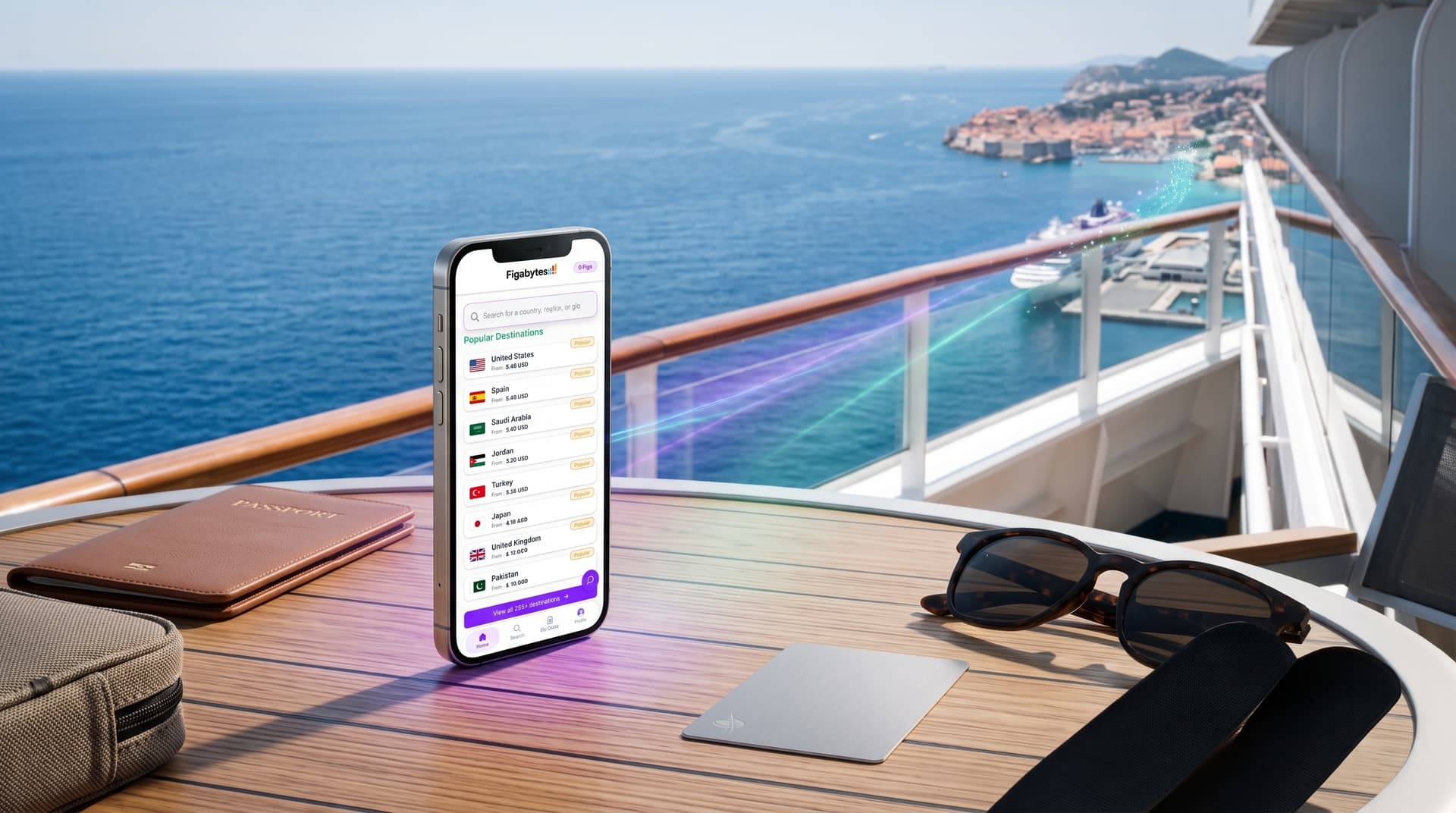
Can you use an eSIM on a cruise?
Yes, but there is an important distinction.
A normal travel eSIM can be extremely useful during cruise port stops, but you should not assume that it will provide mobile data while your ship is sailing far from land.
Traditional travel eSIMs connect through supported terrestrial mobile networks.
Once a cruise ship moves beyond normal land-based cellular coverage, connectivity usually comes from completely different systems, including:
Understanding the difference can help you stay connected while avoiding unexpected maritime roaming charges.
A standard travel eSIM generally works when your cruise ship is in a supported country and can connect to a supported land-based mobile network.
It should not automatically be expected to work while the ship is sailing in international waters.
At sea, cruise ships may provide satellite Wi-Fi or a maritime cellular network such as Cellular at Sea. These are different from the normal terrestrial networks used by most travel eSIMs.
Specialized cruise eSIM products also exist that explicitly support connectivity at sea.
For most travelers, a practical setup is:
Travel eSIM for ports
plus
Cruise Wi-Fi or a dedicated maritime connectivity product while at sea.
| Location | Normal travel eSIM | Ship Wi-Fi | Maritime cellular | Specialized cruise eSIM |
|---|---|---|---|---|
| Before departure | Yes | Usually no | No | Depends on plan |
| In port | Usually yes | May be available | Usually off | Often yes |
| Shore excursion | Yes | No | No | Depends on plan |
| Near coastline | Possible | Yes | Depends on ship | Depends on plan |
| International waters | Usually no terrestrial coverage | Yes | Often available | Yes if specifically supported |
| Requires satellite infrastructure at sea | No | Yes | Yes | Yes for maritime service |
The exact services depend on your ship, itinerary and provider.
Normal travel eSIMs connect your phone to terrestrial mobile networks.
These are the same types of cellular networks used when traveling normally through:
When a cruise ship travels far enough from land, those terrestrial signals disappear.
Your travel eSIM cannot create a connection where its supported mobile network has no coverage.
At that point, another connectivity system is required.
While the ship is close to land, your phone may still receive a normal mobile signal.
As the ship moves farther offshore, that signal eventually disappears.
Some cruise ships then activate an onboard maritime cellular network.
Your phone may display a network name such as:
This is not the same as connecting to a normal local mobile tower.
Cellular at Sea is a maritime cellular service used on many cruise ships.
When the ship reaches international waters, an onboard cellular network can provide connectivity.
Calls, messages and data are then transmitted from the ship through satellite infrastructure.
If your home carrier has a roaming agreement with the maritime network, your phone may connect automatically.
The resulting charges are normally determined by your mobile carrier.
Do not assume it is.
Cruise ship cellular roaming can have different rates from normal international roaming.
Some mobile operators sell dedicated cruise packages or day passes.
Others charge maritime roaming separately.
Check your home carrier before sailing.
It can be.
A major risk is that your phone may automatically connect to the ship's maritime network.
Background activity can potentially use data without you intentionally opening an app.
This may include:
Calls, messages and voicemail behavior can also create carrier charges depending on your mobile plan.
If you do not intend to use maritime cellular roaming, one of the safest approaches while sailing is to use Airplane Mode and then manually turn Wi-Fi back on when needed.
A common setup at sea is:
Airplane Mode: On
Wi-Fi: On
Ship Wi-Fi: Connected
Cellular: Not being used
This helps prevent the phone from automatically connecting to an expensive maritime network.
Check your cruise line and mobile carrier instructions because your setup may differ if you intentionally purchased a maritime cellular package.
It depends on what you are trying to use.
For a normal travel eSIM while visiting a supported country, Data Roaming may need to be enabled on that travel eSIM.
While sailing at sea, however, you should not simply leave every cellular line available for roaming unless you understand the maritime charges.
A safer configuration for travelers using ship Wi-Fi is often:
Cellular connection: Disabled through Airplane Mode
Wi-Fi: On
Then, when you arrive in port, you can restore cellular connectivity and use your travel eSIM.
A Figabytes country or regional travel eSIM should be treated as terrestrial mobile connectivity.
It can be useful when your cruise reaches supported destinations and the eSIM connects to one of its supported partner networks.
For example, on a Mediterranean cruise, a suitable regional plan could potentially provide mobile data during port stops across multiple supported European destinations.
You should not assume that a normal Figabytes country, regional or global plan provides maritime satellite connectivity while the ship is sailing offshore.
Always check the exact countries and networks included in your plan.
A travel eSIM can be especially useful for:
This can reduce dependence on ship Wi-Fi whenever you are ashore.
Not necessarily.
This is where regional eSIMs can become particularly useful.
Imagine a Mediterranean itinerary:
Barcelona → Marseille → Rome → Naples → Athens
Instead of purchasing five separate country plans, a Europe regional eSIM may cover the itinerary if all destinations are included.
Always verify the actual country list before purchasing.
A regional Europe eSIM can be a practical option for Mediterranean cruises visiting several countries.
Depending on the itinerary, ports might include:
Not every Europe eSIM includes exactly the same countries.
Check every stop on your itinerary.
Figabytes Europe Extra currently covers:
37 countries
across
61 networks.
Current packages include:
| Data | Validity | Price |
|---|---|---|
| 1 GB | 7 days | $2.68 |
| 5 GB | 30 days | $9.44 |
| 10 GB | 30 days | $15.50 |
| 20 GB | 30 days | $26.78 |
Short-duration unlimited options are also available.
Prices checked: August 31, 2026.
The important point is that this coverage applies through supported terrestrial networks in included destinations.
It should not be interpreted as maritime coverage between ports.
Caribbean itineraries require particularly careful coverage checking because a cruise can visit several countries and territories in one week.
Possible stops include:
Do not assume that a plan called Caribbean automatically includes every island on your itinerary.
Check each destination individually.
Alaska cruises can involve:
A US-only eSIM may not cover Canadian port stops.
A North America regional plan can be more convenient if the exact itinerary is included.
Figabytes currently offers a North America regional product covering three countries.
Again, terrestrial coverage does not mean continuous coverage while sailing offshore.
River cruises are different from ocean cruises.
Because the ship remains inland and often relatively close to terrestrial cellular infrastructure, a regional travel eSIM may remain connected much more frequently.
For example, a river cruise through:
Germany → Austria → Slovakia → Hungary
may spend much of the journey within normal mobile-network coverage.
Actual signal still depends on location and partner-network coverage.
Often, yes, when the vessel remains within coverage of a supported terrestrial mobile network.
This is fundamentally different from an ocean cruise crossing international waters.
You may still encounter:
but satellite maritime connectivity may be much less important.
Cruise ship Wi-Fi connects your device to the ship's onboard internet system.
The ship then uses satellite or other maritime infrastructure to connect to the internet.
From your phone's perspective, it works similarly to joining another Wi-Fi network.
You may need to:
Exact procedures vary by cruise line.
| Travel eSIM | Cruise Wi-Fi |
|---|---|
| Uses mobile networks | Uses ship internet system |
| Best in port | Designed to work at sea |
| Can work during shore excursions | Usually only on/near ship |
| Pricing based on eSIM plan | Pricing set by cruise line |
| Useful for maps ashore | Useful during sea days |
| Does not normally provide maritime coverage | Uses satellite connectivity at sea |
They solve different problems rather than directly replacing one another.
If you need internet during sea days, probably.
A standard destination eSIM cannot be relied on when the ship is far from land.
Cruise Wi-Fi may therefore be useful for:
The services supported depend on the Wi-Fi package purchased.
Yes, if you have an internet connection.
At sea: use ship Wi-Fi or another supported maritime internet product.
In port: use your travel eSIM.
WhatsApp can continue using your existing registered phone number.
Potentially, yes, if the ship's Wi-Fi package supports the necessary internet traffic.
In port, a travel eSIM can provide the data connection for WhatsApp calling.
Network quality and cruise Wi-Fi package restrictions may affect call quality.
Potentially.
FaceTime requires internet access.
At sea, that means your ship's Wi-Fi or another supported maritime data connection.
In port, your travel eSIM can provide mobile data.
Video calling can consume significant bandwidth.
Yes, when your iPhone has internet access.
This could come from:
Whether SMS works is a separate issue because SMS depends on cellular service rather than internet alone.
Yes, this is one of the strongest use cases.
Once you leave the ship, a travel eSIM can provide data for:
You are no longer dependent on the ship's Wi-Fi.
Generally, no.
Once you move away from the vessel, you will lose access to its Wi-Fi network.
That makes a travel eSIM particularly valuable during port days.
Yes.
A travel eSIM can provide mobile data while ashore.
It is also useful to download offline maps before the cruise as a backup.
This is especially helpful if:
Yes, where Uber or another ride-hailing service operates.
A travel eSIM can provide the mobile data needed to:
Having independent mobile data is especially useful when you have a strict boarding deadline.
Often, yes, if the specific plan allows tethering.
You could share data with:
Hotspot policies vary by plan.
It depends on how the family spends port days.
If everyone stays together, one phone with hotspot may be sufficient.
If family members separate during shore excursions, separate connectivity is safer.
For example:
Parent 1: museum
Parent 2: shopping
Teenagers: different excursion
If only one person has mobile data, the other groups may lose maps and messaging.
An unlimited terrestrial travel eSIM can still only provide connectivity where its supported mobile network is available.
Unlimited data does not create coverage in the middle of the ocean.
At sea, you still need:
depending on your preferred setup.
Yes.
Specialized maritime eSIM products now exist.
For example, Cruise+ currently provides an eSIM product designed specifically for connectivity:
The service uses maritime connectivity while the ship is in international waters.
This is fundamentally different from a normal destination travel eSIM.
Cruise+ is a specialized cruise eSIM service associated with Cellular at Sea.
It is designed to provide mobile data during the cruise, including while the vessel is at sea.
The user selects a plan based on the itinerary and installs and activates the eSIM before boarding while connected to Wi-Fi.
Once the ship reaches international waters, the maritime service becomes available.
While on land, the package can operate like a normal eSIM where supported.
Yes.
They solve different connectivity problems.
A normal Figabytes travel eSIM connects through supported terrestrial mobile networks in covered countries.
Cruise+ is specifically designed to provide connectivity through maritime infrastructure while the vessel is at sea as well as supported connectivity on land.
Travelers should not treat the two products as technically equivalent.
| Standard travel eSIM | Specialized cruise eSIM |
|---|---|
| Terrestrial mobile networks | Can include maritime network |
| Designed mainly for land travel | Designed for cruise itinerary |
| Useful in ports | Can work at sea |
| Country/regional/global coverage | Ship/itinerary support matters |
| Usually lower-complexity mobile data | Uses specialized maritime infrastructure |
Check supported ships and itineraries before purchasing a maritime product.
These are also different.
Cruise Wi-Fi: your phone connects to the ship through Wi-Fi.
Maritime eSIM: your phone connects to an onboard cellular network.
Both ultimately rely on maritime infrastructure to reach the internet while far from land.
Which is better depends on:
For many travelers, a practical setup is:
At sea: ship Wi-Fi
In port: travel eSIM
Backup: offline maps and downloaded travel information
Travelers who specifically want cellular data at sea can compare maritime roaming packages and specialized cruise eSIMs.
There is no universal cheapest method.
For a traveler who mainly needs internet during port days:
Travel eSIM + free/limited ship connectivity
may be sufficient.
For someone who wants internet every day at sea:
Cruise Wi-Fi or a dedicated maritime product may be necessary.
For families:
One cruise Wi-Fi package plus separate port eSIMs may sometimes be more economical than buying maximum connectivity for every device.
Compare the actual itinerary and usage.
A rough starting point for the entire cruise:
| Port-day usage | Suggested data |
|---|---|
| Maps + messaging | 1 to 3 GB |
| Moderate browsing/social | 3 to 5 GB |
| Frequent social media | 5 to 10 GB |
| Heavy video/uploading | 10 GB+ |
This refers to terrestrial mobile use during supported port visits.
Ship Wi-Fi usage is separate.
Probably not if the travel eSIM is mainly for shore excursions.
Maps, messaging and ride-hailing consume much less data than streaming.
A fixed 5 GB or 10 GB regional plan can potentially cover several port days.
Unlimited data becomes more relevant if you expect heavy video use while ashore.
Yes.
Install your travel eSIM while you have:
For specialized cruise eSIMs, follow the provider's activation instructions carefully.
Some specifically require installation and activation before boarding.
For a normal travel eSIM, turn it on when you are in a supported destination and ready to use the plan according to its activation conditions.
While sailing far offshore, there is usually little benefit in leaving a normal terrestrial eSIM searching for networks.
If you are using ship Wi-Fi instead, Airplane Mode with Wi-Fi manually enabled can help prevent unintended maritime cellular connections.
Not automatically.
Some eSIMs can be:
For Figabytes, eligible eSIMs showing Reinstall status can be installed again on another compatible device.
Check the provider's policy before deleting the profile.
Yes.
On compatible Dual SIM phones, your normal SIM/eSIM can remain stored while a travel eSIM handles data in port.
At sea, be particularly careful about leaving your home cellular line active because it may connect to a maritime roaming network.
Check your carrier's cruise roaming policy.
If you do not want maritime cellular connectivity, a simple approach is:
This prevents many accidental maritime roaming scenarios.
When you arrive at a supported destination:
You can then use normal mobile data during the port visit.
If you are not using maritime cellular:
This simple routine can be repeated throughout the cruise.
Imagine a seven-night Mediterranean cruise:
Barcelona → Marseille → Genoa → Rome → Naples → sea day → Barcelona.
A practical setup could be:
Barcelona: regional Europe eSIM
Marseille: regional Europe eSIM
Genoa: regional Europe eSIM
Rome: regional Europe eSIM
Naples: regional Europe eSIM
Sea day: ship Wi-Fi
This is where a regional eSIM becomes particularly useful.
One compatible plan can potentially cover several port stops without pretending to provide coverage in the Mediterranean Sea itself.
Before departure:
Standard travel eSIMs can work while the ship is within supported terrestrial mobile coverage, especially in ports. They should not be assumed to work in international waters.
Figabytes can provide data through supported terrestrial networks at covered destinations. A normal Figabytes plan should not be treated as maritime satellite connectivity while sailing offshore.
Yes. This is one of the strongest reasons to use a travel eSIM on a cruise.
A normal terrestrial travel eSIM generally cannot connect when no supported land-based mobile network is available. Specialized maritime eSIM services exist for this purpose.
Yes. Specialized products such as Cruise+ are specifically designed to provide eSIM connectivity through maritime networks while at sea.
Cellular at Sea is an onboard maritime cellular network used by many cruise ships. It transmits cellular traffic from the ship through satellite infrastructure.
Charges depend on your home carrier and cruise roaming package. Do not assume your normal roaming allowance includes maritime cellular service.
Yes. Compatible phones may automatically connect to an onboard maritime network when it becomes available.
If you do not intend to use maritime cellular, turn on Airplane Mode while sailing and manually enable Wi-Fi for the ship's internet service.
Yes. On modern smartphones you can turn on Airplane Mode and then manually re-enable Wi-Fi.
Enable it on your travel eSIM when required in a supported port. Do not leave cellular roaming enabled at sea without understanding your maritime plan and charges.
At sea, cruise Wi-Fi can provide internet where a normal travel eSIM cannot. In port, an eSIM can provide independent connectivity away from the ship. They complement each other.
Yes, through ship Wi-Fi, supported maritime data or your travel eSIM while in port.
Yes. A travel eSIM can provide the required mobile data. Download offline maps as a backup.
It can be when the itinerary visits several countries in the same region. Check that every port is included.
It can be useful for heavy data use in port, but unlimited terrestrial data does not provide coverage in the middle of the ocean.
Usually, if the specific travel eSIM plan permits tethering.
Yes. Installing before departure gives you reliable Wi-Fi and time to troubleshoot.
Not automatically. Check whether it can be reused, topped up or reinstalled.
A cruise creates two completely different mobile environments.
In port, you are essentially an international traveler using normal terrestrial cellular networks.
At sea, you are outside the normal mobile environment and may need satellite-backed ship Wi-Fi, maritime cellular roaming or a specialized cruise connectivity product.
That means a standard travel eSIM and cruise Wi-Fi should not necessarily be compared as alternatives.
They can work together.
For many travelers, the most practical setup is:
travel eSIM in port
ship Wi-Fi at sea.
A regional eSIM can be particularly useful for itineraries with several countries because one compatible plan may cover multiple shore excursions.
Figabytes country and regional plans can provide terrestrial connectivity at supported destinations, but they should not be represented as providing maritime coverage unless a specific product explicitly says so.
Travelers who need cellular connectivity while sailing should instead investigate their carrier's cruise roaming options or a specialized maritime eSIM.
Understanding that distinction before boarding can help you stay connected without unexpected roaming charges.
Figabytes:
Cruise connectivity:
Last checked: August 31, 2026.
Cruise connectivity varies by ship, itinerary, cruise line, maritime network, mobile carrier and eSIM provider. Check your specific sailing and mobile plan before departure.

