Business travelers often need mobile connectivity before they even leave the airport.
A delayed connection can mean missing:
That makes choosing an eSIM for business travel different from choosing one for a normal holiday.
The best business travel eSIM should provide the right combination of:
It should also allow you to keep your primary work number active where needed.
The best eSIM for business travel depends on your itinerary and how critical mobile connectivity is to your work.
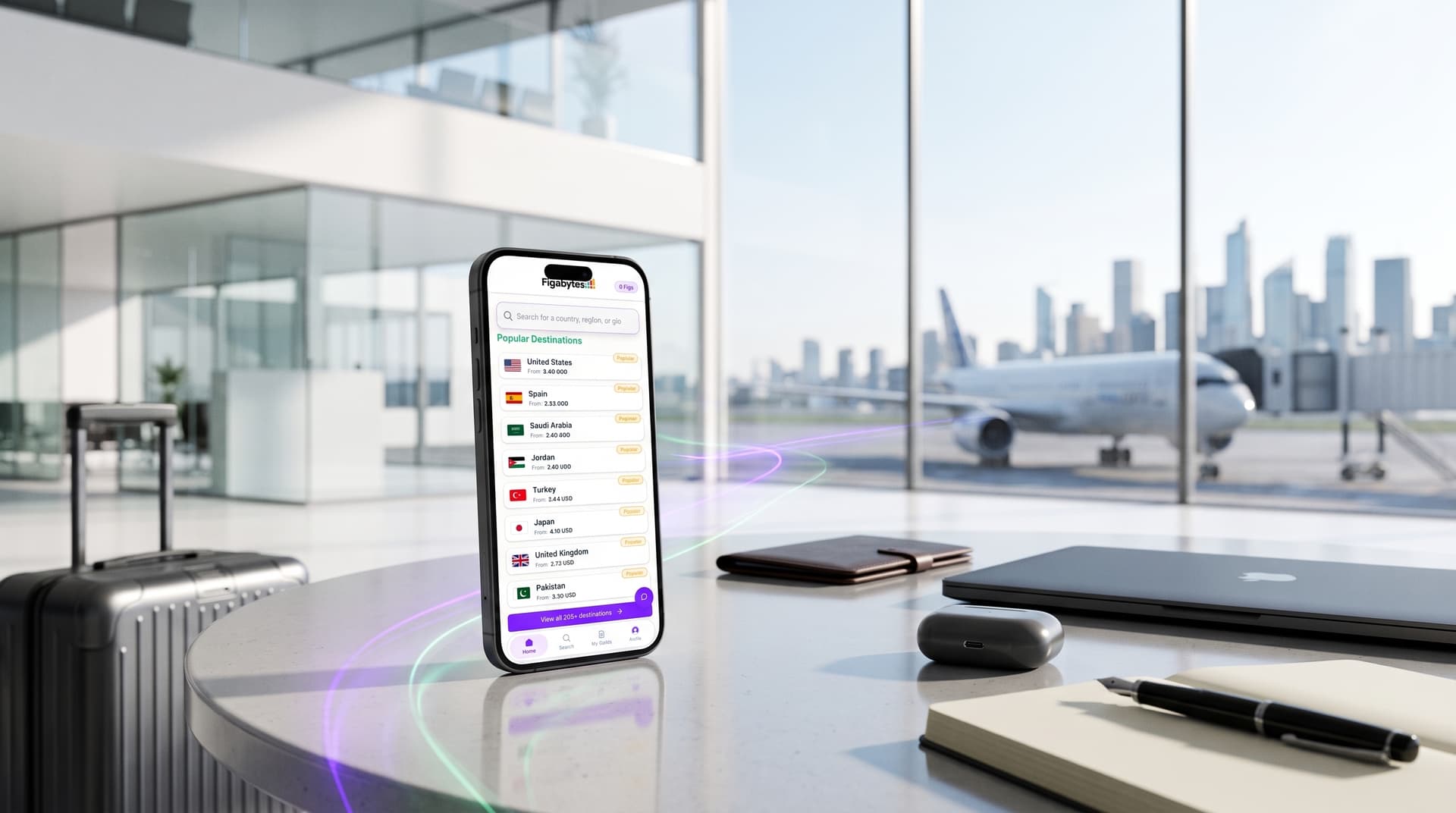
Figabytes may suit business travelers who want country, regional and global plans managed through a website without requiring a dedicated app.
Roamless can be useful as a persistent backup connection because its FLEX balance works across 200+ destinations and purchased credits do not expire.
Nomad offers fixed, regional, global and unlimited products through both app and web management.
Ubigi can suit frequent business travelers looking for reusable eSIMs and longer-validity connectivity.
For important trips, the strongest setup is often a primary business eSIM plus a backup connectivity option rather than relying on one connection.
| Provider | Country plans | Regional / Global | App required | Long-term option | Useful business feature |
|---|---|---|---|---|---|
| Figabytes | Yes | Yes | No | Depends on plan | Website-first management |
| Airalo | Yes | Yes | No | Depends on plan | Broad app + web ecosystem |
| Saily | Yes | Yes | App-centered | Depends on plan | Security-focused app features |
| Nomad | Yes | Yes | No | Selected products | App + web + add-ons |
| Roamless | FIX | Global FLEX | No | FLEX credits do not expire | Persistent backup connectivity |
| Ubigi | Yes | Yes | No | Monthly / annual selected plans | Reusable eSIM |
| Holafly | Yes | Regional | No | Trip-duration based | Unlimited-focused products |
Last checked: August 31, 2026.
A tourist may tolerate being offline for an hour.
A business traveler may not.
Mobile connectivity can be required for:
That makes reliability and backup planning particularly important.
Yes.
eSIM can be useful for business travelers because it allows compatible phones to add a travel data plan digitally without removing the primary SIM or eSIM.
A common setup is:
Work SIM: phone number, calls and SMS
Travel eSIM: mobile data
This allows the traveler to retain access to the work number while using a separate data connection abroad.
Yes, on compatible Dual SIM devices.
Your primary work line can remain active while the travel eSIM is selected for mobile data.
A typical configuration is:
| Function | Line |
|---|---|
| Mobile data | Travel eSIM |
| Work number | Primary SIM/eSIM |
| SMS / OTP | Primary line |
| Existing registered number | |
| Hotspot | Travel eSIM |
| Data roaming on work SIM | Usually off |
Your home carrier may still charge for calls, SMS or other roaming activity on the work line.
Potentially, yes.
If your primary SIM or eSIM remains enabled, you may still receive SMS verification codes while the travel eSIM provides mobile data.
This can be important for:
Whether SMS reception is free or chargeable depends on your home carrier.
Check your corporate mobile plan before departure.
Yes.
Teams uses an internet connection.
A travel eSIM can provide the mobile data required for:
Data consumption is much higher for video meetings than for text chat.
Business travelers who regularly join meetings over mobile data should choose a larger allowance.
Yes.
Zoom works over mobile data where network quality is sufficient.
Performance depends on:
For critical meetings, test the connection before the call starts.
Yes.
Slack messaging usually consumes relatively little data.
Higher consumption comes from:
A small eSIM can therefore be sufficient for messaging-heavy business trips if reliable Wi-Fi is also available.
Often, yes.
A compatible smartphone can share travel eSIM data with a laptop using Personal Hotspot or tethering if the plan allows it.
This can be particularly useful:
Always check hotspot restrictions before buying.
A practical setup could be:
Primary work line: calls, SMS and authentication
Travel eSIM: mobile data
Hotel or office Wi-Fi: main high-volume work connection
Backup eSIM: emergency mobile connectivity
This setup reduces dependency on a single network.
For important trips, it can be worthwhile.
A backup can help when:
Ideally, the backup provider should not rely on exactly the same local network as your primary plan.
Roamless FLEX currently works across more than 200 destinations.
Purchased credits do not expire and are consumed according to usage.
This allows a traveler to keep a balance available between trips instead of repeatedly buying a backup plan.
Roamless FLEX can also be used for in-app calls.
That can make it useful as secondary connectivity for frequent international business travelers.
Figabytes can suit travelers who prefer a conventional prepaid model.
It offers:
Management is handled through the Figabytes website and My eSIMs.
A dedicated app is not required.
For travelers moving across several countries, regional or global plans may reduce the need to install multiple destination products.
Figabytes currently lists its Global product as covering:
Current fixed-data plans include:
| Data | Validity | Current price |
|---|---|---|
| 1 GB | 7 days | $16.12 |
| 5 GB | 30 days | $71.88 |
| 10 GB | 30 days | $131.94 |
| 20 GB | 30 days | $237.04 |
Short-duration unlimited options are also currently listed.
Prices checked: August 31, 2026.
A global plan can be useful for complex international itineraries, although a regional or destination-specific plan may provide better value when travel is concentrated in one area.
A regional eSIM can make sense for trips such as:
London → Paris → Frankfurt
or
Dubai → Riyadh → Doha.
A global eSIM becomes more useful when the itinerary crosses multiple regions.
For example:
Dubai → London → New York → Singapore.
The tradeoff is often:
regional plan: more targeted coverage
global plan: greater convenience
Always compare price and included countries.
Europe is particularly suitable for regional eSIMs because business travelers can cross several borders within one trip.
Figabytes Europe Extra currently covers:
A single supported regional plan can be easier than buying individual country plans for several meetings across Europe.
Check your exact itinerary, especially if it includes countries whose inclusion varies between providers.
Middle East business itineraries often include combinations such as:
A regional Middle East eSIM can simplify connectivity across several of these destinations where supported.
Figabytes currently offers a Middle East product covering 10 countries.
Business travelers should also check provider-specific restrictions before entering the region because some international eSIM services can have limitations affecting purchase or access inside certain countries.
Buying and installing before arrival is a sensible strategy for the UAE.
Some international eSIM providers currently have restrictions affecting website or app access from within the country.
Completing the setup before departure reduces the risk of arriving without usable connectivity.
Figabytes currently lists UAE plans including:
| Data | Validity | Price |
|---|---|---|
| 1 GB | 7 days | $4.52 |
| 5 GB | 30 days | $16.78 |
| 10 GB | 30 days | $29.98 |
| 20 GB | 30 days | $53.10 |
Unlimited short-duration plans are also currently available.
Prices checked: August 31, 2026.
Business travelers visiting Saudi Arabia should compare:
Figabytes currently lists Saudi Arabia plans starting at $3.98.
Its current options include fixed-data and short-duration unlimited packages.
Prices checked: August 31, 2026.
For US business trips, consider whether you need:
Figabytes currently offers US plans including:
Its current destination page lists access across two networks.
For work-critical travel, compare network partners with your exact destination cities.
Use a country plan when:
Use a regional plan when:
Business schedules frequently change, so broader coverage can sometimes be worth paying more for.
A short business trip may require less data than expected if hotel and office Wi-Fi are reliable.
A reasonable starting point:
| Business usage | Suggested starting point |
|---|---|
| Email + messaging | 1 to 3 GB |
| Maps + messaging + light calls | 3 to 5 GB |
| Moderate remote work | 5 to 10 GB |
| Frequent video calls | 10 to 20 GB+ |
| Laptop hotspot | 20 GB+ |
| Mobile connection as main internet | Large plan / carefully checked unlimited |
Always account for unexpected hotspot use.
It can be for a short trip if usage is mainly:
It becomes less suitable if you regularly use mobile data for:
For many one-week business trips, 10 GB can provide a useful balance.
It can support:
Heavy video conferencing can still consume the allowance quickly.
Unlimited data can be convenient, but the Fair Usage Policy matters.
Some unlimited eSIMs allow ongoing data while reducing speed after a daily high-speed allowance.
That can be problematic during:
A large fixed-data plan with predictable high-speed capacity can sometimes be a better business option.
Most current Nomad unlimited products provide approximately:
2 GB of high-speed data per day.
After the high-speed allowance is consumed, speeds are reduced to around:
1 Mbps or 2 Mbps
depending on the plan.
The high-speed allowance resets every 24 hours.
This may be adequate for general communication but can affect demanding remote work later in the day.
Before purchasing, check:
Do not rely on the word unlimited alone.
Frequent business travelers may benefit from products designed for reuse.
Options include:
Roamless: persistent global eSIM with non-expiring purchased FLEX credits.
Ubigi: reusable eSIM with selected monthly and annual products.
Figabytes: eligible eSIMs can support reinstallation.
Nomad: eligible plans support add-ons through an existing eSIM profile.
The right model depends on whether you prefer a permanent connection or a fresh destination-specific package for each trip.
Ubigi offers one-off, monthly and annual products on a reusable eSIM.
Selected long-term plans can therefore suit travelers who repeatedly visit the same destinations or travel throughout the year.
Its current catalog also includes global long-validity products.
This can reduce repeated installation.
Usually, yes.
In fact, installing before departure is often preferable.
You have:
Check when validity begins before activating the plan.
Not always.
With Figabytes, most plans begin when the eSIM first connects to a supported local network or according to the specific activation rules.
Installation alone usually does not start validity.
Provider rules vary, so check before buying far in advance.
Once you arrive:
Do this before leaving the airport if connectivity is important to your schedule.
Many travel eSIMs require Data Roaming because they connect through partner networks.
You can have:
Travel eSIM: Data Roaming On
Corporate SIM: Data Roaming Off
This lets the travel plan access partner networks while helping reduce accidental roaming data charges on the corporate line.
Yes.
WhatsApp Business normally remains associated with its existing registered number.
Using a travel eSIM for data does not automatically replace that number.
The app can use the travel eSIM's internet connection.
Yes.
Authenticator applications do not normally depend on your travel eSIM's phone number for their standard generated codes.
Some authentication workflows may still send SMS or require internet connectivity.
Make sure your authentication setup works before traveling.
Usually, yes.
A travel eSIM provides an internet connection similar to other mobile data.
Your employer's VPN should generally work over it unless:
Test required corporate systems before an important meeting.
It can reduce reliance on unknown public Wi-Fi.
Using cellular data for sensitive work may be preferable to connecting automatically to every café or airport hotspot.
However, eSIM itself does not replace:
Treat it as a connectivity tool, not a complete security solution.
| Public Wi-Fi | Travel eSIM |
|---|---|
| Often free | Paid |
| Venue dependent | Works while mobile |
| Can be congested | Uses cellular network |
| Shared infrastructure | More independent |
| Useful for large downloads | Useful for backup |
| Requires available Wi-Fi | Can work immediately after landing |
A business traveler can use both strategically.
Sometimes.
A strong 4G or 5G connection may support normal work.
But using mobile data as the only internet connection can be risky for:
It is better to treat travel eSIM as mobile connectivity and a backup unless you have specifically purchased enough data for full-time remote work.
For a short trip:
A 3 to 5 GB plan may be sufficient for light business use.
For a week:
For an itinerary such as:
Dubai → Riyadh → Doha
or
London → Paris → Berlin
consider a regional plan first.
For itineraries spanning different continents, compare:
Convenience may matter more than the absolute lowest cost when schedules change quickly.
This is where broader coverage can become valuable.
A destination-only plan may not work if a last-minute meeting sends you to another country.
Regional or global plans can provide more flexibility.
A persistent backup such as Roamless FLEX can also help cover unexpected travel where supported.
Many providers support top-ups or add-ons on eligible products.
With Figabytes, top-up availability depends on the specific plan.
A top-up can add more data but does not necessarily extend the original validity.
Do not wait until a critical meeting to discover whether your plan supports additional data.
For small teams, a practical process can include:
Larger organizations may prefer enterprise travel-connectivity arrangements rather than employees purchasing individual consumer plans.
That depends on provider rules.
With Figabytes, eligible eSIMs showing Reinstall status can be installed on another compatible device while remaining associated with the original account.
This can provide flexibility for colleagues or travel companions, although the same eSIM cannot be installed on multiple devices simultaneously.
Not as independent mobile connections.
One phone may be able to share connectivity through hotspot if the plan permits it.
But employees who separate during the trip need their own connectivity.
For business travel, depending on one person's hotspot creates a single point of failure.
A simple approach is:
| Traveler | Connection |
|---|---|
| Team lead | Main eSIM + backup |
| Employee 2 | Separate eSIM |
| Employee 3 | Separate eSIM |
| Laptop/tablet | Hotspot when required |
Everyone who may travel separately should ideally have independent data.
It can be, but not always.
Some corporate plans include negotiated international roaming packages.
Before replacing them, compare:
If corporate roaming is inexpensive and includes business voice services, it may remain the simpler option.
| Travel eSIM | Corporate roaming |
|---|---|
| Separate data plan | Existing corporate line |
| Can offer destination pricing | Negotiated carrier pricing |
| Requires setup | Usually automatic |
| Good for data-heavy travel | Keeps all services on one line |
| Helps separate roaming data | Easier for IT/accounting in some companies |
| Coverage varies by provider | Carrier roaming footprint |
The right choice depends on the company's mobile contract.
Yes.
A hybrid strategy can be very effective.
For example:
Corporate line: calls + SMS
Travel eSIM: data
This retains the familiar business number while moving most international data usage to the travel eSIM.
Figabytes is one option for travelers who prefer a website-first experience.
The service is managed through:
There is no dedicated Figabytes app.
Nomad, Airalo, Roamless and Ubigi also provide various web-based purchase or management options despite having apps.
Travelers who prefer mobile app management can consider providers such as:
Apps can make it easier to:
App preference is ultimately a workflow decision rather than an indicator of network quality.
Before flying:
The best option depends on destination, trip length, data use, hotspot requirements and whether you need regional or global connectivity. Figabytes, Nomad, Roamless, Ubigi and other providers use different models suited to different business itineraries.
Yes. It allows travelers to add international data while keeping their normal business line on compatible Dual SIM devices.
Yes. Your work SIM or eSIM can remain active while the travel eSIM is selected for mobile data.
Yes, potentially, if your original line remains active and your home carrier permits SMS reception abroad.
Yes. Teams works over mobile data, although video meetings can consume significant data.
Yes, provided the connection is fast and stable enough.
Yes, either directly on supported cellular laptops or through phone hotspot when the eSIM plan permits tethering.
Light business usage may need around 3 to 5 GB, while frequent video meetings and laptop hotspot can require 10 to 20 GB or more.
For many travelers, yes, especially with hotel and office Wi-Fi. Heavy video conferencing may require more.
Only after checking the Fair Usage Policy, high-speed allowance and hotspot limits.
It can be useful for trips where losing connectivity could disrupt meetings, transport or work.
No. Figabytes is managed through the website and My eSIMs.
Yes. Its current Global plan covers 105 countries and 199 networks.
Purchased Roamless FLEX credits currently do not expire.
It can be particularly useful as persistent backup connectivity for frequent travelers because FLEX works across 200+ destinations.
Yes. WhatsApp Business can continue using the existing registered number while the travel eSIM provides mobile data.
Usually, yes, subject to the local network, country restrictions and your corporate VPN configuration.
Usually, yes. This gives you reliable Wi-Fi and time to troubleshoot.
Usually not. Most Figabytes plans start when the eSIM connects to a supported network or according to the specific plan's activation rules.
It can be, but compare the cost with your employer's existing corporate roaming agreement before deciding.
The best eSIM for business travel should reduce the risk of being disconnected when connectivity actually matters.
For short trips, a country plan with enough data for messaging, navigation and emergency hotspot may be sufficient.
For several meetings across one region, a regional eSIM can simplify border crossings.
For complex international itineraries, a global plan or persistent backup can provide additional flexibility.
Figabytes offers a website-first model with country, regional and global plans and no dedicated app requirement.
Roamless is particularly interesting as a reusable backup because purchased FLEX credits do not expire.
Nomad combines app and web management with fixed and unlimited plans.
Ubigi offers reusable connectivity and selected longer-term options for frequent travelers.
For high-stakes business travel, the most resilient strategy is often:
primary work number + travel eSIM for data + reliable Wi-Fi + backup connectivity.
Figabytes:
Roamless:
Nomad:
Additional provider characteristics should be checked against current official product pages before purchase.
Last checked: August 31, 2026.
Prices, network partners, plan validity, hotspot policies, roaming conditions and provider restrictions can change.

